Is this police force professional and capable of handling violen...
/ 2026-10-16 18:54:07Focus


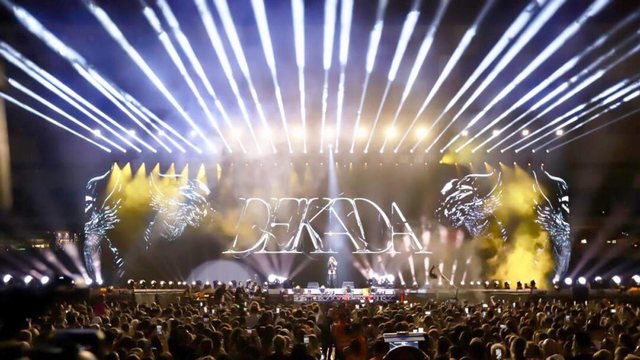
Even concerts are "immigrating". Albanian singers are following the logic of the market. The audience has moved abroad, the money is abroad and the demand is greater abroad. So the music is also following them...
In the new map of Albanian cultural circulation, singers' concerts are following the same path as people. They are moving to where the diaspora is. Around 2.25 million Albanians live abroad today, almost half of the total Albanian population.
Italy, Germany, Switzerland, Austria and the United Kingdom form the core of this community. It is where incomes are highest, economic stability is greatest and a willingness to spend on identity-related experiences is strongest.
This explains why more and more Albanian artists are building their calendars starting from the diaspora and not from Tirana. A concert abroad not only offers a larger audience, but also more predictable income. Ticket prices are higher, the halls are larger and the financial risk is lower.
A performance by a well-known Albanian artist abroad is usually paid several thousand euros for an evening, often more than in the domestic market, where events are seasonal and often depend on sponsors or public holidays.
The symbolic peak of this reality was seen when Elvana Gjata filled the “Lanxess Arena” in Cologne with around 20 thousand spectators. A figure that is difficult to imagine within Albania, but which in the diaspora proved not only achievable, but also sustainable as a model. This was not only seen as an artistic success related to a particular artist, but a demonstration of a real market that exists and functions.
This is where the key players, namely the tourist agencies, come in. They have realized that the concert has become a reason to travel as strong as the beach or shopping. Packages that include a concert ticket, transportation and hotel are being sold more and more often, especially for large events organized in cities where the diaspora is concentrated. The concert is becoming a tourist product, while the music is serving as a magnet that moves people, money and services.
In a conversation with "Eventur Travel", which has been operating for several years in the field of organizing travel for concert reasons, the demand for this type of product has increased significantly in recent years, moving from a limited and sporadic market to an increasingly structured segment. According to them, customers no longer travel only for the destination, but for the full experience that the event offers, where the concert is the focal point that justifies the entire trip.
In many cases, bookings are made as soon as the concert date is announced, which indicates a more planned consumer behavior and willingness to spend more on experiences related to identity and entertainment. The offers published by them show packages for music events in places like Milan, Vienna or cities in Germany, where prices usually range from around 150 to 300 euros per person, depending on the artist and destination.
These packages include transportation, accommodation and in many cases even the concert ticket, making the event the center of the entire experience. What is striking is that the promotion starts as soon as a major concert in Europe is announced, directly targeting the Albanian public who are willing to travel for their favorite artists.
In this way, the concert is no longer an activity that happens where you are, but a reason to move, creating an organized flow of travel that follows the event calendar and not the traditional tourist season.
From an economic point of view, this is an interesting circulation. Income no longer flows only in the form of remittances to Albania, but also in the opposite direction. Culture is produced in Albania, but consumed abroad. Albanian music is functioning as an export commodity with added value. The beneficiaries are not only the singers, but also the managers, technicians, organizers, transport companies and hospitality businesses in the host countries.
However, according to the agency, Albanians do not only travel for Albanian singers, but also for foreign artists. Names like Bad Bunny, Imagine Dragons, ColdPlay, etc., have attracted their travels in recent years.
Socially, a concert in the diaspora is much more than entertainment. It serves as a community meeting point. A space where Albanians of different generations feel part of the same story. This increases the willingness to spend.
An immigrant family in Germany or Switzerland is more likely to buy tickets, travel a few hours, and stay a night in a hotel, because the experience is not measured only by music, but by belonging.
Even for the youngest artists, the diaspora is becoming a springboard. A small tour in a few European cities brings not only income, but also professionalization of the industry. Clearer contracts, medium-term planning, digital communication with the public and higher technical standards. In the absence of a large domestic market, the diaspora is playing the role that national festivals once had.
Why do concerts "migrate"?
Although there has been an interesting movement in the last two years with international-scale events, featuring well-known artists, Albania remains a small and seasonal market, mainly focused on summer and tourist areas. Abroad, activities are year-round and in many cities simultaneously.
This gives artists more opportunities to maintain a stable concert calendar.
Alban Skënderaj will hold his “Motiv” concert at the “Porsche Arena” in Stuttgart, Germany, on May 16 and 17, 2026. The concert has seen record interest, with 50% of the second night tickets sold within two hours, continuing his success after concerts in Milan and Pristina. Standard tickets start from 40-80 euros and reach over 150 euros for the most elite areas of the stadium.
Their capacity is reported to be 12-15 thousand spectators. Tickets for the first night of the concert were sold out in January, while Albanian travel agencies that work with concert travel packages report that there is still interest in the second night, not only from Albanians within Albania but also from those living in nearby cities. According to the German platform “Eventim.de”, the second night of Alban Skënderaj’s concert still has some tickets available, which start at 60.15 euros and go up to 115.15 euros.
Along the same lines as this model, other Albanian artists are attempting to replicate the concert format in large European arenas, targeting the same consolidated diaspora audience.
Elvana Gjata is expected to hold a concert at the “Unipol Forum” in Milan on May 10, 2026, the same arena where Alban Skënderaj performed. The capacity of this hall reaches up to about 12-15 thousand spectators in concert configuration. The announcement of the concert has generated immediate interest on social networks and ticket sales platforms, while their prices vary in ranges similar to events of this level, starting from about 40-50 euros and reaching over 120 euros for areas closer to the stage.
This is one of the clearest cases that Albanian artists are aiming to fill large arenas abroad, moving from concerts in clubs or seasonal events towards a more structured format with more concentrated income on a single night.
At the same time, artists like Dafina Zeqiri and Luiz Ejlli are not yet targeting single arenas of this size, but are operating with a distributed strategy in several European cities. They develop concert tours in Italy, Germany, Switzerland and the Nordic countries, with events that often fill large clubs or halls with several thousand people. Although the capacity per event is lower compared to an arena, in total these tours generate a high volume of income and keep the artists active throughout the year.
Another trend that is being noticed is the involvement of Albanian artists in international festivals or joint events in the diaspora, where names like Era Istrefi participate. These formats are not always measurable with the capacities of a single artist, but often gather thousands of participants and create a wider audience, beyond the traditional Albanian public.
Unlike "arena"-type concerts, which require months of preparation and rely on massive ticket sales, the international presence of Albanian artists in 2026 remains mainly linked to a network of diaspora events, announced on social networks and organized in a fragmented manner, usually in clubs or smaller spaces.
This model is also clearly seen in concrete cases, such as the announced concert of Kida and 2TON in Italy on April 10, 2026, promoted online by event organizers, where tickets range from 25 to 30 euros and with a focus on table reservations, as well as in Kida's performances at "Albania by Night" format events in various European cities, where artists take the stage for the diaspora audience in an atmosphere that resembles nightlife more than a proper tour concert.
Essentially, this is a model that functions more like a distributed event economy than a structured international music touring industry.
Experts suggest that, outside of Tirana, specifically in the diaspora, the gig economy functions more simply, is safer, and more profitable.
First is the real size of the audience. In Tirana, the market is small and quickly saturated. Even the most famous artists have difficulty filling large halls with paid tickets several times in a row. In the diaspora, hundreds of thousands of Albanians live in Italy and Germany alone. This means a sufficient audience for a large concert regardless of the season, weather or tourist weekend.
Second is purchasing power. A 40 or 60 euro ticket in Tirana is still expensive for a large part of the public. In Germany or Switzerland, the same amount is affordable and seen as a normal expense for entertainment. This allows organizers to set higher prices and artists to be paid better, without scaring off the public.
A very practical element is financial risk. In Tirana, concerts often depend on sponsors, the municipality, the weather, or last-minute sales. In the diaspora, tickets are sold online months in advance. The organizer knows in advance how many people will come and how much money will be circulating. This significantly reduces uncertainty and makes the business more predictable.
Then there is the infrastructure. European cities have standardized halls, with tested acoustics, security and logistics. In Tirana, capacities are limited and often large concerts are held in improvised spaces, which increases costs and organizational problems. A hall in Cologne or Milan is ready for such performances every weekend, Tirana not always.
There is also a social factor. For the diaspora, the Albanian concert is a community event. People travel from other cities, meet friends, plan the weekend around the event. In Tirana, the audience is more dispersed and the competition with everyday life is stronger. The concert has to compete with coffee, a spontaneous outing, a wedding, or just plain tiredness.
Another reason is the artists' strategy. Concerts abroad enhance their professional image. A packed hall in Germany or Switzerland has more symbolic weight than a single concert in Tirana. It is more easily sold as a success, as a tour, as a story of artistic growth. / Taken with abbreviations from Monitor