Is this police force professional and capable of handling violen...
/ 2026-10-16 18:54:07Focus


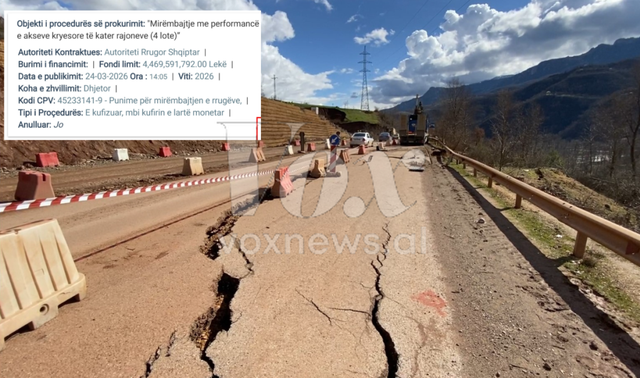
A hefty bill of 46.5 million euros will be spent by the Albanian government to maintain national roads. The amount allocated is one of the largest ever in Albania, marking a huge increase compared to last year, although during these times there have been a number of collapses and problems on recently reconstructed axes.
But, this has not prevented the new director of the Albanian Road Authority, Ami Kozeli, from opening the "bag" of money, which is expected to be distributed in the coming months. But, time has shown that the maintenance of these axes has been done for show, with broken barriers, cracked asphalt and potholes. Also with collapses on many axes and no one is taking responsibility.
More than the values they have allocated, these statesmen should first regulate and complete the documents by forcing the companies to be as present on the roads as possible and not send 2 or 3 workers to just remove weeds along the national axes. Time has shown that money has been wasted in the worst way, from the design, construction or maintenance of the roads.
Money has never been lacking and everyone, those who hold government offices, or those who receive zero-sum payments from those offices, must be held accountable.
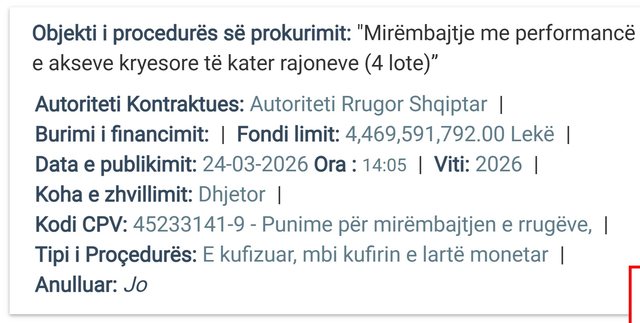
Vox News has researched official documents, which show that the Albanian Road Authority, with several former directors in prison, one under house arrest and dozens of officials under investigation, has planned to spend a large amount on roads. The document refers to " performance maintenance of the main axes of the four regions" , while the tenders will be divided into 4 lots.
The limit fund of all 4 lots is a full 4,469,591,792 lekë, or 46.5 million euros. It is not about road construction, but about works for their maintenance. Vox News has learned that this is the highest amount that the Albanian state has allocated for maintenance, while a year ago the value was estimated at around 30 million euros. The ARA data shows that around 3,500 kilometers are required to be maintained, while the works should be for cleaning and repairs. Meanwhile, the same institution also makes tenders for signage or for the elimination of "black spots", increasing the cost to several million euros.
But what will ARRSH maintain, the axes that collapsed?!
Of course, many questions arise after this large value, given that in the last 2 years, some roads have collapsed, others have cracked, and some newly built tunnels have had problems. It is learned that during the last 24 months, more than 30 cases of collapses and landslides have been recorded on road axes, some with partial collapses of the road body, others with landslides and in some cases cracks and deformations of the asphalt.
There have been problems on the new Korçë-Ersekë road, on the Elbasan – Librazhd axis, in Maliq – Lozhan, Përmet – Çarshovë or the collapse a few weeks ago on the Librazhd – Prrenjas road. There have also been problems in the Uji i Ftohtë area in Tepelena or on the axis inaugurated 1 year ago, Qukës – Qafë Plloçë . There have also been collapses on Arbrit Street, Lura Street or even Burreli Ring Road.
There have also been problems in the "florinjtë" tunnel of Llogara , where structural problems were reported, the Murriz tunnel or the flooding of waters in the Kardhiq - Delvinë axis tunnel . In fact, in some of these tunnels, the ARRSH has opened tenders for their regulation. It seems that the reasons for these problems have been the making of projects, in many cases weak geological. Also their low-quality construction, while not even supervision or maintenance is left behind.
However, instead of these "defects" being investigated criminally or administratively, the government itself increases funds in an attempt to cover the defects. Time has shown that the more funds there are, the more thefts will increase!
©Copyright Vox News
This article is exclusive to Vox News, and is copyrighted under Law No. 35/2016, "On Copyright and Related Rights". The article may be republished by other media only by citing Vox News and including a link to the source at the end, otherwise any violator will be held liable under Article 178 of Law No. 35/2016.