


Is this police force professional and capable of handling violen...
/ 2026-10-16 18:54:07Focus


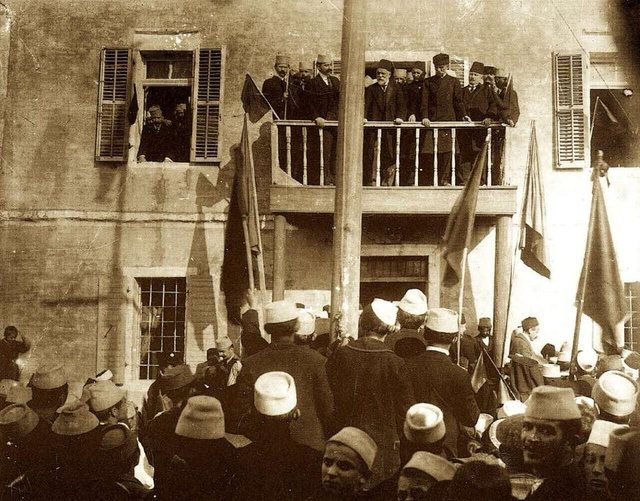
Eqrem bey Vlora gives his version of the story of the flag that was raised by Ismail Qemali on November 28, 1912. He says explicitly: "I extended the story of the raising of the flag a bit, because in recent years completely different variants have circulated untruth and I want the exact event to be described and remain once and for all". Here is what Eqrem Bey Vlora writes in his memoirs.
Return to Vlora
Upon returning from Kuçi, I immediately went to the house of my cousin, Dzhemil, to meet the Chairman of the Provisional Government, the house was a scaled-down copy of the haramlek, it had not four, but three floors. Through the intermediate door I entered the ground floor where the grand staircase was.
The courtyard, the upper and lower halls, the stairs were full of people with faces, behavior and clothes that I had never seen in Vlora. Everyone talked loudly and when they got bored in one place, they moved freely and aimlessly as if they were at home. Upstairs was a large drawing room furnished with beautiful Biedermeier style furniture, the door of which was wide open. In front of it, people crowded and pushed to hear what was being said inside. I paused for a few moments to greet a host of acquaintances and then entered the salon. Ismail Bey was sitting on a sofa with a faint look, so much so that it hurt me. I hadn't seen him in three years, and now he seemed more old and frail. He suffered in this new and foreign environment for him. For years, Ismail Bey had been a senior employee of the Turkish administration and val, these positions, when the distance between the top and the bottom was maintained. Thus, he had fallen into a chaos of social contrasts, which he could not find his way around. I approached him, kissed his hand respectfully and sat next to him. At least the sofa, the people filling the space had been kind enough to leave it.

He asked me the usual questions: how did I get it, where was my father, did he get lost in Kuc with this bad weather and so on. Then I got up to leave. But he held me and asked me in a low voice: "I want to pay you a visit. Is it the same for you as here?" I replied that if he wanted to come to me, I would come and get him myself. "No," he said. Dzhemil told me that the intermediate door is still there. I'm coming myself." However, it was not better for me either. But thanks to my mania for protocol, thanks to the unapproachable and closed character, the distance was nevertheless maintained. Why would this mess and this chaos be caused in a private house, one might ask. Ismail Bey had learned from his paternal and ancestral times that Sanjak Bey's residence was also the seat of government. That is why the salamllek of the houses of the beylers was called zapana in Albanian.
So Ismail Bey did not like to stay in the municipality. And people, who had to meet the head of state, with or without work, came in droves to his private residence. In the days that followed, I met the senior officials of the new government, appointed on 4. 12. 1912, by the honorable Prime Minister Ismail Bey and the highly respected Deputy Prime Minister Nikollë Kaçorri. The members of the new government were good friends and acquaintances, and I had to add that in the circumstances at that time, it was difficult to make a better choice. And if this did not at all respond to the demands of the time, it was not her fault. The position of any progressive government after the fall of Ottoman rule could not be easy; only a strong dictatorial watch could possibly have succeeded in governing. But where was this dictator and the power to be such? In the government of Ismail Qemal bey and grandfather Don Nikolle Kaçorri, there was no place for medieval tyrants, it consisted entirely of reasonable people. The Council of Ministers met in Ismail Bey's house, but I never found out where his ministers were based, even though I say that I knew very well that miserable nursery, which was called Vlora at that time. Better than the others - I have seen this myself - was the Minister of Posts and Telegraphs: he was the master of an entire ministry, the Postal Telegraph Office of Vlora. The national assembly that proclaimed the independence of Albania on 28. 11. 1912, was dissolved on 7. 12. 1912, after previously electing, at its feet, a Council of Elders, (senate) with 18 members. it consisted entirely of sane people. The Council of Ministers met in Ismail Bey's house, but I never found out where his ministers were based, even though I say that I knew very well that miserable nursery, which was called Vlora at that time. Better than the others - I have seen this myself - was the Minister of Posts and Telegraphs: he was the master of an entire ministry, the Postal Telegraph Office of Vlora. The national assembly that proclaimed the independence of Albania on 28. 11. 1912, was dissolved on 7. 12. 1912, after previously electing, at its feet, a Council of Elders, (senate) with 18 members. it consisted entirely of sane people. The Council of Ministers met in Ismail Bey's house, but I never found out where his ministers were based, even though I say that I knew very well that miserable nursery, which was called Vlora at that time. Better than the others - I have seen this myself - was the Minister of Posts and Telegraphs: he was the master of an entire ministry, the Postal Telegraph Office of Vlora. The national assembly that proclaimed the independence of Albania on 28. 11. 1912, was dissolved on 7. 12. 1912, after previously electing, at its feet, a Council of Elders, (senate) with 18 members. Better than the others - I have seen this myself - was the Minister of Posts and Telegraphs: he was the master of an entire ministry, the Postal Telegraph Office of Vlora. The national assembly that proclaimed the independence of Albania on 28. 11. 1912, was dissolved on 7. 12. 1912, after previously electing, at its feet, a Council of Elders, (senate) with 18 members. Better than the others - I have seen this myself - was the Minister of Posts and Telegraphs: he was the master of an entire ministry, the Postal Telegraph Office of Vlora. The national assembly that proclaimed the independence of Albania on 28. 11. 1912, was dissolved on 7. 12. 1912, after previously electing, at its feet, a Council of Elders, (senate) with 18 members.
The route of the bey of Vlora from Kuçi to the coastal town
During my stay in Kuc, I was elected (in absentia) as a delegate, and now I was elected senator of Vlora. Two of the ministers were my friends, Myfit bey Libohova and Abi bey Toptani. But there were no two people more different, even more opposite in character. While Myfit Bey took all this with scorn: the shortcomings of the temporary government, the immaturity of the Albanian people, even all these insults that had plagued us, Abdi Bey, on the other hand, was saddened and despaired beyond words when he was forced to was paying one or two weeks late receiving salaries in the new Albanian state. But where did the Albanians learn, we often asked mockingly, the concept of monthly salary? The problem of finance, which I would call by its real name:
According to Turkish-Albanian concepts, Vlora and Berat were rich provinces. But customs revenue was no longer forthcoming due to the Greek naval blockade, and with the roughly 6,000-7,000 napoleons the Provisional Government could provide per month, Abdi Bey had to work wonders, mentioning here that none of the Beylers ever received a penny. as salary or compensation. Myfit Bey, the Minister of the Interior, stayed with me for a few weeks, then rented a pleasant lodge behind our courtyard, where he lived during his stay in Vlora. The style in which he ran the Ministry of the Interior was somewhat reminiscent of the time of Dagobert, the good King of the Franks: a little paternal, a little chivalrous, but also a little despotic.
After one week
A week after my return to Vlora, I took Murat Bey Toptan and Hydaj Efendi to Ismail Qemali, begging him to return the flag that I had lent them. They promised to return it to me immediately, as soon as Mrs. Marigo Posjo (a great democratic patriot, but who liked advertising) had sewn and embroidered the new flag. Well, on November 28, the main object of the day, the flag as a symbol of independence, was forgotten with that typical Albanian-Eastern carelessness. Moreover, most did not know what he was like. No one had seen or held it before. No one in Vlora had a flag at home. The statesmen fell into trouble and looked at each other in confusion.
Then my friend Hydai Efendi gets up and says that in Eqrem Bey's bedroom, an Albanian flag hangs on the wall, inserted in a beautiful frame. And asked if it could be taken without the master being there? Ismail Bey gave him permission, and so the flag that Don Aladro Kastrioti had solemnly presented to me in Paris traveled to the neighboring mansion and fell into the hands of Ismail Bey, who handed it over to Murat Bey Toptan, with the order to hang it outside, while he himself stayed in the window. Thousands of people gathered in the square in front of the house and in the garden, chanting "long live, long live" even though many of them did not even understand what was happening. Later, when I raised the Albanian flag in front of our house on the festive days of the declaration of independence as a free and independent state, some good Kosovars told me: "You know, you did very well to raise the flag of Father King (that is, Emperor Franz Joseph) because now there is nothing more to do to us, neither the vile Serb, nor the scurrilous Montenegrin. When I asked where I saw the black eagle, they answered me proudly: "At the soldiers of father Krali, in Pazarin e Ri."
But of course, there was also someone like a certain Haxhi Muhamet Efendi, an important and fanatical cleric in Vlora and a strong supporter of my eti, who expressed his anger that Ismail Bey had chosen a raven as a symbol of free Albania. (Ah, Syria Bey had made Albania, he complained, - now we would have the beautiful eyes of the Koran on our flag. But what else can you expect from Ismail Bey, who has spent his whole life in the land of the Turks?)! When I told the story to Ismail bey, he laughed out loud, but also threatened me with his finger that he would tell Hoxha that he had not found the flag, but I!


