Is this police force professional and capable of handling violen...
/ 2026-10-16 18:54:07Focus


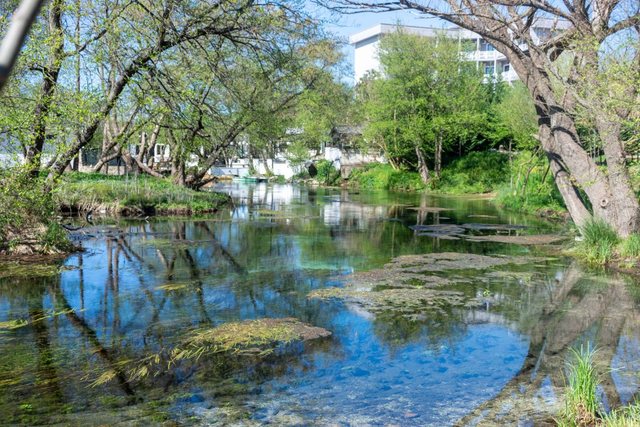
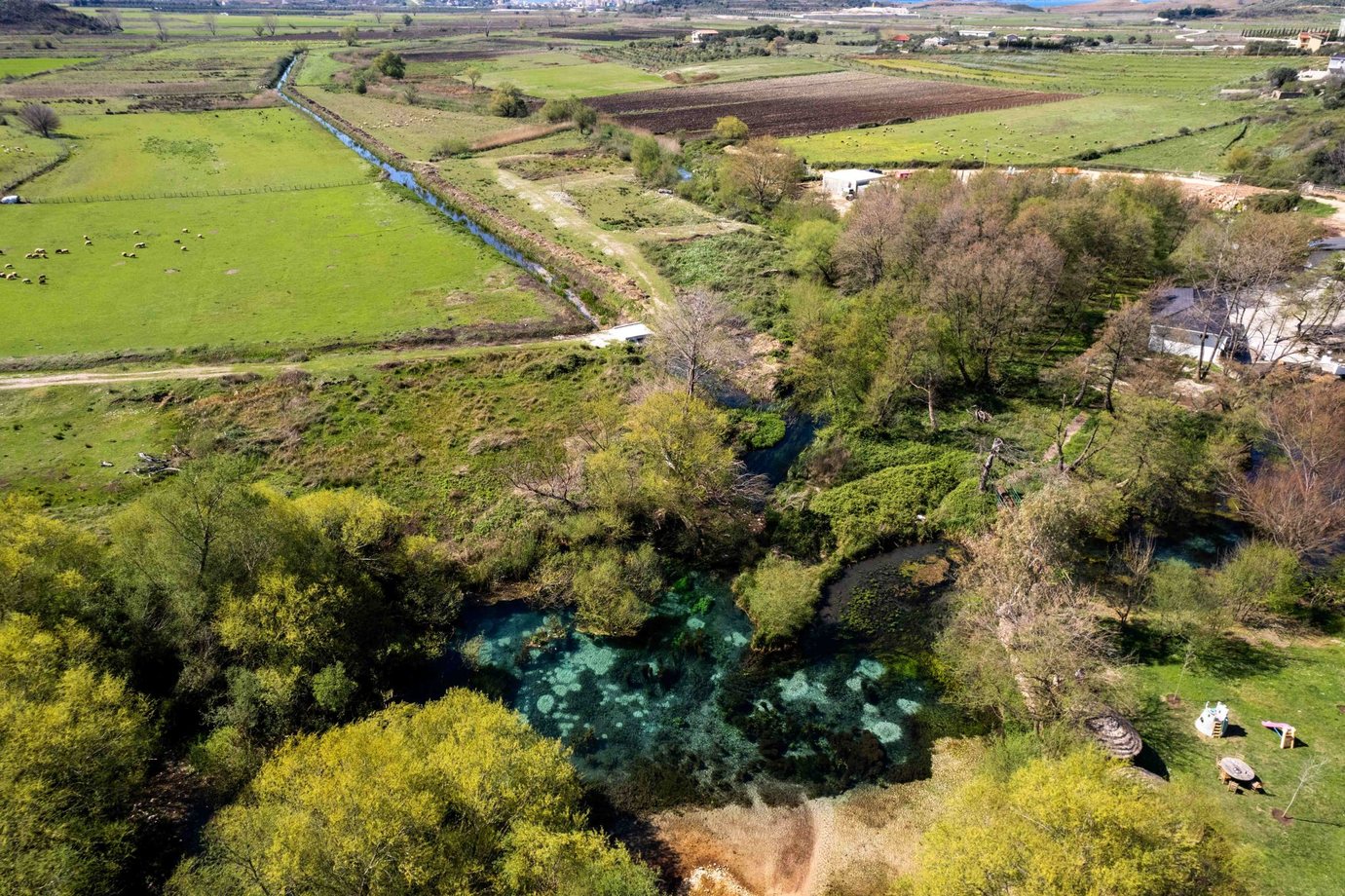
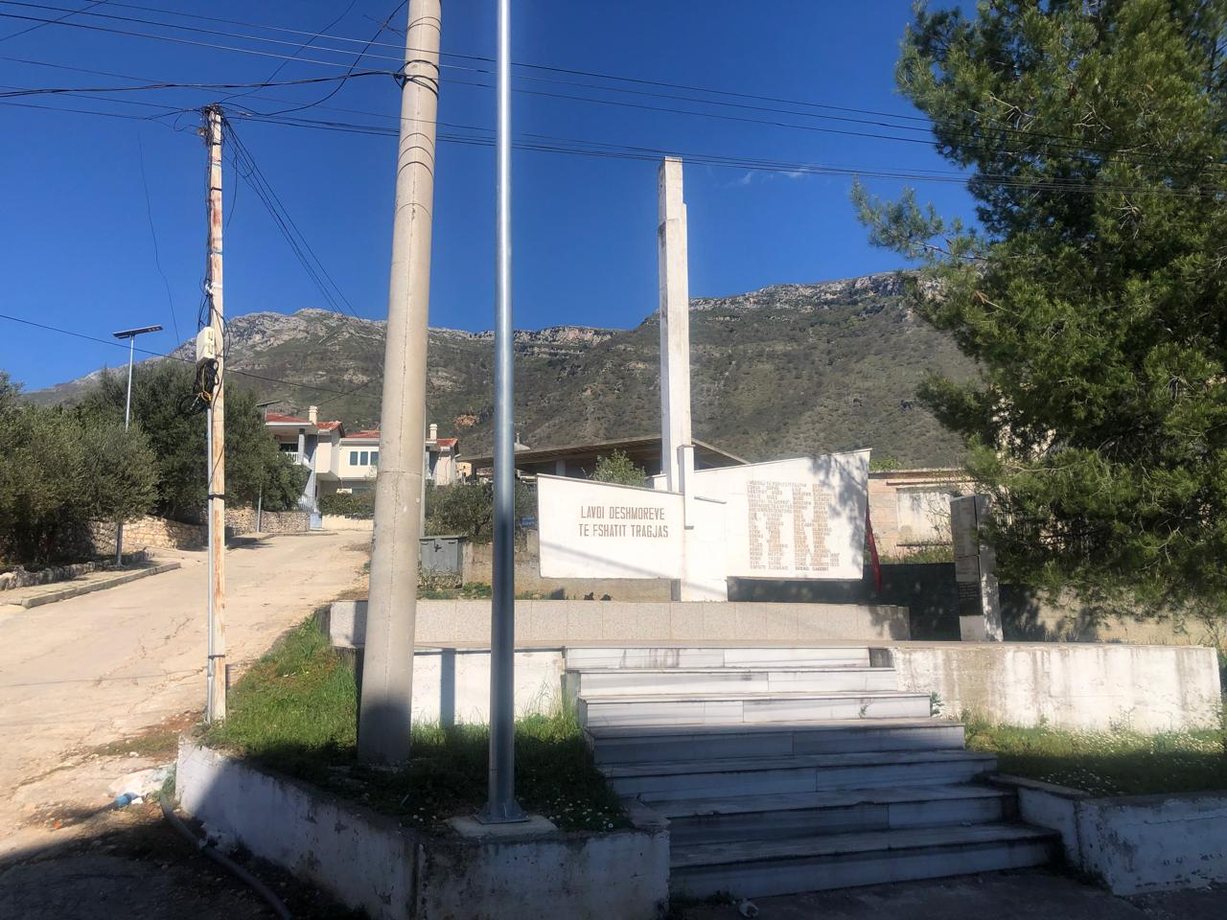
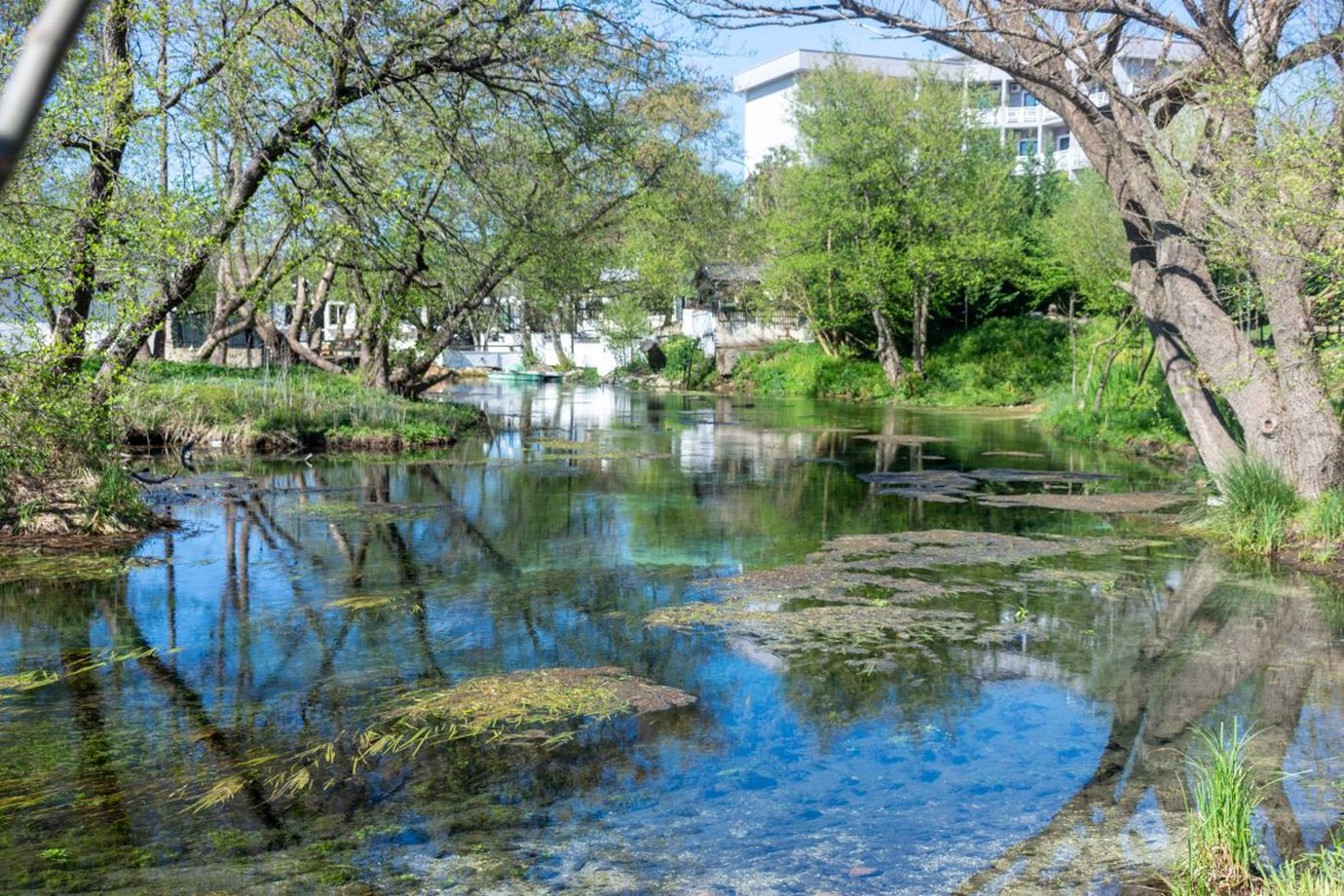
On a sunny morning on March 20, the sound of water gushing and flowing through the greenery is the only music heard in the square by the Izvor spring in the picturesque village of Tragjas in Vlora. Two or three families are drinking their morning coffee. The adults sit and chat, while the children run after a duck.
The springs that emerge from the underground create a pool of crystal clear water, which due to its former depth, the locals called “the sea”. But the residents of Tragjas are now worried that this little corner of paradise is in danger of disappearing due to a government project, which aims to pipe the water and send it about 30 kilometers to the South, to supply the luxury tourist complexes in Palasa and Dhërmi, christened by the Albanian government as strategic investments.
“Strategic, strategic, I don’t understand the word strategic,” says Emiliano Daupi angrily, the owner of a small family restaurant next to the Izvor water sources. “Strategies are for war or economic and financial strategies, but strategies that you devour, I haven’t seen that,” he adds.
Since the adoption of the controversial law in 2015, the government of Prime Minister Edi Rama has granted "strategic investor" status to dozens of residential and tourist complexes on the Albanian Riviera, often at the expense of public property or money invested in the construction of their road and energy infrastructure.
But in the last two years, the thirst for water of these resorts is disrupting the lives of small local communities that live dozens of kilometers away.
Data obtained by BIRN through official documents show that the new Tragjasit water supply is planned to exclusively supply water to seven of the luxury complexes in Palasa, Drimadhes and Dhërmi, approved through 11 development permits with hundreds of thousands of square meters of planned construction.
The potential use of Izvor's resources was initially identified by the Municipality of Himara, while the project was pushed forward by the National Water Supply and Sewerage Agency through a tender worth over 9 million euros for the construction of the water supply.
The residents of Tragjas strongly oppose the project, complaining that they have not been consulted by anyone and that the Izvor springs do not have sufficient flow to meet their needs for drinking water and irrigation.
The residents' protest is supported by civil society representatives, who emphasize that strategic investments in tourism have been made without proper studies and are harming the livelihoods of local communities and the ecosystem.
“Now we are only seeing the tip of the iceberg, the coastal area is still under construction,” warned Olsi Nika, head of the environmental organization EcoAlbania, which has previously opposed a similar plan for the Shushica water supply on the Vlora River. “The standard of living in these new urban units is 4 times higher and they have a high demand for water,” Nika added.
The National Water Supply and Sewerage Agency, AKUK, told BIRN in its capacity as the project implementer that all legal steps had been followed for the approval of the water supply and that according to the law, ownership and management of water resources did not belong to the residents, but to the state. AKUK admitted that no consultations had been held with the residents for the new water supply, as the project had not been subjected to the in-depth Environmental Impact Assessment procedure.
"We clarify that consultations should only be carried out in the case of drafting the in-depth EIA report, which has not been requested by the National Environment Agency for this project," AKUK added.
Public water supply for luxury resorts
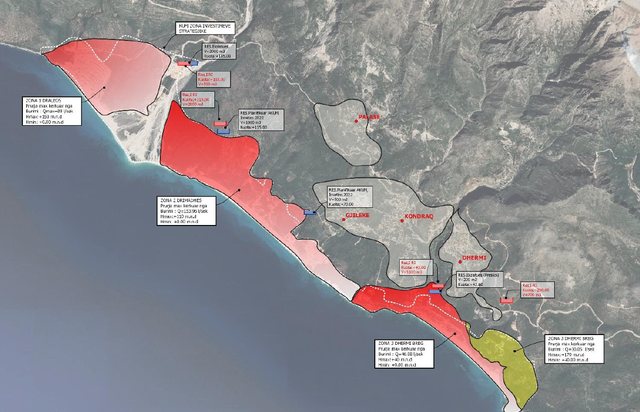
Strategic investment areas in Draleo, Drymadhes and Dhërmi for which the Tragjas water supply is foreseen.
The Izvor springs currently serve for the drinking water supply of Tragjas, the village of Radhimë as well as the coastal area of Radhimë, Orikum and Vlorë. The village of Tragjas itself is partially connected to the water supply and a large part of the houses provide water through wells they have invested in.
While their water supply network had been neglected for years, residents learned in July 2024 during a visit by Infrastructure Minister Belinda Balluku to the area that the government planned to build a new water pipeline to deliver spring water to the luxury complexes of the South.
A document titled "Technical Report on the Assessment of Water Needs", drafted at the request of the Municipality of Himara in August 2023 by the studio "Grama Consulting & Engineering", indicates that the new water supply will serve exclusively for the supply of strategic investment areas in Draleo, Drimadhes and Dhërmi, excluding the existing villages in Palasë, Gjilekë, Kondraq and Dhërmi.
According to the document, the new water supply will benefit the 3 projects of the Green Coast complex in Draleo/Palasë owned by the "Balfin" group of businessman Samir Mane with 360 thousand square meters of construction; the Gone Perivol complex built by the Concord Investment company of the Dulaku brothers with 110 thousand square meters of construction, and the Delta Falaise Resort & Village project of the Delta company of Luan Muça with 100 thousand square meters of construction.
Also, the new water supply is expected to benefit the "Ionian Olea" complex built by the company Shushica sh.pk with 35 thousand square meters of construction; an investment by Trema Shpk with shareholder Ilir Trebicka with 20 thousand square meters of construction; the "Coast to Coast" project of the Gjikuria company with 50 thousand square meters of construction, as well as the "White Rocks" project of the Eurocol company of Pandeli Carapul with 25 thousand square meters of construction.
In total, the new Tragjas water supply is expected to supply 700 thousand square meters of construction in the three areas, where according to the report, the usage rate is high.
"Referring to the above regulations and taking into account that we are dealing with elite tourism in these areas, the minimum consumption rate of 250 l/inhabitant per day and for residential tourists... 280 l/inhabitant per day has been maintained, which takes into account the needs for garden irrigation, use of swimming pools...," the technical report states.
The designer, Grama Consulting & Engineering, told BIRN via email that the process of assessing water needs and taking measurements at the source was carried out in accordance with applicable national regulations, technical standards and relevant legal procedures.
"However, I would like to clarify that our professional responsibility has been limited only to the design aspects. Issues related to the planning of this project, the implementation of the project, community engagement have not been and do not form part of our duties and belong to the project investor and the relevant public institutions," said "Grama Consulting & Engineering".
The Green Coast company dismissed as "rumors" residents' claims about its connections to the water supply project.
"What is true is that Green Coast currently has no water problems and therefore cannot be related to what some residents are saying," the company said through a spokesperson.
'Suspicious' measurements
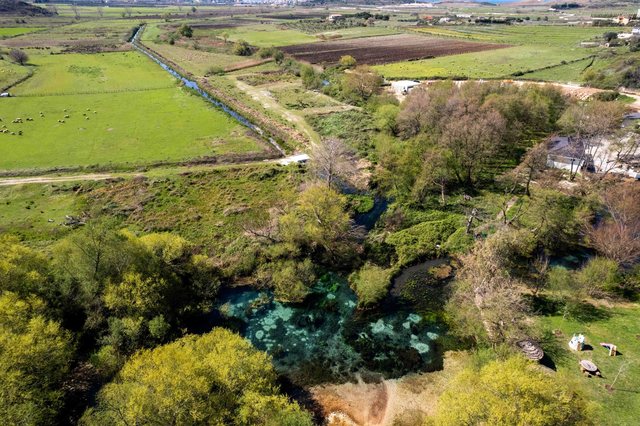
The National Water Supply and Sewerage Agency, AKUK, claims that the Izvor springs have enough water to meet both the needs of residents and those of strategic investors.
AKUK estimates that the spring has an average annual flow of 1,800 liters per second and a minimum flow in the hot months of 700 liters per second, while the new water supply is planned to receive 290 liters of water per second, or less than half, on account of the resorts in the south of the country.
In a response to BIRN, AKUK acknowledged that Tragjas residents had problems with uninterrupted water supply because a previous investment had not included the full construction of the distribution network.
But AKUK insisted that the new water supply project does not affect the drinking water supply or the need for irrigation of this village.
"The drinking water supply needs of the village of Tragjas are not affected by this project, as the flow needed to supply the village of Tragjas is only 11 liters/second, while the minimum flow of the source is 700 liters/second," said AKUK, adding that the irrigation needs were 4 liters/second.
However, residents are skeptical and the situation at the current pump depot is not promising.
An employee of the current Tragjas and Radhima water supply company told BIRN on condition of anonymity for fear of being penalized at work that water was not sufficient during the summer season and the pump system had to work 16 hours to ensure the water supply.
“If the pumps stay on for too long, they start to pick up gravel,” he said, referring to the hot season. At the peak of the spring flows, the pumps, he said, only worked for four hours a day and did not need constant supervision.
Residents do not trust AKUK's measurements and have hired a licensed engineer for more reliable data. Measurements they conducted in March, considered the peak of flows, found them to be 974 liters/second, or almost half of the average flows claimed by AKUK.
“This village lives on this water and they don't drink it,” says Vasilika Bitri, an elderly resident of Tragjas who also declares herself a “sworn leftist.”
"These village waterworks are not supplying water, because the state is not functioning. Nature itself shows that it is drying up, the waters are disappearing, they are not the same waters that they used to be," she added, recalling that there has been no snow on the mountain for years.
Hyso Xhuveli, a resident of Tragjas, also says that the spring does not meet the conditions to provide drinking water and water for irrigation. He further adds that the village obtains water from wells it has dug itself, investing thousands of euros, and fears that the project will put them out of use.
"Let the Prime Minister do his thing, we will do ours, because there is no water..." said Xhuveli.
"He will dry up our wells completely, he will leave us the corn, we call it the reeds, which we grew up with, he will leave it there in the fields and he will do good to those who bathe in the pools of water of Tragjas," he added, reminding Rama that the majority in the village voted for him.
Even the Albanian Geological Survey, in an opposition to the project, raises questions that the measurements are incomplete and that the needs of the residents should be paramount.
"Since we do not have regular measurements of the spring's flow during the low water period, the water supply of the population should be a priority," states the Service's opposition to the data made available by the planner.
Left in the dark
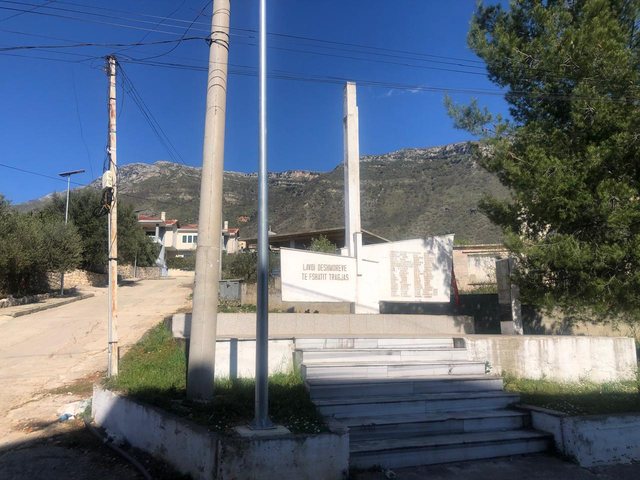
After clashing with the police in March of this year and having the construction equipment driven away, the residents of Tragjas say they are ready for even more intense confrontations. They have piled up piles of stones against the fences of their yards.
A March 6th statement by Prime Minister Edi Rama regarding the Tragjas water supply did not convince them. Rama claimed that residents had been consulted beforehand and that the project would serve the residents first, while alluding that “someone had poisoned the Tragjas residents.”
Publicist Fatos Lubonja explains the government's behavior towards the residents of Tragjas with the repeated scheme that the government, in alliance with a small group of oligarchs, exercises to maintain power.
"Those poor desert dwellers are victims, just as they were victims during Saliu's time, who took their water and gave it to the oligarchs who built hydroelectric power plants to make Albania an energy superpower," Lubonja said.
"Rama wants to make it a tourist superpower. Basically, they just want to keep power," he added.
A dozen Tragjas residents told BIRN in separate interviews that they learned about the project the moment the fadromats appeared in the village. They said they were never consulted or explained.
"Categorically, definitively, no consideration has been taken at all whether someone lives here or not," said Emiljano Daupi, adding that the residents were not even clarified after sending letters to the prime minister and the municipality.
Jewel claims the same thing.
"It's not even a month, a month. They did everything secretly. That canal they built upstairs, they worked at night, we don't know anything about what you're going to do," he said angrily.
Residents complained that they also encountered difficulties in collecting documents on which they want to file a lawsuit in court. They told BIRN that some institutions, including AKUK, have not made the requested documents available to them even after the deadlines.
Duke Muço, a former member of the municipal council, says that the project is full of technical and legal shortcomings and that informing residents about the project too late caused the conflict.
"Too late. The reason it came so late obviously raises a very big question mark or several questions, both in the legal aspect and in the technical procedural aspect," says Muço.
For the former municipal councilor, the conflict and clash are a consequence of the disconnect between those who govern and the residents. Muço, however, leaves open the possibility that the project could be accepted if it is revised and takes the water further from the source.
"Please, sir, take another look at the project so that it does not descend into anarchy," he said.
"The moment the lack of water begins, life is threatened, then (resistance) will increase. The protection of life, water, will begin," he concluded./ reporter.al