Protests highlight trauma crisis, operating rooms under reconstr...
/ 2026-10-15 18:35:16Focus


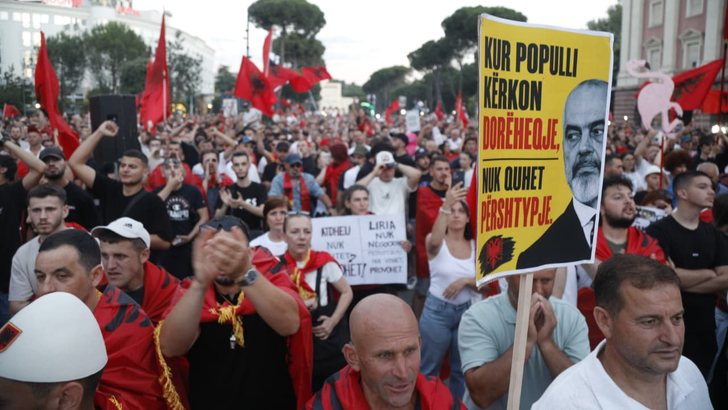
Amid the chaos caused by protests and citizens' demands for and against strategic investments, today we as a society must raise a fundamental question: what exactly does the citizen receive in return from a strategic investment?
This question has become inevitable, at a time when public debate has always been limited to two extremes. On the one hand, it has been presented as progress, according to the “strategic” definition. On the other hand, any large investment has been seen as suspicious, to the point where it has been said that we do not want this development model. Of course, the latter should not be taken into consideration at all, except for the doubt about transparency. Albania must be open to investments, especially when they come from large groups of investors.
This is indisputable.
The real issue here is how the investment can be structured, what it will leave behind, who benefits most, and how it can strengthen the economy and citizens.
This can be resolved by fundamentally revising the law on strategic investments according to the 40% principle.
The idea behind this principle is simple.
Strategic investments, which receive support through bureaucratic and fiscal facilitation, must guarantee a measurable return for the Albanian economy and the affected community from the moment they present the project proposal.
In practical terms, it means that at least 40% of the value generated by the investment must remain linked to the country's economy. Albanian companies must be part of the construction, supply and maintenance chain of the project with at least 40% of the value. Also, the workforce must be involved from construction to the service that the project will provide in the future. On the other hand, Albanian products, mainly food and agricultural, must be included with at least 40%. This is a principle that makes the opening to strategic investments more functional and creates measurable value for the state budget, the affected community and households.
Until now, such principles have been left to the will or discretion of the investor and have never been structured as a condition for investment, either by law or by contract.
The first condition should be the economic participation of the country in the project. At least 40% of the subcontractors should be companies that pay taxes in Albania. This creates an interconnected mechanism between companies, which can participate where they meet the required criteria. Otherwise, strategic investments will remain beautiful to look at, but without benefit for the local economy.
The second condition is the participation of the Albanian workforce, which also has the opportunity to increase qualification in terms of quality. So, not only by hiring Albanian workers, but also to qualify them, if necessary. In this way, the application of the 40% principle as a condition for the inclusion of Albanian workers in the project will translate into a higher standard of service, higher salaries and further development of the labor market.
The third condition is definitely the promotion of domestic production. A major project and the others that will follow it, can create a sustainable infrastructure in the country's production chain, from construction materials to agricultural products. The application of the 40% principle will force domestic producers to plan the supply chain, according to contractual obligations. In other words, to sustainability.
The fourth condition is what benefits the community. At least 40% of public investments in the community affected by the project must be financed by the strategic investor. This means that the state or municipality will only invest 60% or less of the value for investments in roads, schools, public spaces and health centers.
The fifth condition must be environmental balance. Considering that in this case nature is an economic asset and the projects are beneficiaries of the landscape, sea, mountains and cultural heritage, they must expand the area where the project is developed by at least 40%.
The sixth and final condition should be what was mentioned at the beginning: Transparency! Every strategic investment, which will be submitted for approval, must include in the draft proposal the entire above chain with concrete steps for each. Also, the entire proposal process, along with the details, must be public and accessible to citizens.
The purpose of the 40% principle as a condition for strategic investments is to change the logic of development, from that of general announcements and benefits, to that of concrete and measurable benefits for communities. In this way, it will be easier to measure how much value has remained in the economy, how much capacity has been created, how much domestic production has been stimulated and how much Albanian families have benefited from development.
Such a principle could become a new rule for economic justice in Albania. There would be clear rules of the game from the beginning, both for investors and for the state. It would strengthen domestic production and the economic chain. The clear rules that this principle provides would also reduce suspicion of a lack of transparency, which would also provide protection from political attacks on the government.
So far we have opened the doors to capital unconditionally, hoping that with a little luck it will get better, but apparently this is not working. As an aspiring European Union member in less than half a decade, the Albanian government must set concrete strategic conditions, in order to use them as a guide and chain of responsibility in the service of its citizens.
A country that fails to demand concrete value in exchange for what it gives is destined to lose its future.