Is this police force professional and capable of handling violen...
/ 2026-10-16 18:54:07Focus


By Zvi Bar'el – Hareetz
A broad agreement was signed between OYAK, the Turkish military pension fund, and the Somali government at a festive ceremony in Ankara on December 17. The fund's capital totals about $30 billion and it manages approximately 130 Turkish companies worldwide.
Under the agreement, it will be a partner in a Somali-Turkish fishing company, Somturk, which will hold exclusive fishing rights off the coast of Somalia. Somturk will be responsible for managing the industry and issuing fishing licenses.
Officially, the purpose of forming the joint company and granting a franchise is to bring order to the chaotic fishing industry and improve its operations. But the signing ceremony was attended by Turkey's defense minister, Yasar Guler, and its military chief of staff, Selçuk Bayraktaroglu.
What do these two officials have to do with the tuna and sardine fisheries that can be found in abundance off the coast of Somalia? Not much. But they have a lot to say about Turkey's deep ties to Somalia.
Turkish President Recep Tayyip Erdogan visited Somalia in 2011 and provided it with generous humanitarian aid. Since then, Turkey has planted deep roots in the country – not only at sea, but also on land and even in the air.
Turkey's largest military base outside Turkey, as well as its largest embassy, are located in Somalia. Some 15,000 Somali soldiers have been trained by the Turks at that base since 2017, and Somali officers have undergone advanced training in Turkey.
Thousands of Somali children study in Turkish-built schools. Turkish companies run the Somali port of Mogadishu and the country's international airport. And recently, Turkey set up a base in Somalia to test its Tayfun ballistic missiles. It also plans to use the base to experiment with launching missiles into space.
Thus, Somalia has become a kind of Turkish protectorate, and Ankara has used its investments and military aid for diplomatic purposes as well, serving as a bridge to other African countries.
Turkey has pursued a policy that sees Somaliland as an inseparable part of Somalia. But Somaliland has been virtually independent since it broke away from Somalia in the early 1990s, and although no country had recognized it until this weekend, it has become a magnet for other countries in the region because of its control over a long stretch of coastline on the Indian Ocean and the Gulf of Aden.
Ethiopia, which lost access to the sea after Eritrea gained independence from it in 1993, found an alternative access route through the port of Berbera in Somaliland. In 2024, an agreement was signed under which Ethiopia would lease a section of the coast near the port and be allowed to build a naval base there in exchange for recognizing Somaliland.
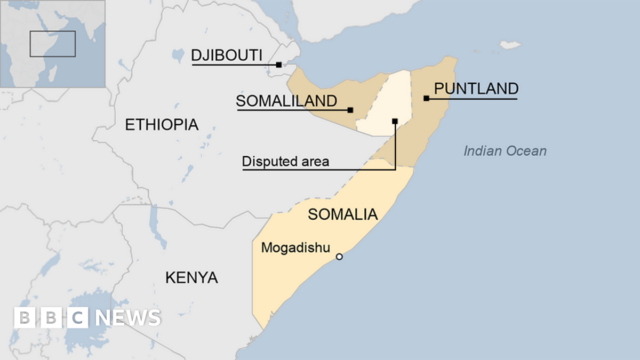
But Turkey, on behalf of Somalia, sought to block this move, which threatened Somalia's sovereignty, and at the end of 2024, proposed a compromise under which Somalia would grant Ethiopia access to the port of Mogadishu.
The UAE is also involved in the intricate web of relations between Ethiopia, Somalia and Turkey. It invested $440 million in the development of the port of Berbera through its giant conglomerate DP (which also offered to buy the port of Haifa). It has also established a military base in Somaliland and has invested in various branches of industry and trade in the little-known country.
For Abu Dhabi, Somaliland is a vital strategic point, and its importance only increased after the UAE's failure to win the right to operate the port of Djibouti. But it is not the only such point.
Abu Dhabi has surrounded itself with a strategic belt that also includes the Socotra archipelago in the Indian Ocean and the port of Aden. Socotra, which is part of Yemen, is controlled by the Southern Transitional Council, headed by Aidarous al-Zubaidi. This organization is part of the Presidential Leadership Council, which runs large areas of Yemeni territory not under Houthi control.
The Southern Transitional Council, which receives funding and political support from the United Arab Emirates, seeks to restore South Yemen as an independent country. This runs counter to the goal espoused by Saudi Arabia, America, and most other countries, which is to preserve Yemen as a unified country.
This is not the only country in which the UAE has adopted an independent policy. In Sudan, Abu Dhabi supports the Rapid Support Forces – the murderous separatist group led by Mohammed Hamdan Dagalo that has been fighting the recognized government headed by General Abdel-Fattah Burhan. In contrast, Egypt and Saudi Arabia support the recognized government.
Israel's role in the UAE's strategic system is not insignificant. According to foreign reports, Abu Dhabi allowed Israel to set up a military base on a key island in the Socotra archipelago, and it may be doing even more than that.
A year ago, the Middle East Monitor reported that the United Arab Emirates was negotiating with Somaliland to allow Israel to establish a military base in that country in exchange for Israeli recognition of its independence.
The UAE itself has not yet recognized Somaliland, but that has not stopped it from establishing military bases there or running its port.
Israel's military participation in the strategic network that the UAE is building around Yemen and the Horn of Africa could put both countries on a collision course with other states in the region, most notably Turkey. Ankara is also fighting for control of African countries bordering the Gulf of Aden and the Bab el-Mandeb Strait.
It is not clear whether Israel's recognition of Somaliland was a condition for an Israeli military presence there.
However, the timing of his announcement is certainly not unrelated to the trilateral summit convened earlier this month to form a “strategic alliance” between Israel, Greece, and Cyprus. Nor is it unrelated to Israel’s desire to keep Turkey under surveillance.