Is this police force professional and capable of handling violen...
/ 2026-10-16 18:54:07Focus


Fatos Tarifa's analysis on the "prime ministerial nomenclature" published today in DITA accurately captures the symptoms of an extremely centralized government.
Decision-making in today's Albania has ceased to be representative. It now links us vertically, with anger and frustration, from the "lonely peak" (as the prime minister describes himself in interviews), down here "below", to us plebeians. Not to discuss it, because everything has already been decided, but to implement it.
"Up", the solitude of power enjoyed with expensive wine. "Down", the routine of obedience.
But this new "nomenclature" of the last three or four decades was not born today. Nor is it explained solely by the behavior of a prime minister. To fully understand it from the '90s onwards, it is necessary to go back to the moment when it began to be rebuilt.
It is true that the “revolution” of the false heroes of December laid the foundations of a model where everything is built on the facade. We have emphasized this more than once. But I want to focus on the year 2008, when the Rama-Berisha agreement and the constitutional changes that followed laid the foundation stone of another layer of centralized power.
A serious parenthesis must be opened here, because this is not just a political maneuver, but also a violation of the blood of the children and innocents of Gërdec.
This makes that agreement doubly difficult, since Berisha also used it to protect himself and his circle from responsibility for Gërdec. While Rama, on the other hand, accepted and used that uninvestigated blood as currency to build the authority he did not yet have within the SP.
The symbolic episode remains that of the hospital, where Rama goes, puts his hand on Berisha's neck. Albanian politics produced the most cynical image of reconciliation. Two men in power, united over an unresolved tragedy, giving each other guarantees of political survival.
They thus carried out that bargain that subsequently emptied parliamentarism of its content, but also gave the message that power can step on blood, if this guarantees political control. As happened again on January 21st.
For me, today's centralization that Tarifa analyzes in his writing is a continuation of that compromise. The analysis of the "prime ministerial nomenclature" gains more meaning when seen as the final phase of this that began in 2008. The decay of the SP, too.
Only by acknowledging this continuity can this debate about democracy go beyond individuals and touch the root of the problem.
This topic has been raised frequently and persistently over the years, especially by the late Moikom Zeqo, who consistently denounced the 2008 agreement in DITA as a fundamental blow to representation and the sovereignty of the vote. Even Pëllumb Xhufi or author Artan Duka have echoed this position in their analyses, so it is an early criticism that this newspaper has kept alive.
There is no need to repeat that the constitutional amendments of 2008 turned parliament into the notary's office of the mayors. The citizen was excluded from real choice.
But suppose we willingly granted our naked kings the sovereign right to choose. Why don't they bring in people with integrity? Why do they choose mediocrity and even common thugs as is emerging lately? Out of ignorance?
No. From the structural need of power. This system does not survive with good people, but with dependent individuals. A real MP speaks for himself, creates opinion, opposes when necessary, builds a public profile. A puppet in a suit has no electoral base, no public authority, no political plan B. So he is totally controllable.
This is the ideal model for a president who cannot govern through debate.
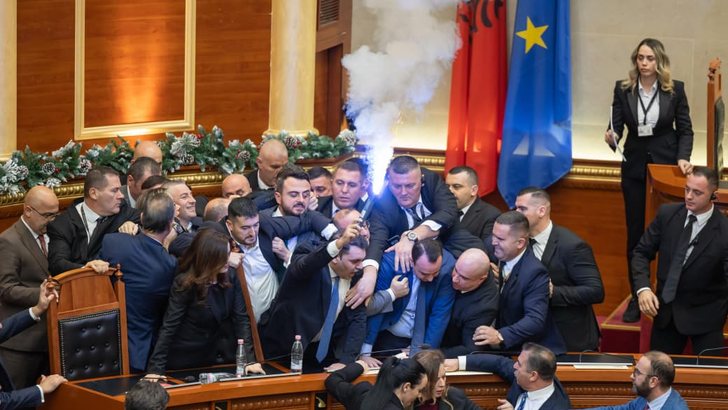
What actually worries me is not the names of the puppets. The problem is broader than that parliament hall that does not deserve the name it bears. It is the unwritten message of this system that does the greatest damage. It goes beyond that hall. DON'T TRY – this message says. Don't get tired of being capable, don't try to be honest, don't try to think differently. Neither knowledge, nor character, nor courage is rewarded, OBEDIENCE is rewarded.
This signal that society reads in the power lists where mediocre, indistinguishable, and weightless people are constantly climbing is the most dangerous consequence of the model we are talking about.
Because this not only produces a weak parliament, but also surrendered citizens. So the ambitious leave, while the others remain silent. The average becomes the norm, just look at the street vocabulary that prevails everywhere and then the rest.
In this sense, the mediocrity in the lists is not accidental. Otherwise it wouldn't be so massive. We would have three or four idiots and that's it. But no. This is already a complete social pedagogy.
Then look how the very architects of this massive mediocrity complain today about the apathetic people. They teach this society every day that effort is futile, and then they are surprised to see the results of their teaching. They create apathy and then put it in the dock.
Is there a more bitter irony? What ridiculous fools!