


Is this police force professional and capable of handling violen...
/ 2026-10-16 18:54:07Focus


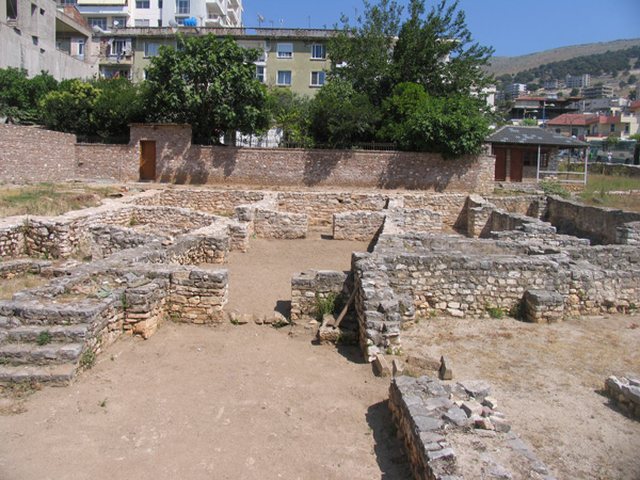
The Jews in the Balkans have had close family and trade ties. Those who lived in Albania were closely related especially to those who lived in Corfu, Ioannina, Arta and other Greek cities.
According to Albanian historian Apostol Kotani, they may have arrived in Albania around 70 BC. He points to sources that describe Roman ships laden with Jewish captives leading them to Rome. Descendants of the captives may have erected synagogues in the port of Saranda in the fifth century BC. There are few records from then, until 1281 when a small group of Jewish merchants selling salt and sheepskins settled in the city of Durrës, which was an important junction on the Rome-Istanbul trade route.
In the 15th and 16th centuries, 1/3 of the citizens of Vlora were Jews.
Jews had come to Vlora from France, Corfu, Spain and Naples. They were exporters of textiles, leather and agriculture.
In the 17th century, Vlora began to lose its importance while Berat was gaining importance. The followers of Shabbetai Zevi (false Messiah) settled there. There is little information on Jews from the 1700s to about 1860. A minority of them converted to Islam or Christianity. But in the 19th century, Jews came from several Greek cities, especially from Ioannina, and settled in Gjirokastër, Delvina, Vlora, Berat, Elbasan, Korçë, Shkodër and Krujë.
In 1912, Jews took part in the struggle for independence. After 1928, when Albania became a monarchy, many Jews entered here from Greece, especially Ioannina. Among them there were pharmacists, doctors and traders. The census of 1930 speaks of 204 Jews.
When Albania was considered a possible homeland for the Jews
In 1935, Leo Elton, a British journalist visited Albania and told Judah Magnes, the first president of the Jewish University of Jerusalem, that 'Albania was an ideal refuge for the Jews and could eventually become their homeland'.
At that time, it was projected that Albania would play the role of a reserve homeland for endangered Jews. As a first step, Leo Elton recommends the establishment of a Jewish national ethnicity in Albania, similar to that of "Mandatory Palestine" (of Mandatory Palestine, the British protectorate, or, as it was later known, of the Palestine Authority), having the cooperation of Zionist movements. Afterwards, Albania could be considered "a homeland for immigrants of Jewish nationality" ("Haaretz", June 25, 2009).
Leo Elton traveled to Albania, where he was surprised by the inter-religious tolerance and especially the lack of anti-Semitic feelings among the Albanians.
"In Albania, when it comes to religion, the lack of tolerance is not recognized... Albanian Muslims are not fanatics...", Eltoni wrote in his letter.
He also adds that, unlike the rest of Europe, Albania had no episodes of discrimination against Jews in its history.
"There is no reason to suspect that the displaced Jews will not live in complete harmony with this diverse population," he wrote.
According to Elton, Albania had only one million people, but the land was so fertile that, if modern agriculture were used, five million could easily live there.
***
After Hitler came to power, Jews from Germany, Austria, Czechoslovakia and Poland poured into Albania. Here they found the saving shelter. Italy invaded Albania on April 7, 1939 and then attacked Yugoslavia, annexing large parts of Kosovo, including Pristina. In 1942 the Jews from Pristina moved to Berat, some went to Shkodër, Tirana and Elbasan. Others joined the partisans.
When Albania was occupied by the Germans in the summer of 1943, the situation for the Jews worsened.
Many of them were hidden by the inhabitants of the country. In the spring of 1944, the Germans' request to hand over the list of Jews was rejected.
After the war, there were about 180 Jews in Albania.
Some left the country in the late 1980s, and others went to Israel in 1991 when the borders were opened.
In January 2011, 69 Albanians were honored as "Righteous Gentiles" by Yad Vashen in Jerusalem.


