Is this police force professional and capable of handling violen...
/ 2026-10-16 18:54:07Focus


A loan is a legal obligation that must be repaid, but not if it turns into usury. Usury is a criminal offense.
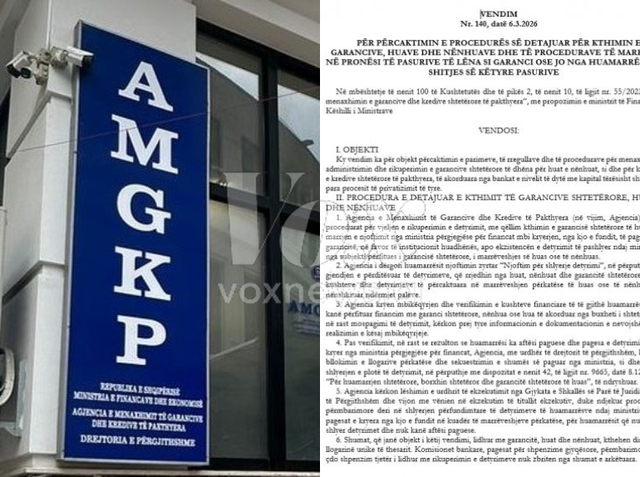
Edi Rama has signed Decision No. 140, dated March 6, 2026, an act that regulates the procedures for the recovery of state guarantees, outstanding loans and sub-loans, as well as the taking ownership and sale of debtors' assets by the state.
The decision, proposed by the Ministry of Finance, grants "usurer" powers to the Guarantees and Non-Broken Credit Management Agency (AMGKP) - formerly the ATK, the Credit Handling Agency.
So, according to the VKM, this agency receives powers to intervene in the recovery of obligations related to sovereign guarantees that arose after the 2020 Pandemic, but also afterwards, as well as for old loans transferred from state-owned banks before their privatization. This includes "tractor" loans dating back to 1993, continuing with loans from the former Agrarian Bank after 1997, all of which are over 20-30 years old.
This decision creates a new mechanism where the state directly intervenes in financial relations between banks and debtors and assumes powers that do not belong to them by law, because they belong only to the judicial system.
The decision provides that AMGKP will pursue debt recovery procedures once the Ministry of Finance pays a state guarantee in favor of a bank.
According to the VKM, the borrower will be pursued by the Agency for the settlement of the obligation and it will acquire the powers of a bailiff for the recovery of the debt. The Agency can block bank accounts itself and seize the relevant amounts to recover the funds paid from the state budget.
This supra-legal scheme causes the public administration to enter the assets and accounts of private entities, while judicial control comes later, at the execution stage. Practically, the executive takes on the role of creditor, investigator, and executor at the same time.
The decision goes even further. If the debtors' assets are not sold at enforcement auctions, they may be transferred to the ownership of the Agency, which then administers and sells them at auctions itself, on behalf of the state.


In this way, the state not only collects the debt, but can also become the owner of the assets of its debtors, as if it were a bank.
The asset is accounted for at the value of the last auction, while the costs of storage, administration and procedures are added to the debtor's liability.
This creates a situation where the debtor can lose property while his debt continues to grow, as if he had been involved in a usurious scheme.
The state as the street moneylender
VKM 140 goes beyond the law and imagination. It allows the seizure of debtors' assets even when they are not pledged as collateral for the loan. This turns the "usurer" state into the owner of private property not linked to a loan or collateral, thus creating an unprecedented European precedent in the administration of financial obligations.
In European Union practice, non-performing loans are dealt with solely by the banking system through risk management mechanisms and not by state agencies that take ownership of private assets. State interventions in this area are limited and regulated by strict standards to avoid distortion of competition and interference in the market economy.
Meanwhile, VKM 140 creates exactly the opposite: a mechanism where the state returns as a direct actor in the management of private loans and assets, reviving an administrative model that has disappeared in market economies for more than 70 years.
Instead of treating old loans according to the logic of the financial market, they are sought to be "nationalized", by centralizing them in a state agency that can act as a court and bailiff; by blocking and seizing bank accounts; by seizing funds and ultimately by taking ownership of the debtors' real estate, i.e. their homes.
In this way, an act that claims to protect the public interest risks turning into a dangerous instrument of executive power over private property, creating an alarming precedent, where the state can enter as a usurer into citizens' assets, with powers that break down "fences" and marked boundaries of the law.
Considering that AMGKP is the former ATK, i.e. the Credit Handling Agency, its new competence extends to all old cases from the 1990s, when a farmer secured micro-financing from former state banks for agricultural or livestock activities. Now, after 30 years, he risks his "catan", his house and not only the value that the loan covered at that time./ Kontrast.al