Protests highlight trauma crisis, operating rooms under reconstr...
/ 2026-10-15 18:35:16Focus


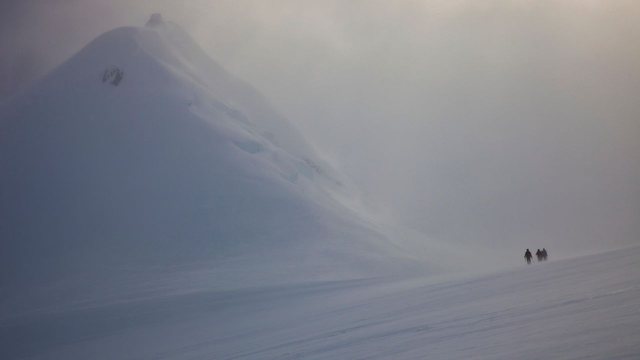
It was a bright summer day in Antarctica. Through frozen eyelashes, Samantha Hansen began to survey the dead landscape that lay before her: a wall of white, the top the same as the bottom. Amid these extreme conditions, with temperatures around -62C, she identified a suitable spot in the snow and pulled a shovel from her bag.
Hansen was in the bleak interior of the continent. Not the relatively mild and picturesque Antarctica of cruise ship tours. But in a wild environment that is rarely frequented even by wildlife. As part of a team from the University of Alabama and Arizona State University, she was searching for hidden mountain ranges, peaks that have never been conquered by any explorer before, and that have never been illuminated by the sun's rays.
These mountains are deep inside the Earth. It was 2015, and researchers were in Antarctica setting up a seismological station. The equipment, half-buried under the snow, would allow researchers to study the interior of our planet. In total, the team installed 15 such devices throughout Antarctica.
And the mountain-like structures they discovered are completely mysterious. But Hansen's team found that these ultra-low velocity zones, or ULVZs, are likely to be almost anywhere in the world. So they could be hiding deep underground, even under your feet.
Earth's interior mountains are positioned between the planet's metallic core and the surrounding rocky mantle. Although the "core-mantle boundary" is thousands of kilometers from Earth's surface, there is a surprising amount of exchange between its impenetrable depths and our world above.
It is thought to be a kind of graveyard for ancient parts of the ocean floor. It could even explain the existence of volcanoes in unexpected places, like Hawaii, by creating super-hot "highways" in the Earth's crust.
The story of mountains deep within the Earth first emerged in 1996, when scientists explored the core-mantle boundary deep beneath the central Pacific Ocean. They did this by studying seismic waves caused by strong ground shaking, which are usually earthquakes, although nuclear bombs can have the same effect.
These waves travel through the Earth and can be picked up by seismic stations elsewhere on its surface, sometimes more than 12,742 km away from where they originated. By examining the paths these waves take – such as the way they are refracted by different materials – scientists can build a picture of our planet’s interior.
When researchers analyzed waves generated by 25 earthquakes, they found that they inexplicably slowed down when they reached a jagged part of the core-mantle boundary. This large mountain range inside our planet was very different from the mountains on the surface.
Some peaks thus extended up to 40 km into the mantle, or 4.5 times higher than Everest. Meanwhile, others were only 3 km high. Since then, similar mountains have been discovered in other places scattered around the core.
Some are particularly large. One of them covers an area of 910 km under the Hawaiian Islands. However, to this day, no one knows how they got there, or what they are made of. One hypothesis is that these mountains are parts of the lower mantle, which have been superheated due to their proximity to the Earth's incandescent core.
While the mantle can reach temperatures of 3,700 degrees Celsius, and is relatively mild, the core can reach atomic fission heights of 5,500 degrees Celsius, not far from the temperature on the surface of the Sun.
It is thought that the hottest parts of the core-mantle boundary can be partially melted, and this is what geologists refer to as ULVZ. Mountains deep in the Earth may be made of a slightly different material than the surrounding mantle. It is thought that they may be the remains of ancient oceanic crust, which was lost to its depths, and then sank over hundreds of millions of years to settle just above the Earth's core.
Geologists have long sought clues to solve a second puzzle. Mountains deep in the Earth tend to be found near other mysterious structures: large low-velocity shear zones (LLSVPs). There are only two of these: an amorphous lump called “Tuzo” under Africa, and another known as “Jason” under the Pacific.
They are thought to be really ancient, perhaps billions of years old. But again, no one knows what they are or how they got there. But their proximity to mountains has led to the theory that they are connected. One way to explain this connection is that it all started with tectonic plates that began sliding down under the Earth's mantle and dipping into the core-mantle boundary.
They then slowly spread out to form a variety of structures, leaving a trail of mountains and blocks. This means that both are made of ancient oceanic crust: a combination of basaltic rocks and sediments from the ocean floor, albeit transformed by immense heat and pressure.
But Hansen says the existence of subsurface mountains beneath Antarctica could contradict this thesis. “Most of our study region, the Southern Hemisphere, is far from those larger structures.” To set up their seismology stations in Antarctica, Hansen and her team flew to suitable locations in helicopters and small planes, placing the devices deep in the snow, some near the coast and others inland.
It took just a few days to get the first results. The instruments detected seismic vibrations almost everywhere on the planet. In some regions, the ULVZ structures are more like thin plateaus than mountains. Could the smaller, mountain-sized remnants of tectonic plates be scattered so far from the larger remnants? Whatever we discover, Antarctica's icy landscape has given us clues about the strange and super-hot mountains deep inside the Earth. / Zaria Gorvett – BBC