Is this police force professional and capable of handling violen...
/ 2026-10-16 18:54:07Focus


Ivana Kottasová - CNN
This week, Russian President Vladimir Putin delivered a clear message to Ukraine and its European allies: Moscow can continue the war because it has powerful friends.
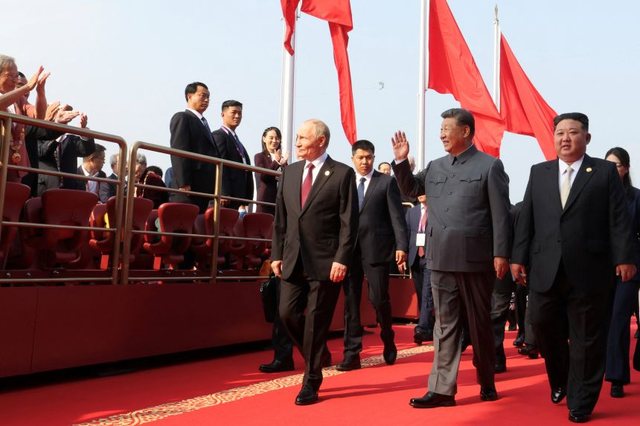
The Russian leader appeared side by side at a series of events in China with the people who have helped him prolong and intensify his war against Ukraine: Chinese President Xi Jinping, Indian Prime Minister Narendra Modi, Iranian President Masoud Pezeshkian and North Korean leader Kim Jong Un.
More than three years after what Putin thought would be a swift invasion of a much smaller, weaker neighbor, Russia would not be able to sustain the war without Chinese and Indian money, Iranian weapons, and, to a lesser extent, North Korean manpower.
But the message from the summit and military parade that China hosted this week went far beyond the war in Ukraine.
The end of Western dominance?
The leaders gathered in China don't agree on everything. Some may not even like each other's company. But all see a golden opportunity to end Western dominance on the world stage. And Europe fears it could be a target.
The events were a stark visual reminder of why Europe needs to rethink its concept of security. The continent has spent years trying to isolate Putin and cripple his economy, while confronting the fact that the United States may no longer be a reliable ally.
Yet Putin appeared there, alongside some of the most powerful men in the world, reaffirming his friendships.
"Russia is trying to show that even though it is isolated from the Western world, it still has partners and allies who are economically strong countries... And this isolation does not mean that the Russian economy will collapse or that Russia will not be able to sustain its war effort," Natia Seskuria, an expert at the Royal United Services Institute (RUSI), told CNN.
The international order established after the end of the Cold War is clearly in danger of disintegration.
The US has retreated from the world stage under the presidency of Donald Trump and his “America First” policy. Meanwhile, Europe is facing its own demons: the rise of far-right nationalism and economic pressures.
Russia, China, India, and other countries that disliked a US-dominated world suddenly saw an opportunity.
"The established dominance of the Western alliance in international relations is fading, and they see this as a chance to rebuild the international system," John Lough, head of the New Eurasian Strategies think tank, told CNN.
This week, those ambitions became apparent to everyone, including Trump. He responded sarcastically: “Please convey my warmest regards to Vladimir Putin and Kim Jong Un as they plot against the United States of America,” Trump wrote in a message to Xi Jinping.
Friendship with conditions
Despite recent handshakes and smiles, China and India's stance on the war in Ukraine remains pragmatic.
The two countries claim neutrality, but at the same time fuel the war by giving Moscow financial oxygen.
When the West imposed sanctions on Russian oil, China and India jumped in. The result: cheaper energy for them and revenue for Russia. But experts say it's not just about the money.
Although neither China nor India is ready for direct confrontation with the West, both are pleased to see Russia pushing an anti-Western agenda.
According to Lough, this approach by Moscow also fits the Indian narrative: “Indians are not unhappy to see Russia protecting the interests of the Global South and demanding that the world governance system adapt to growing economies with large populations.”
Currently, China and India are the largest buyers of Russian oil and coal. Beijing is also the second largest buyer of gas and petroleum products from Moscow.
The reliance doesn't stop at oil. According to the US Treasury, Chinese and Indian companies have supplied Russia with dual-use technologies, components that can be used for both civilian and military purposes, such as chips and telecommunications equipment that Moscow cannot provide due to sanctions.
"You only need to look at the number of Chinese components in the Russian drones that are being dropped on Ukraine to understand that China is a vital supplier," Lough added.
On the other hand, Ukraine and its European allies do not want to completely close the doors to China and India, because they know that only they, in the absence of a tougher stance from Trump, can exert real pressure on Putin to end the war.
Limited alliances
Meanwhile, North Korea and Iran have firmly aligned themselves with Russia. Long isolated and sanctioned, they have little to lose.
Iran was crucial to Moscow in the early months of the war, providing knowledge to mitigate the effects of sanctions and, above all, weapons. The Shahed drone is the weapon that has changed the way Russia fights in Ukraine.
The two countries have signed new partnership agreements and conducted joint military exercises. But Tehran has learned that friendship with Russia has its limits.
Putin did not come to its aid when Iran was attacked by Israel and then by the US this summer. In Syria, too, apart from offering a safe exit to former President Bashar al-Assad, Russia did not intervene when his regime was toppled in December.
For North Korea, the relationship with Russia is largely transactional. Moscow needs human resources, and Pyongyang is perhaps the only one that can send troops without worrying about the public reaction.
Realism and interest
The grand welcome given to Putin in China and the diplomatic force displayed during the summit and military parade had a clear goal: to show the US and its allies that this group of countries is a force to be taken seriously.
"Here we have a symbol of countries that are not necessarily close friends, but that share common strategic interests and manage to align themselves with the West," Lough said.
But how sustainable is this?
The events in China did not happen overnight. Europe may have been caught off guard by the full-scale Russian invasion of Ukraine, but it has changed since then.
"We are already seeing what the Europeans have become. In defence there are extraordinary developments," said Lough.
What seemed unthinkable until yesterday – Germany changing its constitution to increase military spending, or Sweden and Finland, traditionally neutral, joining NATO – is a reality due to the geopolitical upheavals of these years.
According to analysts, Putin's relationship with Xi and Modi is not a friendly alliance, but a convergence of interests. And interests can change.
"We are not at a point where we can say the game is over just because some leaders we don't like gathered in China for a big party," Lough stressed.