


Is this police force professional and capable of handling violen...
/ 2026-10-16 18:54:07Focus


The largest empires in history have covered one-fifth of the world, ruled hundreds of millions of people, and lasted anywhere from 100 years to a millennium.
"Emperor", the term which comes from the Latin word "imperare" which means "to command," is a collection of united countries or ethnic groups, led by a single ruler or oligarchy.
But what have been the world's largest, most powerful, most enduring, and most unusual empires. Read them below:
1. Roman Empire
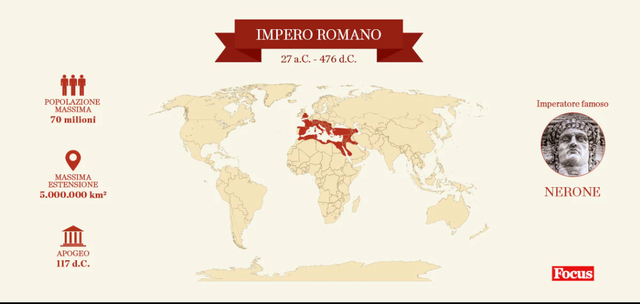
The imperial city of Rome was the largest urban center of its time, with a population of about one million people. Life in Ancient Rome revolved around the city of Rome, perched on seven mountains. The city had a large number of monumental structures such as the Colosseum, the Forum of Trajan and the Pantheon. The Roman Empire was the empire that arose and was ruled by the city of Rome. The two dates that mark the beginning and end of the Roman Empire are 27, the beginning of the year of Octavian's principality, with the title "Augustus", and 395 AD, when with the death of Theodosius the empire was finally divided in the middle, in the western part the eastern one. From the time of Augustus until the fall of the Western Empire, Rome dominated Western Eurasia and North Africa, and made up the majority of the region's population.
2. Mongol Empire

The Mongol Empire was an empire from the 13th and 14th centuries that spanned all of Eastern Europe as far as Asia. This is the largest empire in the history of the world. It emerged from the unification of the Mongols and Turkish tribes in Mongolia, and grew with the invasions, after Genghis Khan, was proclaimed ruler of all the Mongols in 1206. In most of its area it stretched from the Danube to the Sea of Japan and from the Arctic to Cambodia, covering over 33,000,000 square kilometers, 22 percent of the earth's surface, and managed to have a population of over 100 millions of people.
3. Russian Empire

The Russian Empire was a state that existed from 1721 until the time of the Russian Revolution of 1917. This empire was the descendant of Russian tsarism and the ancestor of the Soviet Union. It was the second largest empire in the world, surpassed only by the Mongol Empire, and the third largest in the world after that of the Mongols and the British Empire. At one point in 1866 the Russian Empire stretched from Eastern Europe along Asia to North America. It was ruled by the emperor and was one of the absolute monarchies left in Europe and in the time before World War I, Russia was one of the five great powers in Europe.

4. Holy Roman Empire
In the Middle Ages it was considered the "superpower" of the time. At its peak the Holy Roman Empire consisted of eastern France, all of Germany, northern Italy, and parts of western Poland. Despite its small geographical size compared to other empires, its influence in the history of Europe is still felt today. This empire lasted from the Middle Ages until the 19th century. The empire was formally dissolved on August 6, 1806, when the last emperor, Franciss II abdicated after a military defeat by France under Napoleon. After the dissolution, Switzerland, the Netherlands, the Austrian Empire, etc. were created.
5. British Empire
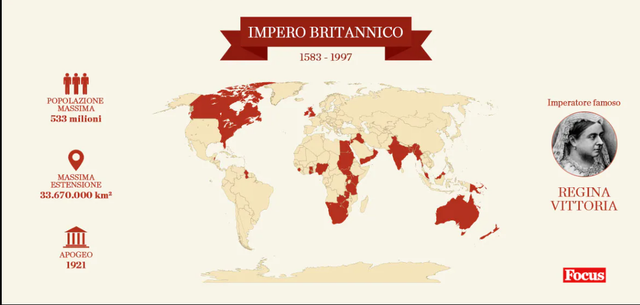
The British Empire was the largest empire in history and for over a century the largest world power. It covered more than 13,000,000 square feet [13,000,000 sq m], which is about a quarter of the dry land, and controlled more than 500 million people, which was again a quarter of the world's population. As a result, it has left cultural, political and lifestyle traces in the occupied countries. English is the second most spoken language in the world and many linguists agree on the fact that English is de facto the standard language of the world. The British Empire expanded its governing borders to over 13 million square kilometers, which included several continents. It dominated 23 percent of the world at the height of its heyday in 1922. Hence the expression:
6. Han Dynasty
During the period of the warring states, all of China became embroiled in a civil war as various kingdoms fought for supremacy. Eventually the state won Qin and swallowed up all of China with 40 million inhabitants under control. The Qin Dynasty did not last long and very quickly passed to Han who controlled China for about 400 years. The Han Dynasty period is considered a golden age for Chinese history in terms of scientific achievement, technological advancement, economic, cultural and political stability. Even to this day the Chinese refer to themselves as the Han people and this group is considered to be the largest ethnic group in the world.

7. Byzantine Empire
Byzantium is a term used to describe the medieval Roman Empire based in Constantinople today Istanbul. Byzantium is actually the eastern Roman Empire. The Byzantine state played an important role in the progress of international history. Byzantium as a superpower on the one hand offered its support to the Europeans of that time from barbaric attacks, and on the other hand, kept and transmitted to the rest of Europe the artistic treasures of antiquity. The empire received a deadly blow in 1204 from the Fourth Crusade, when it disintegrated and split between Greek Byzantine and Latin kingdoms.
8. Persian Empire

Before they were Romans, they were Persians. They unified all of Central Asia, which consisted of different cultures, kingdoms, empires, and tribes. It was one of the largest empires in ancient history. At the height of its power, the empire covered approximately 8 million square kilometers. The empire was created by Cyrus the Great and spanned three continents, including the territories of Iran, Afghanistan, and Pakistan, parts of Central Asia, Asia Minor, Thrace, many Black Sea coastal regions, Iraq, and northern Saudi Arabia. , Jordan, Palestine, Israel, Lebanon, Syria, and all important centers.
9. Caliphate Umajad

The Umayyad Caliphate was the second of four Islamic caliphates established after the death of Muhammad. He was ruled by the Umayyad dynasty, whose name comes from Umayya in Abd Shams, the great-grandfather of the first Umayyad caliphate. Although the Uamayad family originated from the city of Mecca, Damascus was the capital of their Caliphate. The Umayyad Caliphate grew to 5,790,000 square kilometers at its peak in the 7th century.
10. Ottoman Empire

At the height of its power (16th-17th centuries) the Ottoman Empire expanded to three continents, controlling Southeastern Europe, western Asia, and northern Africa. There were 29 provinces and many vassal states, which were later assimilated into the empire, while others gained different types of autonomy. The 16th and 17th centuries were the heyday of this empire, while in the 18th and 19th centuries frequent wars with Russia and Austria-Hungary marked the decline. Involvement in World War I, alongside the central powers, Austria-Hungary and the German Empire, brought the Ottomans complete destruction of their empire.


