


Is this police force professional and capable of handling violen...
/ 2026-10-16 18:54:07Focus


In the modernized and mechanized era of war, where decisions are made by civilians, officers far from the battle front, congressional committees, and unknown military strategists, the military is something without a leading face and responsibilities and are shared among many figures.
Once upon a time responsibilities and consequences were not so separate. Brilliant strategy, technique and logistical minds had total control of the great armies and those armies became victorious or defeated because of the capabilities of a single man. The military commanders on the list have been field commanders, with unquestionable autonomy in their battles, and not generals standing in their chairs away from the war.
In this ExpertExtra expert article we will explore military geniuses, a list of famous military figures. World leaders who come only once in a lifetime, and who leave their mark on the history of human civilization.
1- Alexander the Great

Alexander the Great stands above Napoleon Bonaparte in terms of his conquests in a faster period of time. Crowned king at the age of 20, after his father, Philip, was killed, Alexander decided to conquer all known world. Alexander granted his father's wish to conquer Persia in a few years, overthrowing King Dar. Dissatisfied with so little territory, Alexander marched on more invasions in areas of present-day Afghanistan and Central Asia.
In an attempt to plunder the world by ocean, Alexander attempted to conquer India but was persuaded by his soldiers to return to Babylon when he died and at the age of 32, having conquered part of of the great world, had given its name to 20 cities as well as spread Hellenic civilization.
2- Napoleon Bonaparte

Napoleon is considered the most capable general to date. He has led brilliant military campaigns, used force focused on battlefield attacks, developed independent and complete army troops (a system still in use today), installed puppet leaders, recruited troops from every nation that defeated, revolutionizing the way of fighting.
In the first decade of the 19th century he led the armies of France against every major European power and managed to dominate continental Europe, through a series of long historical victories, in battles such as that of Austerlitz and Friedland.
3- Hannibal Barka
The most formidable adversary Rome has encountered, grew up with the task of defeating the Romans by his father, Hasdrubal. Hannibal set aside the Carthaginian tactics of passive naval superiority and marched with elephants into the Italian Alps. Hannibal conquered the mighty Roman Empire through the Alps.
He defeated the Romans in a series of battles at Trebe and Trasemina. He never lost personally in a battle with the Romans and kept his army in Italy for more than a decade after the Second Carthaginian War.
He is considered one of the greatest military strategists who have ever existed. His Roman enemies even adopted some of his tactics for their use.
4- Sun Tzu
When looking for a book on military tactics that still teaches and inspires leaders after 2,500 years, do the right thing if you read Sun Tzu's Art of War. Sun Tzu's name is now famous thanks to that book. Sun Tzu's brilliant work deals with war philosophically, addressing them in detail.
The book talks about the strategy of patience as one of the basic elements for winning a war. The book is very popular today not only for the military but also for diplomats, football coaches or CEOs of various companies. What makes him an interesting military figure is that he always chose a less bloody approach. Sun Tzu preferred to win wars without starting them yet. Genius.
5- Georgy Zhukov
This military figure is known for Europe's victory during World War II.
Although the Soviet attempts to suppress the Nazi occupation were something collective like all wars in general, Zhukov is seen as the person who destroyed the Nazi war machine. At the time, Hitler had broken his pact with Stalin on June 22, 1941, and Zhukov was already a high-ranking officer. Charged by Stalin to defend Moscow and drive out the Germans.
The Red Army under Zhukov's command stopped the advance of the German Nazis and defeated them. Zhukov went on to win several major battles against the Germans. Zhukov's army marched west until it reached the capital of Nazi Germany, Berlin, in the spring of 1945.
6- Ervin Rommel
Ervin Rommel is considered the father of modern tank warfare. Born into a German aristocratic family, Rommel saw his first battle during World War I during German campaigns in Romania and northern Italy.
Over time he rose in rank and became a military instructor in tank warfare in Berlin. When World War II broke out, Rommel was again asked to serve serving the Reich and further elevating his prestige as a skilful military man. During the German occupation of France and the Netherlands, Rommel's military division was nicknamed the "Ghost Division" because of the way his military unit infiltrated enemy territory.
His life was tragically interrupted when some evidence was revealed that he had taken part in several plots to assassinate Adolf Hitler.
7- Saladini
Saladin was the most prominent military leader in the time of the Crusades, thwarting the invading crusading states and European invasions, with the same composure.
Known for his calmness and nationality, lack of fanaticism and respect for opponents, he managed to conquer Syria, Egypt and most of modern Israel, quite steadily and without much difficulty.
He was widely respected by almost all his rivals and had a friendship in correspondence with Ricard Zemërluani, sending him gifts, horses and even his personal doctor.
7- Jul Cezari

Caesar's military campaign against the Gauls continues to be in the books of many military academies around the world.
Julius Caesar took absolute control of the Roman Republic and its armies and led for the first time the Roman conquest of Britain. Caesar's military expeditions in every terrain and in all climatic conditions owe much to the strict discipline of his legionnaires, whose admiration and devotion to him was a typical example of his tactical brilliance.
He also maneuvered his troops with legendary speed, as well as using the number system he used to communicate with his generals.
8- Atila
His name had become synonymous with fear and violence. During his leadership, he was one of the most formidable enemies of the eastern and western empires.
He conquered the Balkans twice and marched through France, all the way to Orleans before being defeated at the Battle of Chalon. He did not attack either Constantinople or Rome. In much of Western Europe it is the epitome of cruelty and gluttony. In contrast, some historians describe him as a great and noble king.
Attila extended the borders of the Hun empire from the borders of modern-day France to the steppes of Russia, gathering the massive strength of all the first tribes and nations historically as savage provincials.
9- Genghis Khan
Genghis Khan is a historical figure who makes the aforementioned Attila seem lenient in terms of the brutality and absolute terror he caused.
Known as the founder of the Mongol Empire, Genghis Khan created perhaps the largest territory that an Emperor had created in all of history. The Mongol conquests were accompanied by the slaughter of civilians if their governments resisted.
Despite the reputation that Genghis Khan and the Mongol army received, he was also important in enforcing religious tolerance within the Empire and developed the system of meritocracy. Even after the death of Genghis Khan, the Mongol empire expanded further.
10-Skënderbeu
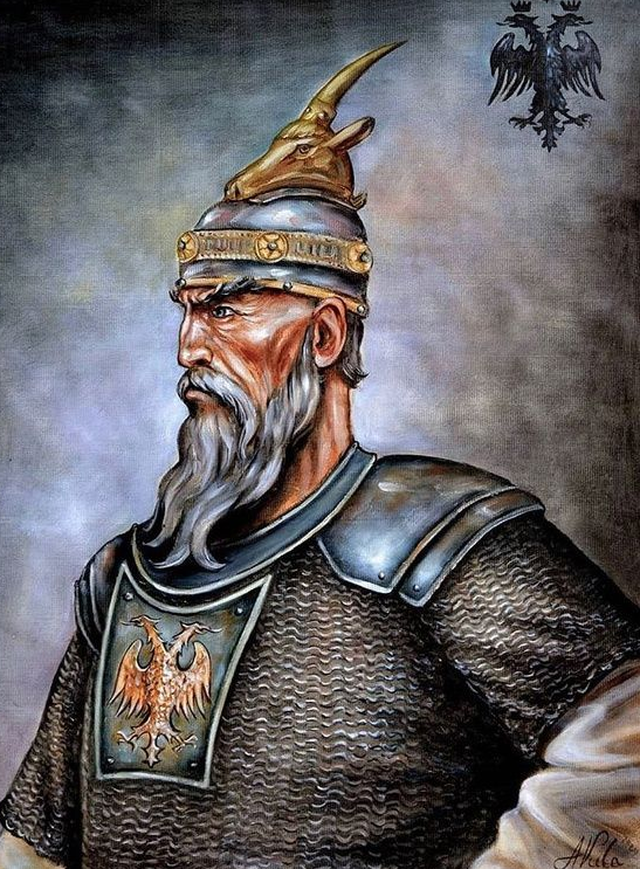
Not including the military commander known as Skanderbeg in the list would not be fair. The reason he becomes part of this list is the fact that no matter how many enemies he had, he managed to dominate and became the Ottoman Empire's obstacle to conquering Europe.
Born Gjergj Kastrioti in the small kingdom of Albania, Skanderbeg was taken prisoner by the Ottoman sultan.
Growing up in the ranks of the Ottoman army he also grew to become one of the greatest generals earning the title "Skanderbeg", meaning Lord Alexander, which equated him with the heroism of Alexander the Great.
But this did not stop him from returning to his country, which angered the Ottoman Empire, which for 25 years sent large armies to invade Albania, but without success. With his armies reaching no more than 20,000 men, Skanderbeg managed to withstand ten times as many armies of enemy troops. For the protection of Western Europe from the Ottoman hordes, the Pope gave the title of "Champion of Christ" to Skanderbeg.
11- George Washington
Washington was the most important and perhaps the most successful leader of the American revolutionary forces seeking independence from the British Empire.
Although assisted by many subordinates (including Benedict Arnold, whose military acumen was obscured by his famous betrayal), Washington turned out to be the Continental Army's unifying force, leading it to victories in Trenton and Yorktown. as well as keeping forces divided into parts together, in the harsh winter in the Forge Valley.
His election president, twice, without serious opposition seemed to be the least the Americans could do for their military leader.
12- George S. Paton
The most contradictory figure of Allied forces in World War II, Paton might have thought he was the reincarnation of ancient warriors, carrying their courage and experience in his battles.
In World War II he used German lightning strikes against them, simultaneously using the maneuvers of the American armed forces to oust the German fronts and thus gaining large areas of ground in short periods of time.
The infamous incidents, including the execution of massacres by troops under his command led to the decline of Paton's image, but he remains the leader of Allied forces' victory in Europe.


