Is this police force professional and capable of handling violen...
/ 2026-10-16 18:54:07Focus


Clea Caulcutt, Nicholas Vinocur, Giorgio Leali and Tim Ross - POLITICO
The French president's domestic problems have dimmed his ambitions and weakened his influence within the European Union.
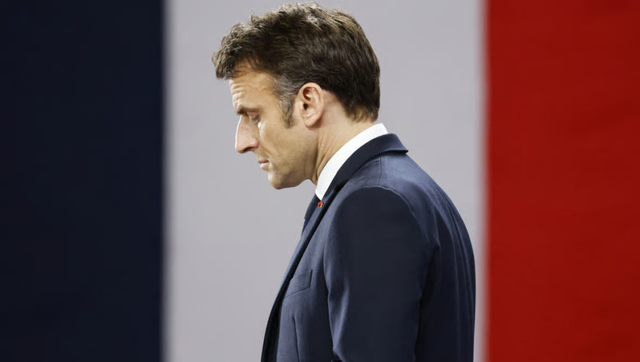
France's Emmanuel Macron will head to Brussels on Thursday for a key European Council meeting, his reputation as a man of ideas for the continent long gone and replaced by a new one: the party boss.
As European Union leaders gather to plan moves in the face of existential crises ranging from confronting the rise of the far right to preventing a bad Trump-Putin deal on Ukraine, they can no longer rely on Macron's grandiose ideas.
Politico's conversations with 10 diplomats and officials from across the European Union, all of whom were granted anonymity to openly discuss the French president's political fate, suggest that the 47-year-old centrist's internal problems and focus on his future have made him an obstacle to progress rather than an engine of it.
The "drone wall" proposed by Commission President Ursula von der Leyen to protect European skies from Russia's increasingly invasive unmanned aerial vehicles?
Unrealistic, according to Macron.
European Council President António Costa's idea to improve the EU accession process by eliminating the need for unanimity?
No. France is not giving up its veto power.
Make our planet great again?
Maybe another day. Now is not the time for the due diligence directive that requires companies to monitor their global suppliers for human rights and environmental abuses. Or for 2040 climate targets, for that matter.
In recent months, Macron has become more cautious, hesitant about proposals that risk generating a backlash in France, and more hawkish about proposals that he does not control himself. Instead, France has poured its energy into cutting red tape.
In recent weeks, the French leader has called for more controls on migration and cuts to red tape, while lobbying for new rules to keep children off social media and aiming to make it easier for carmakers to meet green policy targets. Hardly something to say about European dreams.
“This Macron is consumed by domestic problems,” said one EU diplomat. “He is no longer the European champion we once knew.”
Not the same person anymore
When it comes to the changes the European Union has seen in the past decade, it is hard to underestimate Macron's influence and vision. Speaking at the Sorbonne University in 2017, he argued forcefully for a more muscular Europe that was less dependent on overseas partners, whether for manufactured goods or for its defense.
His call fell on deaf ears at the time. Yet today, the European Commission and leaders across the bloc preach Macron’s gospel of “strategic autonomy” as they seek to diversify away from China and strengthen the continent’s military capabilities in the face of Russian aggression and American military shrinkage.
Macron earned the nickname “the EU’s chief informant,” and his flurry of initiatives and ideas for reforming Europe defined his early standing as a leader on the world stage.
However, if we fast forward to October 2025, it has become clear that politics and legacy figure heavily in Macron's calculations.
Just look at the issue of expansion.
Macron has long been seen as a supporter of bringing new members into the European Union to increase the bloc’s economic and geopolitical weight. He led the European Political Community as a kind of “waiting room” for members aspiring to become EU members in 2022, and a year later pledged to bring aspiring candidate countries into the bloc as “soon as possible.”
It is no wonder, then, that Macron’s allies found it hard to understand France’s decision to oppose Costa’s proposal to remove Hungary’s Viktor Orbán’s veto on parts of the accession process. A senior figure in Macron’s “Renewal” group in the European Parliament said the move was “completely contrary” to Macron’s previous commitments.
"It's a fundamental mistake," he said.
According to a senior Macron ally, the French president simply does not have the political capital to back some of his ambitions, particularly those that feed eurosceptics and Marine Le Pen's far-right National Rally.
"It's not the right moment, we have the far right blowing down our necks," said the ally.
“Any talk about Albania and Montenegro joining the European Union is a gift to… Le Pen,” he said, noting that French farmers would be the first to take to the streets to protest against the entry of agricultural giant Ukraine into the EU.
Declining impact
The influence in Brussels has been a casualty of France's chaos at home. Macron has changed five prime ministers in less than two years and was almost forced to seek a sixth after his current choice, Sébastien Lecornu, resigned after his first government lasted just 14 hours. The French president reappointed Lecornu and the crisis eased, at least temporarily.
While successive French governments have shared similar views on EU matters, their successive decline has left France increasingly less influential in Brussels.
“If you have a dysfunctional government for a year and a half, that gives you a little less influence on decisions,” said an EU diplomat from outside France.
This change makes the situation in the chamber more difficult when ministers meet, the diplomat added.
It also makes it difficult for the French government to draft and circulate the ever-important policy documents ahead of ministerial meetings that drive the agenda and represent national priorities.
As Macron approaches the twilight of his presidency, he may sketch some grand plans for Europe, but his ability to turn dreams into reality has largely been eclipsed.
Even if the French president manages to pull off another “great escape” and find a way through the political deadlock with a government that lasts and a budget that is approved, the devastating truth for those working in Brussels’ institutions and embassies is that Macron’s influence has been seriously weakened. And that his grand pro-European project is over.
Diplomats from outside France are already speaking of Macron in the past tense and talking about his "legacy," even though he is not expected to leave office until 2027.
"He was something special," one of them told Politico.