"The fate of the homeland is in our hands" - An appeal by Ismail...
/ 2026-10-18 16:09:54Focus



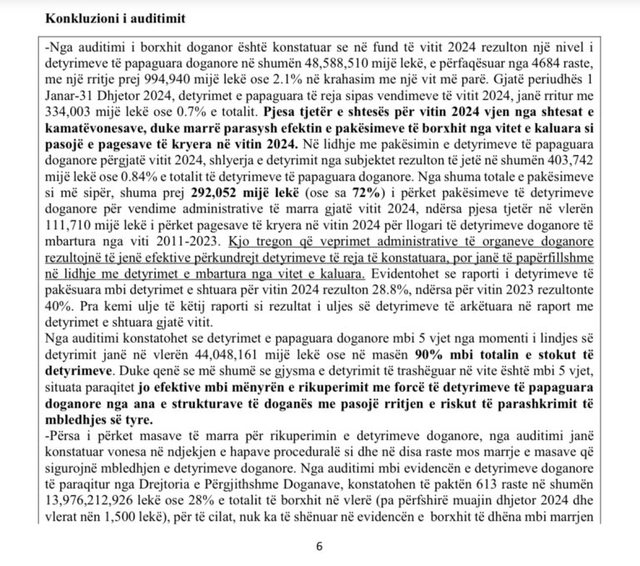
The country's customs debt continues to expand year after year, while the latest audit conducted by the Supreme Audit Office on unpaid duties has highlighted a serious picture not only in terms of the value of the stock, but also the way it is administered, recovered and monitored by customs structures. The data shows that at the end of 2024, unpaid customs duties reached around 48.6 billion lek, distributed in 4,684 cases, registering an increase of 2.1% compared to 2023.
But the most alarming figure is related to the age of this debt, as 90% of the total stock, or 44 billion lek, consists of obligations older than five years, a direct indicator of the malfunctioning of forced recovery mechanisms and the real risk of prescription, given that the "Fiscal Peace" has now been announced.
During 2024, new liabilities recorded increased by 334 million lek, while the amount reduced through payments resulted in only 403.7 million lek, or 0.84% of the total stock. The vast majority of the reductions are related to administrative decisions in 2024, while the repayments of old liabilities for the period 2011–2023 are negligible.
The ratio of reduced obligations to increased obligations has dropped significantly: from 40% in 2023, to 28.8% in 2024. This indicator reinforces the belief that the customs administration is managing to recover mainly new obligations, while inherited debt is turning into an unmanageable stock.
The SAI notes that there is a systematic lack of Forced Recovery Decisions. The audit reveals that 613 cases, worth 13.97 billion lek, do not have a documented Decision on the Forced Recovery of Customs Debt (VRFB), although the legal deadlines had passed. In the absence of a decision, the further execution procedure has not started at all.
Customs also did not request an execution order from the court. Despite the fact that for many cases the VRFB existed, in 840 files, worth 2.47 billion lek, the court did not request the issuance of an execution order, even though the law clearly provides for it as a necessary step. This is one of the most serious deviations found, as such delays lead to loss of time, increased interest on late payments and an increased risk of prescription.
The SAI found that court orders are not executed by customs branches. Even when courts had issued execution orders, customs branches did not send them for execution. The audit found 105 cases, worth 404.3 million lek, where the files were left in a drawer without being processed further.
A total lack of alternative enforcement measures is noted. Beyond enforcement, the instruction also provides for enforcement mechanisms that can be undertaken by the customs administration itself: blocking of NIPT, bank accounts, sequestration of assets. But in 765 cases, worth 14.28 billion lek, no measure was taken by the customs authority, even though the files were sent for enforcement. This shows that the customs administration has chosen to rely almost entirely on enforcement, ignoring the legal instruments of direct enforcement.
According to the Albanian Supreme Audit Office, Customs Branches often do not have updated information on files sent for enforcement, being unable to report their status. Documentation of communication with enforcement agents is incomplete or non-existent.
In the files checked, the audit did not find any case of cooperation between customs branches and central DPD structures for asset seizure, as provided for in instruction no. 15. This indicates a permanent gap between operational and central structures.
The customs administration appears to have overestimated enforcement as an enforcement instrument, neglecting its legal powers for direct enforcement under Article 280 of the Customs Code – a violation that the audit considers essential.
In the Fier, Lezha and Tirana branches, cases have been identified where interest on arrears was not calculated from the date of the obligation, but from the date of notification of the decision – contrary to instruction no. 15. This deviation leads to incorrect calculations and economic damage to the budget.
The SAI has also given a series of recommendations such as: Conducting an in-depth analysis of stock growth and determining responsibilities; Immediate issuance of VRFB for cases with set deadlines; Sending requests for execution orders to the court without delay; Immediate execution of court orders and transition to enforcement; Application of internal enforcement measures: blocking of accounts, NIPT, seizure of assets; Stronger monitoring by the DPD over customs branches, etc./ ekofin.al