Is this police force professional and capable of handling violen...
/ 2026-10-16 18:54:07Focus


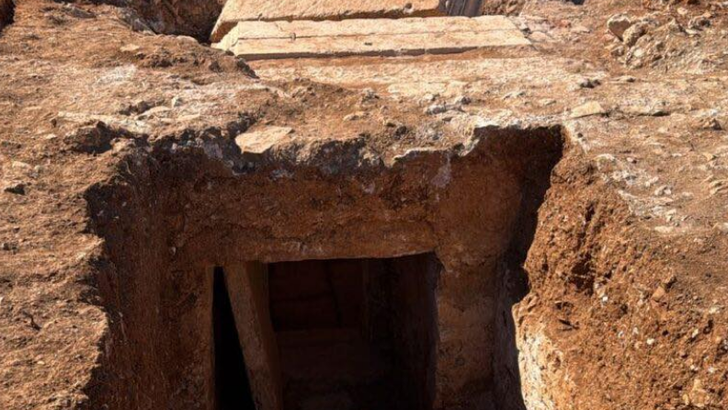
A monumental tomb from the Roman period recently unearthed in Bulqiza is considered an interesting discovery for several reasons.
It is the first tomb of this type in our country, and it belongs to an important figure of the time.
But archaeologists managed to recover very little material, some broken glassware, a piece of fabric from the deceased's clothing, and some knife tips.
Unfortunately, this tomb, which is thought to have been filled with other ancient objects, has been robbed not only in antiquity, as the archaeologist stated, but also recently.
In fact, archaeologists were alerted after residents reported that a heavy excavator had thrown a rope over one of the large tombstones and pulled it in. Whether this has happened recently is unclear, but as in many other cases, underground treasure hunters seem to be one step ahead of the authorities.
Researcher Artan Shkreli also raises such a concern. He says he would prefer Albania to have a controversial archaeologist like Bulgarian Georgi Kitov, who was criticized for his uncritical excavations, but did so to hasten the discovery of Thracian treasures before they fell into the hands of looters.
Here is his reaction:
AFTER . WHAT . DISCOVERY . OFFICIAL
…
in archaeology, the question arises whether the site is untouched or previously looted…
This was also raised in the discovery of Strikcani, Bulqize: if the grave was violated, was it robbed? And by whom, and when?
Meanwhile, we know from practice that as soon as archaeologists discover something, treasure hunters are immediately potential targets for criminal excavations (it happened before with the tomb of Jorgucat in Gjirokastra).
Thus, in conditions of weak control of the territory, the archaeologists' dilemma - whether to dig leisurely (season after season) or to speed up excavations beyond standards and protocols - is great.
What we currently know - in the case of the Strikcan funerary monument - is that the "discovery", as important as it appears, was made only after the tomb had been previously raided by clandestine diggers; who, it turns out, used heavy equipment to move the massive stone slabs to get inside. No one knows today what inventory of artifacts from Illyrian-Roman antiquity was looted from that magnificent tomb...
Admittedly, the phenomenon is not only Albanian, although the dimensions of antiquities looting in our country have never been statistically measured, but the fact that we almost never have spectacular finds leads to the idea that archaeological sites are illegally "cleaned" before the archaeologist's pickaxe falls on them.
Elsewhere - out of desperation, of course - figures like Georgi Kitov have also emerged, one of the most controversial figures in Bulgarian archaeology today, who was called half hero, half criminal by the magazine "National Geographic". The reason for this was his method of rapidly excavating ancient Thracian mounds using machinery. The truth is that for decades, while trying to enter the tombs of the Thracian kings, still unlooted, Kitov (in the service of the state) has been competing with the mafia of treasure hunters, who have the most modern equipment at their disposal. And he has often succeeded, making sensational discoveries. However, in 2001, the Bulgarian authorities revoked his excavation permit for a year on suspicion that he had excavated without the relevant protocols...
(Kitov - a hero to me - died of a heart attack while excavating a temple in central Bulgaria, a temple considered one of his greatest discoveries).
To return to us, it seems that what will remain in Bulqiza will be a magnificent, but empty, funerary monument; spectacular in image, but without words, without a personalized story to tell.
Perhaps an Albanian Kitov, not very orthodox, but well-financed, who would have used the same heavy tools (which it turns out the "tombaiols" of Strikcani used), with the corresponding side effects, could have laid the foundations, through a priceless inventory, for a unique museum.