Is this police force professional and capable of handling violen...
/ 2026-10-16 18:54:07Focus


Top Channel has published the audio during the special meeting of judges, which was hidden from the official minutes of the Supreme Court.
Anisa Kulo (chancellor): "Regarding a ballot, where one of the causes of invalidity of the vote is any mark other than the voting mark, it will be considered invalid. The Commission considers this ballot invalid, and for the sake of transparency, a mark other than the voting mark has been made on number 2."

Judges: "Valid, it's on number 2 signs."
Anisa Kulo (chancellor): " Yes, since it is one of the causes besides the signs, no other kind of note."
Sokol Sadushi: "Please, the committee has the paper in hand, none of the members have the right to be consulted. Let the committee decide. Then the opinion... your decision?"
Anisa Kulo (Chancellor): "Our decision is to consider this ballot invalid!"
The selection of the new member of the Constitutional Court has turned from a legal process into an issue that challenges the credibility of the judicial system with serious violations.
The manipulation of the minutes by the Supreme Court during the voting process on September 30 and the declaration of an invalid vote influenced the change in the outcome of the race.
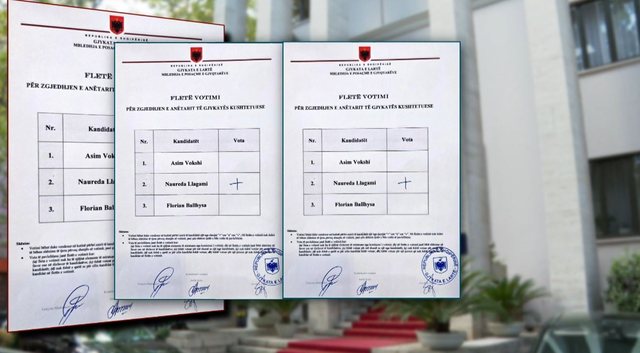
According to official documents, judge Asim Vokshi was declared the winner with 6 votes, although candidate Naureda Llagami received 3 more votes than him.
The decisive factor was the invalidity of a ballot, which prevented Llagam from achieving the 3/5 majority of votes necessary for the nomination.
Tch published the audio and minutes of the meeting, in which there are discrepancies. Although the high court claims that all the documents we have are official, it does not at any point admit the discrepancy between the facts.
In the recording, Chancellor Anisa Kulo is heard declaring the ballot invalid, while several judges object, calling the vote valid. Supreme Court President Sokol Sadushi is heard intervening, stopping the debate and leaving the decision-making to the secretariat's technical commission.
But in the transcript of the meeting, opposing statements are missing, and the intervention of the chairman who stopped the discussion is not reflected, while the voices are clearly heard in the audio.
The gap between the recorded audio and the official transcript raises questions about the integrity of the process and has raised doubts about the transparency of the meeting documentation.
The matter is now in the hands of the Constitutional Court, which is expected to decide whether or not to accept the invalidity of the vote.
Naureda Llagami's lawsuit requests recognition of the result in her favor, as she describes the procedure followed by the technical commission as illegal and beyond its competence, emphasizing that only the Special Meeting of Judges has the right to decide on the invalidity of a vote.
This is a precedent-setting case, because it will determine whether technical administration in a court has the power to influence the outcome of an important constitutional process.
Now the floor belongs to the Constitutional Court, not simply to decide on a lawsuit, not just to fill the vacancy, but to stop violations and to decide: Can a commission with secretaries be imposed on judges?
The Constitutional Court, which is above all in the hierarchy of justice, has the power to restore the trust in justice that has been violated by a dubious process that has called into question the integrity of the secret ballot in the Supreme Court./ tch