"The fate of the homeland is in our hands" - An appeal by Ismail...
/ 2026-10-18 16:09:54Focus


The Vera Rubin Observatory will launch its flagship project, the Legacy Survey of Space and Time (LSST), this year. It will take highly accurate scans of the night sky every day for a decade.
According to the observatory's official website, the telescope and camera "will take detailed images of the southern hemisphere sky for 10 years, covering the entire sky every few nights and creating a super-wide, ultra-high-resolution time-lapse movie record - the largest astronomical movie of all time."
Images with unprecedented clarity
The world's largest camera has recently released the first images of the star-forming regions of galaxies. The Vera Rubin Observatory can detect even the smallest changes in the sky, making it an ideal tool for detecting asteroids. The Vera Rubin Observatory in Chile has released the first images of scenes within our Milky Way (the Milky Way) as well as distant galaxies, showing distant objects with unprecedented clarity.
The US-funded observatory, located on the summit of Cerro Pachón in central Chile, where the night sky is particularly clear and pollution-free, is equipped with the world's largest digital camera and an 8.4-meter-diameter telescope.
Among the first images released was a composite image of the Trifid Nebula and the Lagoon Nebula, taken over a period of seven hours. Both of these star-forming nebulae are located within our galaxy but are several thousand light-years away, and the image reveals details never before seen.
Another image showed the Virgo Cluster, which contains up to 2,000 galaxies. The observatory, which has been under construction for 20 years, will launch its flagship project — the Legacy Survey of Space and Time (LSST) — later this year. The project will take highly accurate scans of the night sky every day for a decade.
The world's largest digital camera located at the Vera Rubin Observatory in Chile has captured a high-resolution celestial image of the Milky Way. The world's largest digital camera located at the Vera Rubin Observatory in Chile has captured a high-resolution celestial image of the Milky Way.
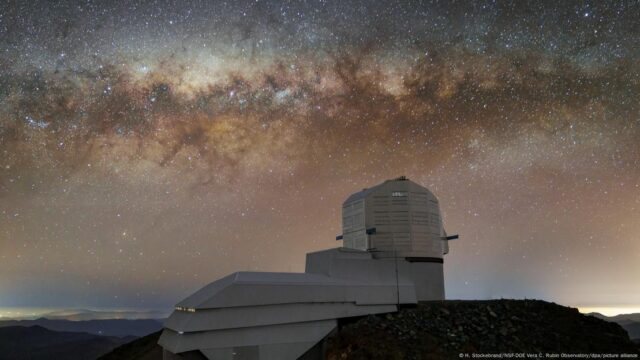
Among other things, the observatory is being praised for its ability to track asteroids and detect interstellar objects passing through our solar system.
The observatory is a joint initiative of the U.S. National Science Foundation and the Department of Energy, and is named after pioneering American astronomer Vera C. Rubin (1928–2016).
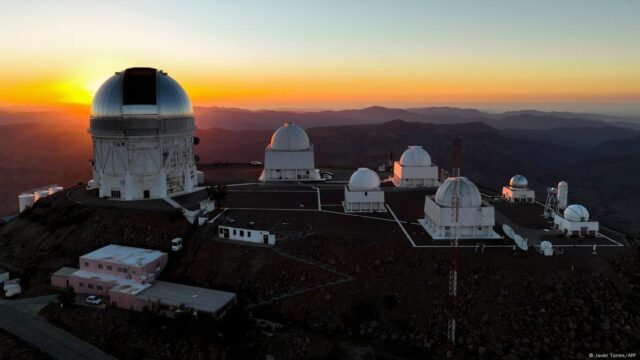
Rubin's research on the rotation speed of galaxies provided the first convincing evidence for the existence of so-called dark matter, which is thought to be a factor holding galaxies together, despite their rapid rotational motion, which would otherwise tear them apart.