


How Belinda Balluku is fabricating the rumor about Top Channel's...
/ 2026-10-19 16:19:00Focus


Pablo Picasso, one of the greatest and most influential artists of the 20th century, was born on October 25, 1881 in Malaga, Spain, and died on April 8, 1973, at the age of 91, in France.
Picasso's father was a drawing professor and encouraged his son towards a career in academic art.
Picasso held his first exhibition at the age of 13 and later dropped out of art school – in order to experiment full-time with modern art styles.
He went to Paris for the first time in 1900 – and in 1901 he had an exhibition opened in a gallery on Paris' Rue Lafitte, a street known for its prestigious art galleries.
The 19-year-old Spaniard was relatively unknown outside of Barcelona at the time, but he had already created hundreds of paintings.
Receiving many positive reviews, he remained in Paris for the rest of the year and later returned to the city to live permanently. Picasso's work, which includes more than 50,000 paintings, drawings, engravings, sculptures, and ceramics produced over 80 years, is described in a series of overlapping periods.
His first notable period – the “Blue Period” – began shortly after his first exhibition in Paris. In works such as “The Old Guitarist” (1903), Picasso painted in blue tones to evoke the melancholic world of the poor.
The "Blue Period" was followed by the "Pink Period", in which he often depicted circus scenes.
In 1907, Picasso painted the groundbreaking work "Les Demoiselles d'Avignon," which, with its fragmented and distorted representation of the human form, broke away from previous European art.
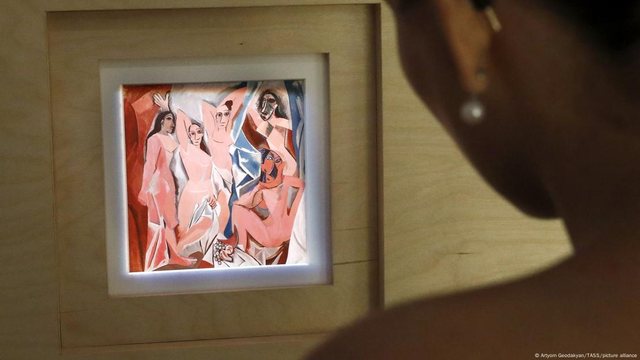
"Les Demoiselles d'Avignon" demonstrated the influence on Picasso of both African mask art and the French post-impressionist painter Paul Cezanne, and is seen as a precursor to the Cubist movement, founded by Picasso and French painter Georges Braque in 1909.
In Cubism, which is divided into two phases, analytical and synthetic, Picasso and Braque established the modern principle – that a work of art did not need to represent reality – to have artistic value.
Picasso's major Cubist works included his costumes and set design for Sergey Diaghilev's Ballets Russes (1917) and The Three Musicians (1921).
Picasso and Braque's Cubist experiments also resulted in the invention of several new artistic techniques, including collage.
Following Cubism, Picasso explored classical and Mediterranean themes, and images of violence and anxiety increasingly appeared in his work.
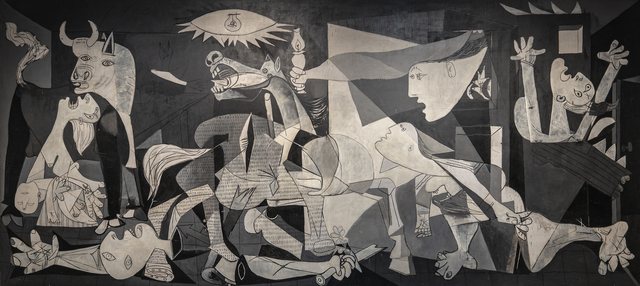
In 1937, this trend culminated in the masterpiece “Guernica,” a monumental work that evoked the horror and suffering experienced in Guernica – when it was destroyed by German warplanes during the Spanish Civil War.
Picasso remained in Paris during the Nazi occupation, but ardently opposed fascism and after the war joined the French Communist Party.
Picasso's work after World War II is less studied than his earlier works, but he continued to work and enjoyed commercial and critical success. He created fantastical works, experimented with ceramics, and painted variations on the works of other masters in art history.
Known for his intense gaze and dominant personality, he had a series of intense love affairs during his life. He continued to create art until his death in 1973 at the age of 91.
Immediately after Picasso's death, legal disputes broke out between his heirs. His family relationships are complicated: Picasso was officially married twice, but he also had children with other women. The children born from his relationship with Francoise Gilot, photographer Claude Picasso and designer Paloma Picasso, as well as the nephew who is the son of Picasso's legitimate son, Paulo Picasso (1921-1975), quarreled a lot over their shares in the large inheritance.
In 1976, the material wealth left behind by the artist and millionaire Pablo Picasso was estimated at 3.75 billion francs (about 669 million euros). This included houses, land, studios, real estate and Picasso's private collection of valuable paintings by painters he was friends with or admired, such as Matisse, Miro, Modigliani, Cézanne, and van Gogh.
The artistic legacy that the Spanish painter left after his death was estimated at around 1.275 billion francs. It contains 1885 paintings, 7089 drawings, 19134 graphics, 3222 ceramics, 1228 sculptures and objects, as well as 175 drawing books with around 7000 drawings that Picasso made in preparation for his major works.
The huge tax levied on the multi-million-euro inheritance was paid to the French state by the heirs partly in the form of the artist's works of art. These paintings, drawings and sculptures were used as the basis for the creation of the Picasso Museum, opened in 1985 in Paris, a place that attracts visitors from all over the world.




