


Is this police force professional and capable of handling violen...
/ 2026-10-16 18:54:07Focus


Before it became US territory, Alaska belonged to Russia. Russia offered Alaska territory for sale to America in 1867.
The purchase cost 7 million and 200 thousand dollars.
In 1896 a considerable amount of gold was discovered in Alaska.
A year later 50,000 people flocked to Alaska in search of gold. Other metals such as copper, coal, platinum, etc. were discovered in the territory of Alaska.
Alaska's greatest wealth, however, is fishing and the fur trade. The development of the fishing industry, mining as well as the beginning of agriculture required a more effective governance of the territory of Alaska. Thus, in 1912, she was given the right to self-government.
During this period the copper mines were controlled by large corporations that could afford the costs of underground mineral exploration.
During the Depression period in America, since the price of gold in Alaska was stable, gold mining there became very lucrative.
On January 3, 1959, Alaska was recognized as the 49th state of the United States. Alaska is located in the northwestern tip of the North American continent. It is bordered on the east by Canada, the Arctic Ocean on the north, the Pacific Ocean on the west, and Russia (Siberia) on the south.
Alaska is the largest state by territory in the United States and the fourth most sparsely populated. Approximately half of Alaska's population of 740,000 lives within the metropolitan area of the capital Anchorage.
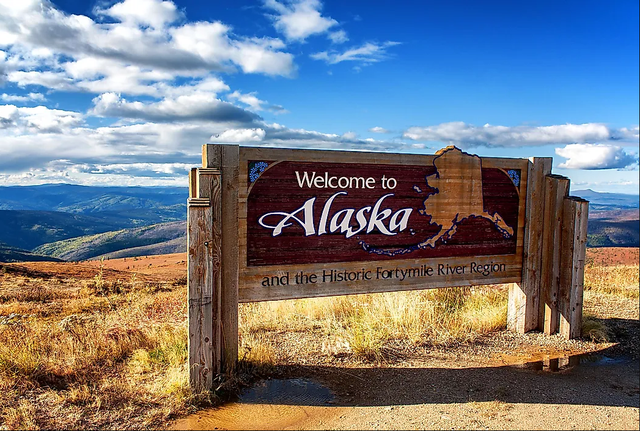
But why did Russia not sell Alaska to Canada, but to America?
Of course the US benefited the most from this deal - 50 years after the sale, Alaska Gold Rush generated more than $ 1 billion in new assets for the United States. Also profitable were the abundance of wood, salmon and oil.
Plus, Alaska became a real strategic asset to the U.S. military as soon as the Cold War came.
Then why did the Russians give such a generous region? And why not sell it to Canada, which - unlike the US - currently borders Alaska?
To answer these questions, we must look back to the 19th century, when a Proto-Cold War emerged. Historians call it the "Great Game."
Russia claims Alaska
From 1829 to 1907, the empires of Russia and Great Britain had a mutual enmity. Each wanted to expand its influence in Central Asia as well as the Pacific Ocean. Thus, a strong rivalry arose. Hostility fueled or intensified several military conflicts, most notably the Crimean War (1853-1856), which pitted Russia against allied forces of Britain, France, Sardinia, and the Ottoman Empire. In the end, Russia was defeated. By some estimates, the Tsarist empire suffered more than 800,000 casualties.
Although this war was limited to Eurasia, it had major ramifications across the Pacific. Among other things, she questioned the future of that magical land, Alaska.
After decades of exploration, Russia claimed Alaska in 1741. Then, on August 3, 1784, it erected its first settlement in North America. The settlement was founded by Shelikhov-Golikov Co., one of the few wool trading companies operating in the area - apparently on behalf of the Empire. In 1799, Tsar Paul merged some of them into Russian-American Co. (RAC). As a powerful conglomerate, the RAC was given a trading monopoly on Alaska resources. He was also tasked with creating new settlements and expanding Russia's presence in the world.

To this end, the head of the company, Alexander Baranov, ordered his men to go as far as Northern California, where they established an outpost called Fort Ross, on February 2, 1812. The RAC's grand vision was for this establishment to serve as a agricultural center, the harvest of which would be borne by the settlers themselves as well as the inhabitants of Alaska. With a guaranteed food supply, settlers in both countries would find it easier to secure the Pacific's most lucrative commodity: the skin of sea otters. Several times more valuable than beaver fur, these were the vital node of the Russian-American economy.
Unfortunately, Fort Ross livestock production was very inadequate. And to make matters worse, the otters were being hunted so much that they almost disappeared. The Russians, therefore, gave up Fort Ross, which was sold to an American frontier in 1844.
The Crimean War and its role
Then came the Crimean War, in which Alaska threatened to become a burden. Had the British decided to invade this territory, Russia's extremely large army would have fought to defend it. No such attack ever came, as the British chose to stay away from Alaska during the war. Many in the tsarist government, however, questioned the wisdom of maintaining a remote, sparsely populated colony whose main source had disappeared.
To make matters worse, whaling vessels from Britain and the US often stepped into RAC-controlled waters, further complicating the situation.
In the late 1850s, Russia began to consider the idea of selling. Under various circumstances, the Province of Canada might have seemed like an ideal buyer, thanks to its 2,475-mile border with Alaska. But Canada was not yet self-governing, and was again under strong UK control. Consequently, the surrender of Alaska would give Britain an extra chess piece in the Great Game.
But fortunately for Russia, a better candidate emerged. During the Crimean War, this Slavic empire found a surprising ally. American newspapers overwhelmingly supported the Russian issue. On top of this moral support, the states also provided the tsar with troops, weapons, and other supplies, even though the U.S. government was officially neutral.

British Imperialism
Both superpowers saw British imperialism as a threat. Recognizing this, Russia allowed its US Secretary of State, Baron Edouard de Stoeckl, to approach the republic's leaders with an offer to sell Alaska in 1854. The deal fell through and the topic was not seriously discussed until the Civil War. American.
The secretary of state under Presidents Abraham Lincoln and Andreu Johnson was William Seuard, a talented diplomat who had preached the benefit of Alaska for years. In 1867, he and Stoeckl reached an agreement that would see the U.S. take possession of the territory in exchange for $ 7.2 million. On April 9 of that year, the Senate ratified the transaction.
On October 18, 1867, Alaska officially became an American territory.


