


How Belinda Balluku is fabricating the rumor about Top Channel's...
/ 2026-10-19 16:19:00Focus


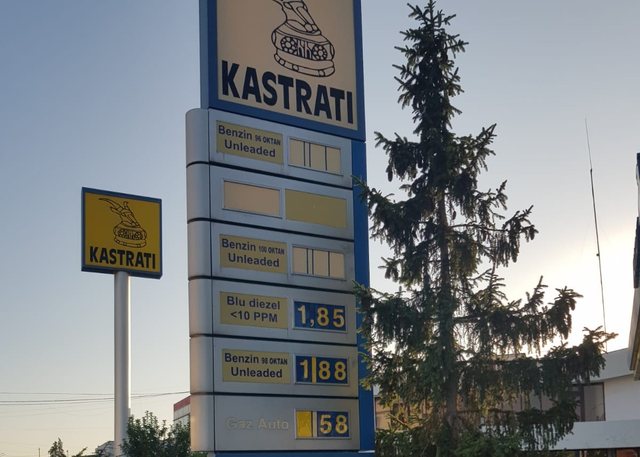
All those who are traveling these days for vacation, work, or other personal reasons will have to pay more to fill their vehicle tanks.
The prices of oil and gasoline in the country have recorded a second increase in a few days, with a total increase of 8-9 lek per liter.
At Kastrati trading points, the largest minority and majority operator in the country, a liter of diesel is sold at 185 lek, from 179 lek that had increased a few days ago, while earlier the price had dropped to 176 lek.
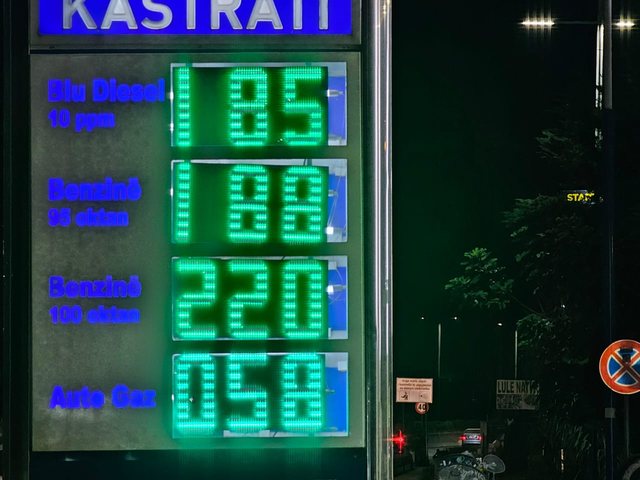
At the trading points of Eida Petrolum, oil is sold for 184 Lek.
Gasoline has also become more expensive. A liter is now sold at 188 Lek, from 182 before, while before the price increase, it had dropped to 179 Lek.
Market operators claim that the increase was forced due to the increase in the price of oil on international exchanges, where the Platts indicator, which is the reference used by importers, has reached about 900 dollars per ton.
This is the second change made by fuel trading operators, after the merger of the Transparency Board, which from March 2022 to June 7, 2023 set the ceiling prices for fuels.
At the time when the Board was abolished, oil was traded at 176 ALL per liter, while the lowest level was reached at 169 ALL per liter, at the beginning of May (see the chart of price trends in the country).
Both changes of operators after the abolition of the Board have only been incremental.
Market operators claimed that the reason for the increase in prices is the increase in the price of fuel on the stock market, where oil first reached $780 per ton and now $900 per ton, from $690 at the beginning of June when the Board made the decision.
The other benchmark oil benchmark, "Brent", reached 85 dollars per barrel, from 74-76 dollars, which was at the beginning of June (see the second chart). According to Reuters, prices have risen steadily due to investor optimism about global economic performance on the one hand and concern about fuel supply constraints on the other.
But, on the other hand, the dollar, which is the currency with which fuel is traded, has fallen significantly in the domestic market, dropping for a few days to close to 90 Lek and currently at 95 Lek, from 100 Lek at the beginning of June.
For more than a year, since March 2022, the fuel price ceiling was set by the Transparency Board, a mechanism created by the government to control prices after the crisis that was caused in this market by Russia's attack on Ukraine.
The operators spoke out against this Board, claiming that it violated the principles of the market economy and did not allow companies to optimize purchases in international markets, which would make them supply when the market was cheaper. According to them, this would enable prices about 5% cheaper than those set by the Board.
The board was abolished on June 7, while its last decision was made on May 26, where the ceiling price of oil retail trading was 176 ALL, and of gasoline 179 ALL./ Monitor





