Is this police force professional and capable of handling violen...
/ 2026-10-16 18:54:07Focus


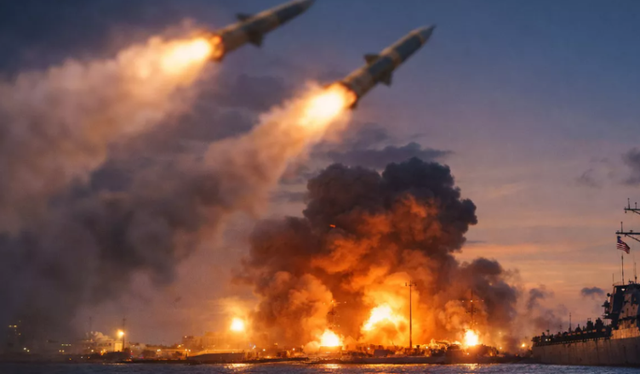
Amid rising regional tensions in the Middle East, Azerbaijani media outlet Caliber writes that Iran is considering the possibility of an Iranian attack on the headquarters of "Monafeqin", a term used by Iranian authorities for the People's Mujahedeen Organization of Iran (MEK), located in Camp Ashraf-3 in our country.
The press service of the Islamic Revolutionary Guard Corps (IRGC) stated on Telegram that the possible actions are related to a structure that Tehran considers involved in "hostile activities."
According to Azerbaijani media, referring to Iran's recent attacks on targets in Cyprus, Tehran is no longer limiting its activities to a specific geographical area when it comes to adversaries, signaling an expansion of operational capabilities beyond the region.
However, according to experts, this scenario is almost impossible. First, it is very complicated for them to reach Albania.
Any missile or drone would have to fly over Turkey, Iraq or through Mediterranean airspace monitored by the US Sixth Fleet and NATO's Integrated Air and Missile Defense (IAMD) systems.
And by attacking Albania, Iran would thus also declare war on NATO.
What is the Mojahedin Organization of Iran?
A fortified compound in the village of Manzë, near Tirana, serves as home to around 3,000 members of the People's Mujahedin Organization of Iran (also known as Mujahedin-e-Khalq – MEK), marking a new chapter in the more than 60-year history of this controversial group.
The opposition movement has been based in Albania since 2013, when our government accepted shelter for its members at the request of the United States and the United Nations. The relocation came after years of insecurity in Iraq, where the group had previously been based.
Founded in 1965, the MEK emerged as an Islamist movement with socialist leanings against the rule of Shah Mohammad Reza Pahlavi. During the 1970s, it carried out armed attacks against the monarchy and also targeted American interests in Iran.
The organization initially supported Ruhollah Khomeini and the Islamic Revolution of 1978–1979. However, relations with the new clerical leadership quickly deteriorated. The group was banned, many members were arrested or forced to flee the country, while the organization continued opposition activity from exile.
In the 1980s, the MEK moved to Iraq, where it operated from bases provided by Saddam Hussein's government. From Iraqi territory, the organization launched military operations against Iran during the Iran-Iraq War, an action that remains deeply controversial among many Iranians and has fueled strong resentment against it.
The United States designated the MEK a terrorist organization in 1997 due to its past involvement in violence. However, after a lengthy legal and political campaign, the U.S. State Department removed the group from its terrorist list in 2012, arguing that it had renounced violence and cooperated in closing down paramilitary camps in Iraq.
The MEK regained international attention in 2002, when it revealed the existence of an undeclared uranium enrichment facility in Iran, pushing for stricter international control over Tehran's nuclear program.
After the overthrow of Saddam Hussein in 2003, the group's position in Iraq became increasingly precarious. Under pressure from Iraqi authorities and due to security concerns, its members were gradually transferred abroad, a process that culminated in their final relocation to our country.
The Islamic Revolutionary Guard Corps (IRGC) press service said on Telegram that the possible actions reportedly relate to a structure that Tehran considers linked to "hostile activities."
Some sources, referring to Iran's recent attacks on targets in Cyprus, claim that Iran is no longer limiting itself to a specific geography when targeting centers affiliated with its adversaries and is expanding the scope of its operational capabilities beyond the region.