How Belinda Balluku is fabricating the rumor about Top Channel's...
/ 2026-10-19 16:19:54Focus


Unlike the former head of Arben Ahmetaj's cabinet, Alda Klosi, who, after being appointed as a director in the Ministry of Finance, had secured 5 apartments, plots of land and a contract for the construction of a building, the General Secretary of the Ministry of Health, Joana Duro, was arrested from SPAK for a bribe of 330,000 lek for a tender for the company 'Dricons', resulting in modest wealth.
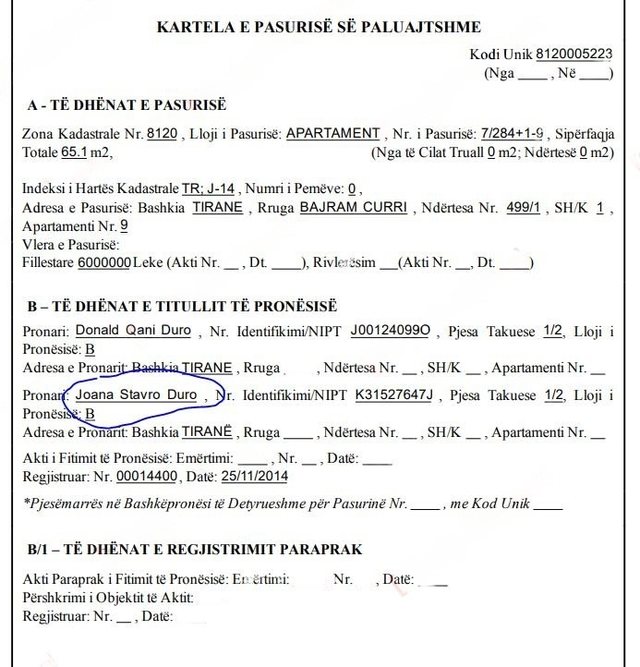
From the verifications carried out by Shqiptarja.com, it turns out that the Health official, Joana Duro, is a co-owner of 1/2 of an apartment in Tirana, with an area of 65 m2, registered as real estate in November 2014. As a source, Mrs. Duro declares a bank loan worth 4.2 million ALL.
This apartment is the only immovable property in the name of the Health official, Joana Duro, who, together with the specialist Laura Shteto, accidentally fell into the surveillance network of the Special Corruption Prosecutor's Office while the investigation was being carried out for another person.
Meanwhile, the company 'Dricons' was founded in August 2015 and has as its object study, design, supervision, approval, as well as consultants for the construction and implementation of public and private construction works. The company was founded by Vladimir Topi, who is still the administrator and owner of 100% of the shares. Topi was also arrested by order of SPAK for corrupting two officials of the Ministry of Health.
Since its establishment, Vladimir Topi's company has received a total of 166 public tenders, with modest values, because the object of the tender has mainly been the supervision of works, i.e. the implementation of contracts. Out of 166 tenders, the company 'Dricons' has received only 8 tenders in health.
Of these 8 tenders, only the tender for which he was arrested was signed by Joana Duro. The other tenders were signed by Merita Xhafaj and Loreta Balaj.
From the Albanian Development Fund, the company 'Dricons' has received three tenders worth about 20,000 euros for work supervision, while it has invited about 150 tenders from local units.
Although the work supervision service is tendered at low values, this process is very important for the implementation of contracts and the quality of works for public facilities by private companies that win the tenders. There have been cases of illegal compromise between the supervisory companies and the companies that implement the contracts, manipulating the volume and quality of the works, in order to share the profits together.