Is this police force professional and capable of handling violen...
/ 2026-10-16 18:54:07Focus


moon
This has been one of man's most ancient dreams: to fly to the stars and walk on the moon. But if in "Orlando the Furious" by Ludovico Ariosto (1532) or in the visionary "From the Earth to the Moon" by Jules Verne (1865), this dream was realized by enterprising individuals who challenged the limits of the known world, the real race for space, between the 1950s and 1970s was actually a technological and political challenge between the two superpowers: the billions spent on space missions by the USA and the USSR more than satisfying the thirst for knowledge served to demonstrate which superpower was the strongest.

The fierce competition began in 1957, when the Soviets sent the first artificial satellite, Sputnik 1, into orbit. The United States, after several failed launches, responded by creating in 1958 NASA, the American space agency. But it was again the Russians who collected successes: in 1959 they reached the Moon with the Lunik 2 probe; in 1961, Yuri Gagarin was the first human to orbit the Earth (but it has been hypothesized that other astronauts have died on earlier missions, which has been kept secret from the world) and in 1963, Valentina Tereshkova was the first female cosmonaut. The Americans got their revenge on July 20, 1969, when the Apollo 11 mission commanded by Neil Armstrong made man finally set foot on the moon.
Rosa Parks

With her "no", the woman has become a symbol that challenges social prejudices and abuses of power in racial segregation. Rosa Parks, African American and civil rights activist, one evening in 1955 in Montgomery (Alabama), was returning home by bus. The only empty seats were in the back, reserved for whites. She sat there. When some white passengers boarded a little later, the conductor ordered him to move to the black section. Rosa refused to get up and was immediately sent to prison. That same night, about 50 leaders of the African American community, led by the then little-known Martin Luther King, followed her example, announcing a boycott of public funds. King, addressing Parks' action, would later write: "Rosa sat down in the name of the abuses accumulated day after day and in the name of the boundless aspirations of future generations". The protest continued for a year, until the Rosa Parks case ended up in the United States Supreme Court, which declared segregation on public transportation in Alabama unconstitutional. Meanwhile, the boycott had paved the way for other protests, which in 1964 brought the adoption of a new law on civil rights, which formally ended racial segregation in the USA.
100-meter

Athletes simply called it "obstacle": to cover a length of 100 meters in less than ten seconds. Last century it was the most coveted challenge of speed athletes. A mental and psychological challenge, in addition to physical. The first to break it (at least after the introduction of electronic stopwatches, after the Second World War), was the African-American James Ray Hines, born in 1946. In 1968, during the Olympics in Mexico, he won the Gold medal in the 100-meter with a time 9 seconds and 95 percent. Not without controversy: in fact it was helped by the high altitude (2600 meters above sea level). The same kind of help that the second man who crossed the obstacle (9 seconds and 98 hundredths), the Cuban Silvio Leonard, had in 1977, at nearly 1,500 meters of altitude. This limit, at a height equal to sea level, has been exceeded by another Afro-American: Carl Luis,
The bottom of the ocean

They called him "the deepest man in the world": among the feats of the Swiss scientist and explorer, Jacques Piccard (1922-2008), there were also several record-breaking deep dives. The researcher had a degree in economics from the University of Geneva, but above all an engineering experience that put him into action when, together with his father, the physicist and pioneer of high-atmosphere exploration, Auguste Piccard, he built the bathyscaphe Trieste, with which he won challenge the depths by touching the deepest point of the ocean. It happened on January 26, 1960 in the Pacific Ocean, where the Marianne Trench (the deepest oceanic trench) is located. That day, Trieste reached 10,902 meters below sea level, maintaining a pressure of 1,075 atmospheres. The initiative was made possible by the US Navy, which in 1957 bought the bathyscaph, taking Piccard as a consultant. by his side, on the descent was co-pilot Don Walsh. The descent to the bottom of the ocean took almost five hours, and the two stayed on the bottom of the ocean for 20 minutes, before coming up, for less than three hours. In addition to being technological, this venture was also scientific: the data collected in subsequent missions also allowed the morphology of the great depths to be clarified.
The flight

The first to try it was Ikari. But the first to succeed after the studies of Leonardo Da Vinci in the 400th century were the Montgolfier brothers, who in 1783 broke away from French soil with the balloon that would bear their name. A breakthrough that started the race for human flight. A year later, the Italian Paolo Andreani imitated them in Milan. And for a century, work continued on the hypothesis of aircraft without engines, with wings that in many cases were set in motion by the force of the pedals. It was only at the end of the Eight Hundred that it was understood that in order to fly, man had to be assisted by a motor, since it was not enough to rely on muscle strength. The first success is officially attributed to the American brothers Wilbur and Orville Wright, that on December 17, 1903, on Kitty Hawk Beach in North Carolina, he made the first flight in a heavier-than-air vehicle, powered by a 16-horsepower piston engine. It was called "Flyer 1" and is considered the first airplane in history. However, for many, the first time belongs to the Brazilian engineer of French origin Alberto Santos Dumont: in 1906 he made the first flight with an aircraft able to "take off" without being pushed by a catapult.
Jan Palach

A noble gesture, seemingly useless, but with a media force capable of shaking consciences and becoming a symbol of defiance to power. It was committed by Jan Palach, a Czechoslovak student who in 1969 set himself on fire in Prague's San Wenceslas Square to protest against Soviet oppression. Something similar to "tank man", the anonymous guy who in Tiananmen Square in China in 1989 stood alone with his body against the advance of tanks. The crisis in Czechoslovakia began when, in January 1968, President Alexander Dubcek introduced the so-called "socialism with a human face", which brought about the Prague Spring. The USSR, fearing a destabilization of the Soviet bloc, sent 600,000 soldiers and more than 5,000 armored vehicles. Repression silenced opposition. Which was broken on January 16, 1969 when Palach, 21, doused himself in gasoline and set himself on fire. 600,000 people attended his funeral.
Columns of Hercules
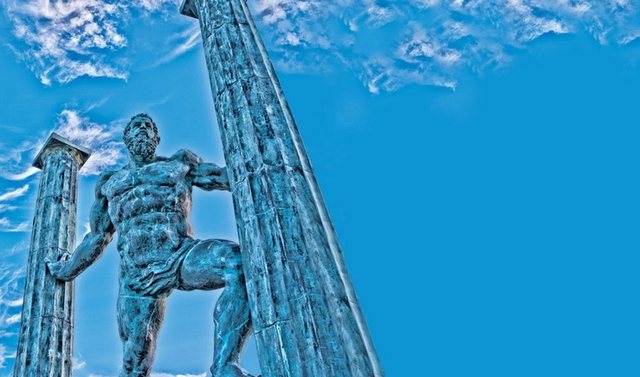
It is not certain where the Columns of Hercules were: some say they coincide with the Strait of Gibraltar, others with the Channel of Sicily. It is certain that for the Greeks they were not an impassable border: the ancient sailors, in search of new trade routes, naturally sailed in the open ocean. It was made in the 4th century BC by the Greek of Marseilles (then a Hellenic colony) Pithea. The full description of his journey, entitled "Voyage Around the Ocean" has been lost. But ancient sources have given us the route: the land of Thule, which some identify with Iceland, others with the Faroe Islands. Pythea sailed close to the coasts of the northern seas, which he reached either by river from France or by crossing the Straits of Gibraltar.
tunnels

To cross mountains by going under and not over them. It was one of the engineering dreams of the 1800s, the century in which man began to modify geography through technology, starting with the Suez Canal. In those galleries would pass the vehicle that would become a symbol of the future: the steam train. The first major railway tunnel united France with Italy: it avoided the ascent and crossing of Frejus (2541 meters) by piercing the mountain at nearly 1300 meters in height. The idea came to a customs official, the Piedmontese Giuseppe Medail. The inauguration, after nine years of drilling and digging that cost 70 million lire (300 million euros today) and the work of 4 thousand workers took place on September 17, 1871: it was the first great work of united Italy, which had just been born.
The tunnel of records was, however, that of Sempione, which connects Domodossola in Italy and Briga in Switzerland. Designed by the Prussian Karl Brandau it was inaugurated on February 24, 1905. And with its 19,803 kilometers it was until 1981 (when it was overtaken by a few kilometers by a gallery of the Shinkansen, the Japanese superfast train) the longest railway tunnel of the world.
Race to the Poles

Kanë qenë dy pushtimet më epike në planetin tonë gjatë shekullit që kaloi, përpara ngjitjes në hapësirë. E megjithatë, garat drejt Polit të Veriut dhe të Jugut, që kanë nisur që në 800, kanë qenë sfida të motivuara më shumë nga etja për para se sa nga kurioziteti shkencor. Anglezët, të parët që përballuan temperatura deri minus 70 gradë në Arktik dhe sipërfaqen e tij të paqëndrueshme, kërkonin në fakt një rrugë të navigueshme drejt Amerikës. Dhe amerikani Robert Peary, zyrtarisht i pari që ka arritur qëllimin ne 6 prill 1909, ishte i nxitur nga një etje e shfrenuar për lavdi. Një lavdi që erdhi, por e shoqëruar me shumë polemika. Një tjetër eksplorues amerikan, Frederick Cook kishte shpallur në fakt se kishte arritur tashmë qëllimin një vit më parë. Peary u quajt gjithësesi fitues, por në vitin 1969 britaniku Ually Herbert (i pari që ka arritur në këmbë) demonstroi që nëse Cook kishte gënjyer, edhe vetë Peary nuk kishte arritur objektivin, duke arritur pothuajse 96 kilometra larg nga Poli Verior gjeografik.
Among the people competing for the southernmost point of the planet was the Norwegian Roald Amundsen. Defeated in the North, but won in the South: his expedition reached its goal on December 14, 1911. He too had a proud competitor, the Englishman Robert Scott, who nevertheless had the bitter experience of arriving at the South Pole on January 17, 1912, but found the Norwegian flag there, before dying on the way back.