


"Condemned" protesters?! Who trapped Rama inside the Prime Minis...
/ 2026-10-23 16:02:00Focus


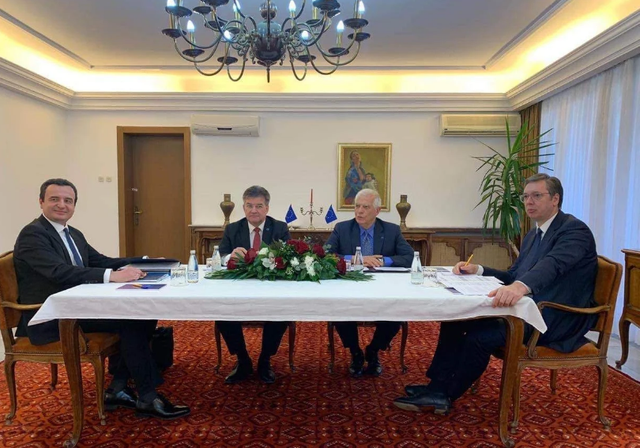
The end of the meeting between Albin Kurti and Aleksandar Vucic turned out to be only a short break and now both leaders have returned to the negotiating table, together with the representatives of the European Union.
The first part of these talks lasted about an hour, while the two leaders are now continuing discussions about the Implementation Annex of the Franco-German proposal.
It is learned that the agreement agreed in principle at the February 27 meeting in Brussels was also discussed this Saturday in Ohrid at the three-party meeting.
Tch has provided the document that was placed on the negotiating table between Kurti and Vucic, with the mediation of the EU.
The document begins with a statement that the Serbia-Kosovo normalization process is supported by the 27 EU member states, including those that do not recognize it.
Next, the key elements of the agreement are listed. It says that the agreement respects the red lines of the parties.
Instead of fighting with Serbia, Kosovo pledges to work to solve the practical needs of the community, while Serbia takes a step back, negotiating the independence of Kosovo, it is written in the document that calls international cooperation necessary, in favor of the people who live in Kosovo.
"Serbia and Kosovo are committed to the peaceful resolution of all disputes
Serbia undertakes to refrain from any action that is perceived as diplomatic hostility towards Kosovo.
Kosovo is committed to self-management
The Serbian community should be in line with the values of the EU" .
With the Basic Agreement, in addition to the normalization of relations between the two countries, it is intended to take steps forward in the process of integration of Serbia and Kosovo into the EU.
The EU also provides financial support for the achievement of the objectives. Further, the benefits that Kosovo and Serbia are expected to have are listed.
Serbia has the opportunity to become a strategic partner for the Western Balkans, becoming an important economic and political factor in the region. It will also bring Serbia closer to the Kosovo Serb community.
As for Kosovo, it will mark the beginning of breaking away from the crisis, an opportunity to focus on social and economic development.
Citing Russian aggression and China's "dangerous" deals, the document provided by Tch states that the West "does not have the luxury of failure in the Western Balkans."
What can happen if the parties reject the agreement? In the document it is stated that the path of integration in the EU is endangered and the processes carried out so far are rejected, along with the benefits they have brought to Kosovo and Serbia.





