"The fate of the homeland is in our hands" - An appeal by Ismail...
/ 2026-10-18 16:09:54Focus


In the era that has just begun without Bashar al-Assad at the helm of the country, the map of Syria looks extremely diverse. Bashar al-Assad is now in Moscow, leaving behind Syria, which his family ruled by inheritance for more than 50 years.
The Hayat Tahrir al-Sham (HTS) rebels are in power, but tomorrow remains unknown for the country of 22 million people.
This is because the rebels who gave life to the revolution are not a unified group, but many factions who fought with the common goal of overthrowing the regime.
In just two weeks, Syrian rebels, led by the HTS group, launched a spectacular offensive, capturing major cities and leading to the fall of Damascus.
The rebels, using small vehicles and motorbikes, took advantage of the country's main road, advancing rapidly towards the capital, which they captured without resistance. Their operation began with the capture of Aleppo in late November and continued with the cities of Hama and Homs before the capital fell.
But according to the BBC, as reported by the UN special envoy for Syria, clashes continue in northeastern Syria between Turkish-backed forces and the Kurdish-led Syrian Democratic Forces (SDF). In the Syrian city of Manbij, where heavy fighting has taken place in recent days, it is now reported that SDF members are being allowed to withdraw safely.
Citing a Syrian opposition source, the Reuters news agency reports that the United States and Turkey have reached an agreement for the safe withdrawal of the Kurds, while Recep Tayyip Erdogan said from Ankara that Manbij had been liberated from what he called "terrorists."
Although Turkey considers them "terrorists," the Kurdish SDF forces were a key ally of a US-led global coalition that worked to expel Islamic State militants from Syria between 2015 and 2019.
Despite the fall of the Assad regime, Syria remains fragmented. HTS now controls the country's major cities, but it is not the only player in the region. Kurds and other rebel groups control large areas of northeastern Syria, while fighting continues between rival factions.
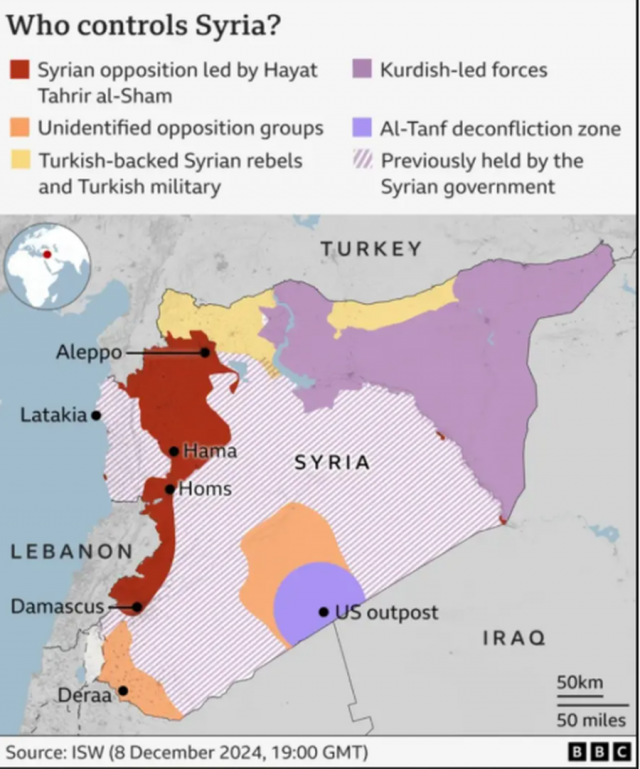
The BBC map shows in red the so-called HTS rebels under al-Jolani. In orange are various politically undefined rebel groups. In yellow are territories controlled by the Turkish army and rebels cooperating with it, while Kurdish forces are in light purple.
The lack of a unified command among the rebels and the presence of many different groups make it difficult to build stability in the country. The situation in northern Syria remains tense, especially in Manbij, where Kurdish forces are clashing with Turkish-backed groups.
Analysts have not yet been able to determine who controls the city, while fighting continues in several neighborhoods.
Manbij is a strategic point, connecting different regions of the country and important for control of northeastern Syria. The city reflects the wider dispute over control of the north.
The geopolitics of Syria and Israel's reactions
Syria, with a population of around 22 million, is located in a strategic position, bordering Turkey, Lebanon, Israel, Iraq and Jordan.

During the war, many external powers, such as Turkey, Westerners, and Gulf states, supported various opposition factions.
The fall of the Assad regime led to immediate reactions from Israel. Israeli forces have carried out airstrikes on suspected chemical weapons and missile facilities in Syria.
At the same time, Israel announced the temporary occupation of a demilitarized zone in the Golan Heights, stressing that the 1974 disengagement agreement has failed. The Golan Heights, which Israel captured in 1967, remains a focal point of geopolitical strife.