How Belinda Balluku is fabricating the rumor about Top Channel's...
/ 2026-10-19 16:19:00Focus


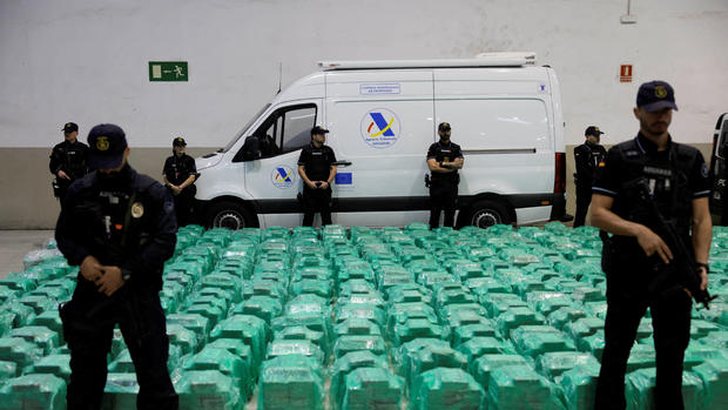
Cocaine shipments were bought in Colombia , arriving in Italy by sea from Ecuador , hidden among crates of bananas or other exotic fruits.
In the port of Livorno, a crucial center of drug trafficking, recovery " teams " intervened, mainly Albanian , Romanian and Italian traffickers.

The Italians who, according to the prosecution, were representatives of 'ndrina Molè', a Calabrian gang from the area of Gioia Tauro specialized in drug trafficking.
According to the Italian media, the manager of the intervention teams at the port of Livorno was a 44-year-old Albanian, Albert Turja, a resident of Santa Croce sull'Arno , but also with interests in Florence, where he owns a hostel in "via Martelli". very close to the "Duomo" square, which he runs with his wife.
Turja is one of the people arrested during the action that broke up the organization, discovered by the Financial Police of Pisa coordinated by the Anti-Mafia Prosecutor's Office of Florence.
At the end of the investigations that started in 2021, on Wednesday 7 November, 30 security precautions were carried out between Tuscany, Calabria, Lazio, Puglia, Campania and Lombardy: 23 people were arrested, 6 under "house arrest", one with " presentation obligation".
The investigation coordinated by the deputy prosecutor of Florence, Luca Tescaroli, who recently took over as head of the Prato Prosecutor's Office, concerns a criminal organization targeting drug trafficking with the aggravating circumstance of transnationality.
According to the prosecution, to manage the drug traffic that would be imported into Italy, exponents of the Italian mafia organizations, "Ndrangheta" (Calabri), Camorra (Naples) and an Albanian gang, which had branches in Belgium, Albania, France and Germany , as well as in Colombia and Ecuador, close alliances had been formed.

"Our hostel, reads the website of the building in 'via Martelli', was born from the initiative of Alberti and his wife, who, driven by their love for the city of Florence, decided to create an environment in which, those who come from abroad can fully enjoy the Tocan atmosphere".
But according to investigations by the Guardia di Finanza, the real job of Alberti, who ended up in prison together with his brother Roland, 38, was not as an entrepreneur in the hotel sector, but as a drug trafficker.
He was the organizer of the Tuscan "branch" of the gang, who used a cryptophone to keep in touch with his associates in Ecuador, who financed the purchase of drugs directly in Colombia, and above all it was him, according to what emerged from the investigations of the Antimafia Prosecutor's Office , who managed the most delicate moment of drug importation, that of "exiting" the port.
One thing that decrees the success or failure of the operation, given that in a few minutes, drug traffickers can see millions of euros disappear.
From the interceptions of "Sky ECC", it turned out that the Turja brothers had collaborators inside the port of Livorno, who could check where the container they were interested in was located, but they have not yet been identified.

The technique used by the team was always the same: inspections with binoculars, waiting for the ship carrying the drug container to arrive, sometimes even using a fishing rod to pretend to be a fisherman at sea so as not to attract too much attention .
Once the container was identified, the team was tasked with placing the GPS with a card in the name of one of the person in the group to track his movements and intervene when the container is emptied of legal cargo and therefore placed in an area with low alertness.
"Recovery Team"
There, during the night, the "recovery" group could dismantle the container, take out the drugs and above all put everything in place to prevent anyone from noticing the detached parts and notifying the police as has already happened in several cases .

Then, for the transfer of drugs, cars with double bottoms were used, some coming directly from Albania.
The "recovery team" was equipped by the organization with all the working tools: drills, scissors, wire cutters, crowbars, bags to hold the drugs and also ropes and harnesses in case the drugs were placed too far in the container.
When the situation was very complicated, the group even managed to get a specialized team from Albania, real "freelancers", who were paid in narcotics, generally 30 percent of the value of the cocaine they recovered.
It was always Albert Turja who took care of the logistics: he would find a place for his members to stay overnight and the day before the action, put them on a boat to do checks and then show them where to go. they parked the car to avoid confronting the police, who passed by every hour and to avoid suspicion, going outside the perimeter of the security camera system of the port of Livorno./ Corriere.it