How Belinda Balluku is fabricating the rumor about Top Channel's...
/ 2026-10-19 16:19:54Focus



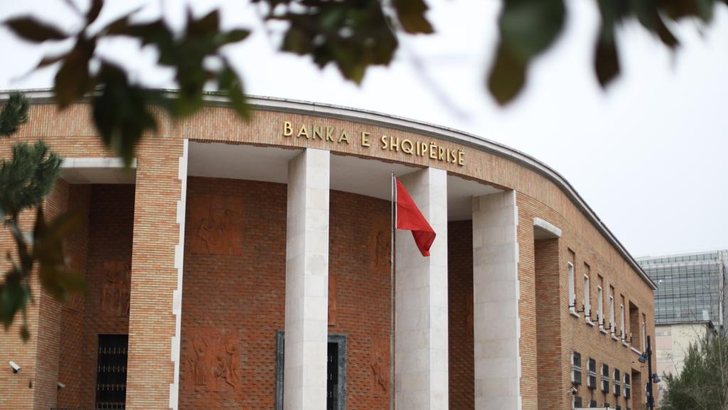
The Bank of Albania has decided to apply for the first time a countercyclical addition to the capital adequacy ratio of the banking sector.
According to the decision of the Governor, Gent Sejko, the rate of countercyclical capital addition (KUNC) for Albania will be 0.25 percentage points, from zero that was foreseen in the previous decision. All commercial banks in Albania must complete this supplement after one year, starting on June 30, 2025.
The application of a countercyclical capital supplement is provided for in the 2018 regulation "On macroprudential capital supplements. Such an addition is aimed at slowing down lending, in case the central bank estimates that it is growing at too fast a pace.
The primary indicator in the assessment of the Bank of Albania regarding the rates of crediting of the economy and the decision-making about the possible need for countercyclical capital additions is the ratio between credit growth and economic growth.
The above ratio shows the deviation of the value of the ratio of credit for the economy to GDP from its long-term trend and is the main indicator that signals the possibility of excessive growth of credit in relation to the National Product. This threshold would be exceeded if the deviation of the credit-to-GDP ratio from the long-term average was positive by more than 2.1 percentage points.
According to the reasoning of the Governor's decision, the values of the primary indicator have continued to be negative until the first quarter of 2024, but the size of the negative value has decreased.
The gap in the ratio of credit to Gross Domestic Product (GDP) was -7.2 percentage points, from -7.84 percentage points that had been in the previous quarter.
But, as a supplement to this primary indicator in the decision-making of the Bank of Albania, several other elements, grouped under the early warning indicator (TPHP) and which signal developments in lending and non-financial assets, specifically the real estate market, serve.
For several quarters, the Albanian economy is experiencing a positive financial cycle based on the accelerated growth of bank credit.
If we analyze the performance of credit given to businesses, for development and investment in real estate (residential and commercial), corrected for the effect of the exchange rate, the annual growth rates until March 2024 have been over 30% in each case .
Further, if the loans granted to individuals and businesses are aggregated, for real estate (residential and commercial), the annual growth rate of this portfolio is 25% (from 21% according to reporting in nominal value). This growth rate is significantly higher than the annual growth rate for the entire loan portfolio of 10% (7% according to reporting in nominal value), evidencing the acceleration of lending.
According to the Bank of Albania, such periods are associated with good levels of financial performance for the agents of the real economy and for the financial system.
"However, these periods are also associated with the beginning of certain risks, which may be related to a drop in credit standards, increased levels of its concentration in certain sectors or markets, increased debt levels for agents of the real economy beyond healthy levels etc.
These situations, if allowed to develop, can make the economy and the financial system more sensitive to various shocks, thus undermining financial stability. For these reasons, in these cases it is suggested to use macroprudential instruments that soften the course of the financial cycle (act countercyclically) and prevent the uncontrolled development of these risks.
In our case, positive developments in the financial cycle are better reflected by the performance of the values of the Supplementary Early Warning Indicator (TPHP). Based on the values of this index during several quarters, the use of KUNC is suggested by the methodology "For the determination of the countercyclical capital addition"," says the argument of the decision of the Bank of Albania.
Further, the central bank adds that, if lending rates remain high, further increases in the countercyclical surcharge rate can be expected in the coming periods.
At the beginning of this year, it was the International Monetary Fund (IMF) that suggested to the Bank of Albania the establishment of a countercyclical capital increase for the banking sector. In the statement of the IMF Executive Board for Albania, it is stated that the imposition of a countercyclical addition to the capital adequacy ratio for commercial banks can be considered in the medium term, to further strengthen financial stability.
The suggestions for the application of a countercyclical rate by the IMF seem to be based precisely on the early warning indicators and mainly on the developments in the real estate market and the credit given by the banks to finance their purchase.
Minimum capital requirements, rapidly increasing
Since the beginning of this year, commercial banks must meet a further increase in minimum capital adequacy requirements since the beginning of next year. The capital conservation allowance since January 1, 2024 has increased to 2.5%, from the 2% that was the obligation to be met during 2023.
Markoprudential capital additions are added to the basic regulatory requirements of bank capitalization, which are defined in the regulation "On capital adequacy". From 12%, which is the minimum basic limit of capital adequacy, with the conservative addition of 2.5%, this limit has reached 14.5%. The January 1, 2024 increase is the last increase in the five-year gradual increase cycle of the capital conservation allowance.
But, with the approval of the new countercyclical supplement, the minimum level of the capital adequacy indicator will now reach 14.75%.
Meanwhile, the capitalization requirements are even higher for a special group of banks, classified as systemically important. National Commercial Bank (BKT), Credins Bank, Raiffeisen Bank and OTP Albania Bank. Currently, BKT has an additional capital adequacy ratio requirement of 1.5%, which together with the conservation allowance of 2.5% brings the total capital adequacy ratio to 16%, Credins and Raiffeisen are obliged to complete a capital adequacy ratio of capital 1% higher than other banks (in total 15.5%), while OTP 0.5% more than other banks (in total 15%).
In addition, systemically important banks from January 1, 2024 must also complete the first required addition of the capital adequacy ratio related to the minimum requirement for regulatory capital instruments and accepted liabilities (MREL).
These banks must meet an additional 1.5% in the overall capital adequacy ratio. This brings the minimum capital adequacy ratio requirement from 16.5% to 17.5% for the five banks in question. To meet the new requirements, some of these banks will use borrowing instruments that are recognized as part of the regulatory capital.
However, the successive additions of the minimum capital requirements have aroused open dissatisfaction from the banks, which consider the additional capital requirements to be excessive, a burden on the activity of commercial banks and a deterrent to lending activity. The banks argue that the European Union applies macroprudential allowances above a base level of the Capital Adequacy Ratio of 8%, while Albania has a base level 50% higher, at 12%.
Last year, the Albanian Association of Banks addressed a letter to the central bank requesting consideration of postponing the entry into force of the MREL-related additions. However, the Bank of Albania has rejected this request and remains unmoved in its position.
Data from the Bank of Albania show that the average capital adequacy ratio for the banking sector at the end of the first quarter of 2024 reached 19.07%, from 18.9% in the same period a year ago.