Protests, violence, curfews: From France to Albania, why Europe'...
/ 2026-10-20 23:47:20Focus



Tch publishes the document issued by the Judicial Appointments Council that confirms the transmission of secret data to senior judge Asim Vokshi, data that was transmitted to him by the National Authority for Classified Information Security.
In this data, the KED headed by Sokol Sadushi did not assess the indication that the judge who was voted to the constitutional court was in the conditions of the prohibitory criteria after being informed of cooperation or contacts with intelligence services.

In this document, it is the KED itself that admits to being informed on the one hand but on the other hand does not evaluate the information of the institutions.
Reading Following decision no. 14, dated 17.06.2025 of the Judicial Appointments Council, it is noted that the National Authority for Classified Information Security (AKSIK) has forwarded to the Council a letter with information with content classified as "secret", regarding the candidate (during June and August 2025).
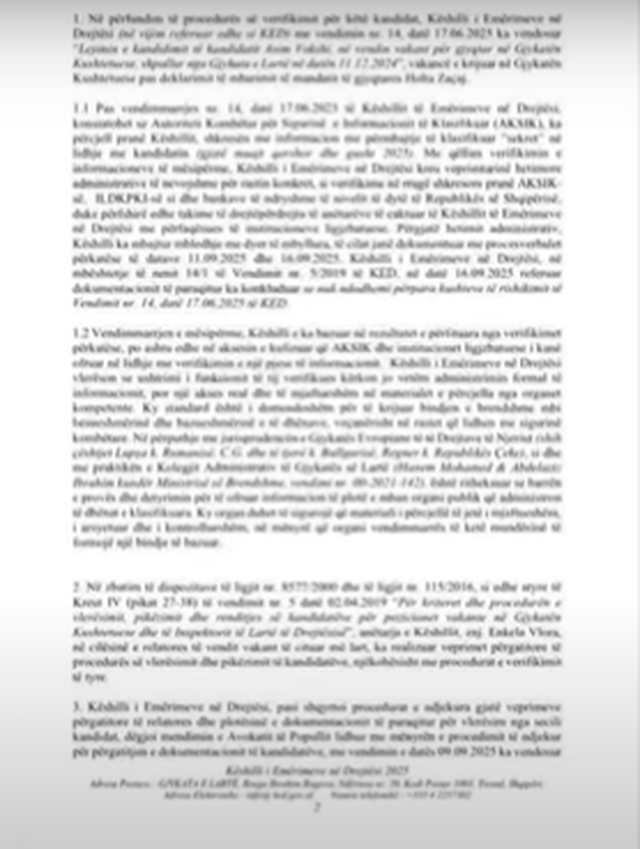
In order to verify the above information, the Judicial Appointments Council carried out the administrative investigative activity necessary for the specific case, such as verifications in writing at AKSIK, HIDAKKI and various second-tier banks, including direct meetings of certain members of the Judicial Appointments Council with representatives of law enforcement institutions.
During the administrative investigation, the Council held closed-door meetings, which were documented with the relevant minutes of September 11, 2025, and September 16, 2025. On September 16, referring to the submitted documentation, the KED concluded that we are not faced with the conditions for reviewing the decision of June 17.
The Council based the above decision-making on the results obtained from the relevant verifications, as well as on the limited access that AKSIK and law enforcement institutions have provided in relation to the verification of part of the information.
The Judicial Appointments Council assesses that the exercise of its verification function requires not only the formal administration of information, but also real and sufficient access to the materials forwarded by the competent bodies.
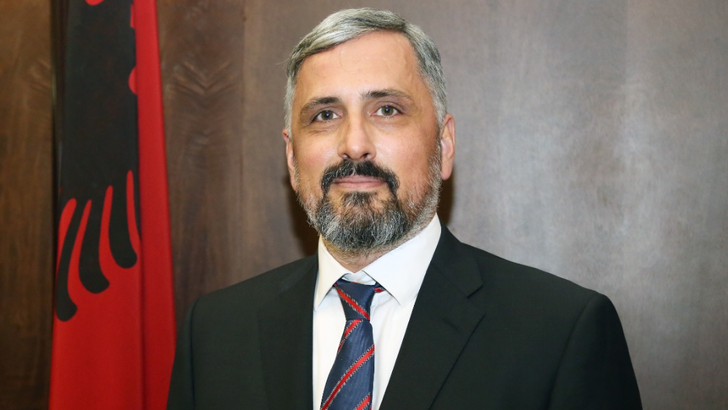
Asim Vokshi is the Supreme Court judge who passed the first phase of the candidacy for the vacancy in the Constitutional Court by the Judicial Appointments Council, composed of 9 members, among them his Supreme Court President Sokol Sadushi, as well as the two members of the Constitutional Court Miriana Semini and Ilir Toska, the latter one of the members who approved him during the KLGJ vetting.
Internal sources and documents of the KED indicate that this institution violated legal integrity verification procedures during the candidacy review.
Also, the failure by the KED to comply with clear legal obligations to verify the integrity of candidates violates not only the law and the internal regulations of the KED, but also violates the Constitution and creates a risk to national security and the credibility of justice institutions. It also invalidates the decision to approve the candidacy of Vokshi with integrity problems.
But in an attempt to deny Top Channel's reporting on the selection process of Judge Asim Vokshi, the Judicial Appointments Council published a statement that, in itself, confirms the existence of the information that Top Channel reported on.
In the same text, the KED describes the information as “false” and, at the same time, “classified” – a contradiction that no one can escape. A piece of data cannot be both false and classified at the same time.
Instead of providing explanations on the content of this information and the way it was handled by the institution, the Council has chosen to accuse the media and demand verification of its sources. An action that raises serious questions about the true purpose of this reaction: protecting the process or avoiding transparency?
Top Channel does not see this reaction as an institutional clarification, but as an attempt to exert pressure on the media that has fulfilled its duty to inform the public about facts and official documents.
The duty to maintain the secrecy or confidentiality of documents does not belong to the media, but to the institutions themselves that administer them.
And if Top Channel will publish the documents in question, then not the media, but the Judicial Appointments Council itself should investigate the way in which this data was kept or handled.
In this case, the responsibility of the KED would not be limited only to revealing the secret, but also to concealing it from the candidate for the Constitutional Court himself, Asim Vokshi.
Top Channel stands by its reporting, based on verified documents and sources. We are not here to accuse, but to inform.
Ultimately, transparency is not a threat to institutions; it is the best test of their legitimacy./ tch