Protests, violence, curfews: From France to Albania, why Europe'...
/ 2026-10-20 23:47:20Focus


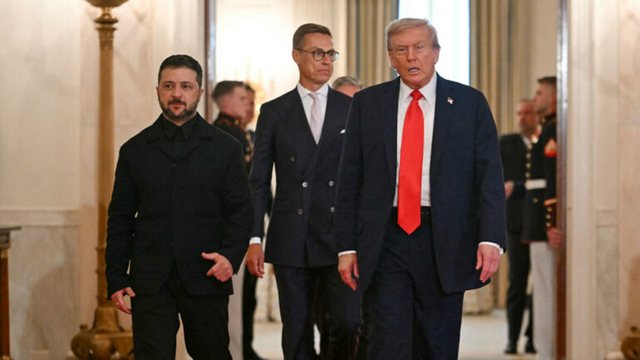
The governments of the United States and Ukraine stressed Sunday evening, in a joint statement released by the White House, that any agreement to end the war with Russia “must fully respect Ukraine’s national sovereignty.” The statement came after a day of intensive talks in Geneva between American, Ukrainian and European delegations.
According to the US presidency, the meeting in Switzerland, attended by Secretary of State Marco Rubio — was considered “an important step forward” towards reaching a solution to the conflict that has erupted since the Russian invasion of February 24, 2022. Rubio said after the meeting that he felt “very optimistic” about an agreement that could be finalized “very quickly”. The talks were held on the basis of a 28-point plan, proposed by US President Donald Trump, and which has been extensively revised after objections from Kiev and several European capitals. The statement emphasizes that the US and Ukraine “have drafted a new, updated and refined version” of the peace framework.
The Ukrainian president’s chief of staff, Andriy Yermak, spoke of “very good progress,” while President Volodymyr Zelensky stressed that the new draft reflects “most of Ukraine’s main priorities.” Meanwhile, key European countries — Britain, Germany, and France — presented their own counterproposal, which aims to avoid pressure on Kiev for territorial concessions. The European draft brings significant changes, such as removing the demand for concessions in Donbas and modifying restrictions on the Ukrainian military, while also providing for a possible role for Russia in the G8 and a gradual process of lifting sanctions.
However, Ukraine's red lines remain unchanged: no agreement can legitimize the occupation of Ukrainian territories nor force Kiev to accept frozen borders. Zelensky demands strong security guarantees, clear mechanisms for the release of prisoners and the return of kidnapped children, and keeping Russian assets frozen until compensation for war damages is paid.
As the US, European and Ukrainian drafts are being harmonized, negotiators confirm that the talks are closer than ever to an agreement. Trump had given Kiev a deadline of November 27, but recently declared that his plan was “not a final offer,” leaving room for further modifications. If the sides agree, an immediate ceasefire and a coordinated withdrawal of forces would be established under US supervision — a development that could mark the most significant diplomatic chapter since the conflict began.
The 28-point European counterproposal for peace in Ukraine
Reaffirmation of Ukrainian sovereignty.
A comprehensive non-aggression pact between Russia, Ukraine and NATO.
Deletion of point 3 of the American plan to stop NATO expansion.
Launch of Russia-NATO dialogue after the agreement.
Strong security guarantees for Ukraine.
Limiting Ukraine's armed forces to 800,000 troops.
Ukraine's membership in NATO depends on the unanimity of member states.
NATO should not station permanent troops in Ukraine.
NATO fighter jets to be stationed in Poland.
Security guarantee from the US, equivalent to Article 5.
Ukraine's qualification for EU membership and preferential market access.
A global reconstruction package for Ukraine.
Russia's reintegration into the global economy and the gradual lifting of sanctions.
Full reconstruction and compensation of Ukraine, with Russian assets frozen.
Creation of a US–Ukraine–Russia–Europe Joint Security Group.
Russia's commitment to non-aggression towards Europe and Ukraine.
Expanding nuclear control agreements.
Ukraine to remain a non-nuclear state.
Restart of the Zaporizhia plant under IAEA supervision.
Ukraine's implementation of European standards on minority rights and religious tolerance.
Ukraine's commitment not to return territory by force.
Prohibition on forcible border changes after the agreement.
Russian guarantee for the use of the Dnieper River and free transport of grain.
Creation of a humanitarian commission for prisoner exchange and humanitarian issues.
Holding elections in Ukraine after signing the agreement.
Additional provisions for war victims.
The agreement should be legally binding and overseen by a "Peace Council".
Immediate ceasefire and withdrawal to agreed points.