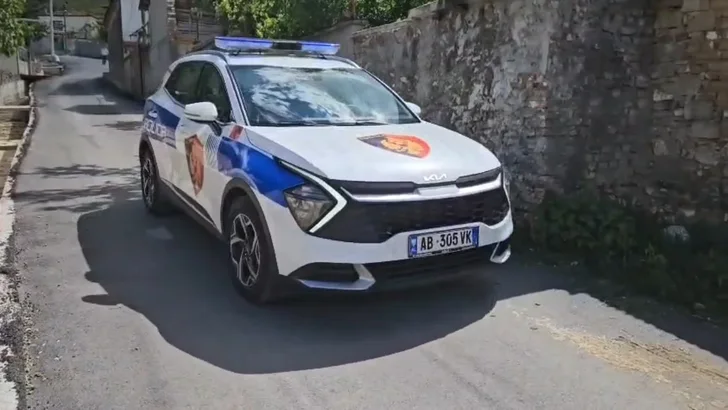
Is this police force professional and capable of handling violen...
/ 2026-10-16 18:54:07Focus


Exclusive from Anila Hoxha: Repentant in Albania
Erjon Alibej, repentant of justice:
We developed an agreement all the time in the Skype application, after the murder of Dorjan Shkoza and Anxhelo Avdija, we continued, we were insisting only on Talo Çela and we wanted to understand whether Talo Çela would be alive or not after the murder.
During this period, there was also the investigation into Altin Ndoci, Nuredini had all the information, he held meetings, Altin Ndoci often came to Durrës and during this time, Nuredini received information that Talo Çela was at Besmir Haxhi's house.
Nuredini took this with reservations and did not devote himself to it much and when Nuredini also focused on the environment where Talo Çela was supposed to be, during this period he was committed to being prepared with the Fushë-Krujë boys. Until these moments, I knew them as the Fushë-Krujë boys, I know that he took actions during that period to monitor where he was and talk about Talo Çela and it was one of those days when they were very careful about him.
This is the story of just one of the criminal episodes of the repentant Erjon Alibej, one of the 12 current collaborators of the Albanian justice in the witness program. The word of Alibej and others under investigation and protected by the state is considered the key with which the prosecution is revealing the unknown of organized crime by shedding light on assassinations, revenge, hired killers, drug trafficking, or corrupt officials who served criminals with information.
A circle within which members of criminal groups were both hunter and hunted. The collaborators of justice are guarded very close to the special SPAK building, in the building that until yesterday was the harsh regime "41 biss".
As a prosecutor who has handed over six convicts to the special court, starting with the hired killer Nuredin Dumani, Erjon Alibej who started the revenge saga for the murder of his trafficker brother, Skerdi Tasi, Ernejt Shyti, Amarildo Nikolli, and two witnesses who lost their status, Klevis Alla and Henrik Hoxhaj, Doloreza Musabelliu knows well that the word of collaborators alone is not enough to solve crimes.
Doloreza Musabelliu, SPAK prosecutor:
The procedure for a collaborator of justice is not simply a statement of "I will speak", but it is a very complex process, verification. Initially, we make contact in two ways: either it is the prosecutor himself who proposes, or there are also cases when the defendants or lawyers themselves signal and express their willingness to cooperate with the proceeding body. He is heard to see what he offers, but immediately after that a cross-examination process begins, because we cannot just take a statement and immediately return a collaborator of justice.
Collaborators can make statements of personal interest. In one case, I was the prosecutor, and an associate's agreement was revoked because it was proven during the investigation that he had lied. It is very important that verifications are carried out as quickly as possible.
At the moment we do cross-examination, if these statements highlight important perpetrators and provide important data, property data about themselves and the defendant and it is considered to be decisive evidence for the process, the prosecutor ultimately assesses whether or not to grant this person the status of collaborator. So the attribute belongs to the prosecutor when we are in the investigation phase.
Florjan Kalaja, Special Appeal Judge:
We cannot recruit collaborators only in the investigation phase, but also in the preliminary hearing, and during the trial. I have a kind of reflection that it could also happen on appeal. And further, when someone who has been convicted can confess and be exempted from serving the sentence.
What I see as most critical is the way our legislation has been developed, unlike other countries which have clear criteria on how it is done and by whom, but for those mentioned for the most occult crimes, where the state is impossible.
Exposing the chaos of the laws surrounding the collaborator of justice, Florjan Kalaja, a special judge at the Appeals Court for Corruption and Organized Crime, is convinced that the repentant cannot be given only two reward offers in exchange for the truth. One of them is avoiding the extreme punishment of the collaborator.
Florjan Kalaja, Special Appeal Judge:
I analyze that the law in this way does not become cohesive, as the formulas would need to be specifically defined, so that the nature of the privileges and offenses would be diverse towards people who decide to leave crime and become attached and contribute to society.
Suffice it to remind you that in reducing the sentence for collaborators, or in conditional release, we have prohibitions that automatically prohibit the collaborator as well, such as conditional release for a recidivist or one who has committed serious crimes. This prohibition penalizes the collaborator and in my opinion this is not right, since the code has been in place for so many years but also for the young person.
We foresee alternatives to imprisonment and say that they can serve certain defendants who will have to avoid the measures, when we do not foresee a similar regime for collaborators of justice. This does not happen in other laws. In European laws there is a special regime. The main replacement with the complementary one.
Doloreza Musabelliu, SPAK prosecutor:
The collaborator of justice has the obligation to tell without reservations about all criminal facts, about all evidence that he is aware of, about any evidence that he has about himself and about others. And in the agreement act it is emphasized that this data must be given without reservations. If the opposite is discovered, all of this is given without reservations because otherwise the proceeding body revokes an agreement act.
We had a law enforcement officer who had told us the truth, but the problem was that he had reservations. We proved that he had not lied, but had hidden facts for another person who had been his friend. We proceeded with a decision for unilateral revocation.
Florjan Kalaja, Judge of Special Appeal:
The criminal liability of a collaborator of justice should be completely different from that of ordinary convicts, as it should be an exception to the rule for the collaborator.
Doloreza Musabelliu, SPAK prosecutor:
The prosecuting body undertakes to argue in court the role that the collaborator of justice had and that this is decisive for the process and this brings him a reduction below the minimum or exemption from the sentence at the end of the trial. In the trials that we have had since 2004, we have found that murder charges are up to seven years, this is a benefit because others risk 35 years.
Court archives over the decades show that collaborators such as Petrit Lici, who spoke about the crimes of the Lushnja gang, Adriatik Coli, Bujar Buzani, to Amarildo Nikolli or Ernejt Shyti, the murderer of Behar Sofia who was given only 7 years in prison from 30 years, or the murderer of Commissioner Artan Cuku, Mikel Shallari, who avoided life imprisonment, actually escaped harsh sentences.
For the other executed police officer, Dritan Lamaj, no one could be found to testify, except for 12 years later, the repentant Nuredin Dumani, who was allowed in court to express the joy he felt for killing a police officer like Lamaj, who had once been the first to cartelize and arrest him, only to spend a long time trying on handcuffs again for the crimes he freely committed./ TCH