


Is this police force professional and capable of handling violen...
/ 2026-10-16 18:54:07Focus


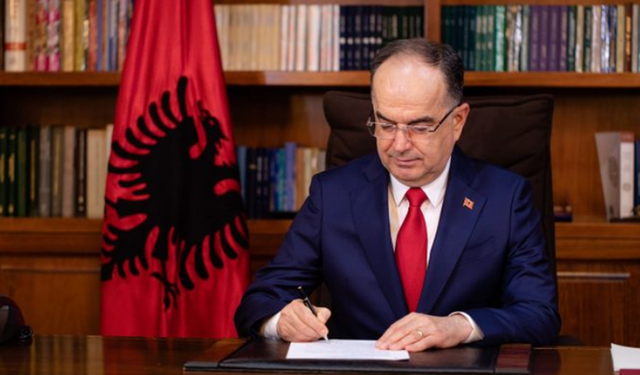
The President of the Republic, Bajram Begaj, has decreed the law “On the Prevention of Conflict of Interest.” The law places restrictions not only on officials, but also on their family members.
The new Law "On the Prevention of Conflict of Interest", which will enter into force six months after its publication in the Official Gazette, imposes drastic restrictions on senior officials, including a ban on post-employment benefits and hefty fines for concealing assets or private interests.
New restrictions for officials and their families
Under the new provisions, the control net is expanded not only to officials, but also to persons associated with them. Some of the most critical points of the law include:
Isolation from public funds and property. Officials in high constitutional positions, members of the government, deputies, and mayors (along with their families) are strictly prohibited from owning shares or conducting business activities that benefit from state assets.
Officials are strictly prohibited from accepting gifts, favors, or preferential treatment. The maximum permitted value for traditional symbolic gifts is limited to only 10,000 lek. Any gift above this value must be refused or reported.
One of the innovations is the ban on former officials being employed in management positions in private companies that had ties to their previous institution, for a period of up to two years after the end of their mandate.
Severe restrictions on heads of justice
The strict rules apply equally to the highest levels of leadership. Members of the Constitutional Court, the High Judicial Council (HJC), the High Prosecutorial Council (HPC), the High Inspector of Justice and the Prosecutor General are subject to the same strict prohibitions.
Furthermore, Article 35 of this law expressly prohibits these officials, as well as any company in which they may have passive interests, from carrying out profitable activities deriving from state property or acquiring property within the territory of the jurisdiction where they exercise their function.
Total blockade of business and secondary professions
According to Article 27 of the law, judges and prosecutors are barred from any connection with the business world. They are prohibited from managing companies, engaging in business activities, or owning shares. Particular attention is paid to indirect share ownership, which is strictly prohibited if the company benefits from public contracts or if it casts doubt on the impartiality of the magistrate.
They are also barred from any other gainful professional activity. A judge or prosecutor cannot simultaneously work as:
Lawyer
notary
Licensed expert or consultant
Arbitrator in commercial arbitrations
The only exception to this rule remains engagement in teaching and science. It is worth noting that these restrictions apply immediately even to newly graduated magistrates awaiting appointment.
Distancing from politics and civil society organizations
To avoid any external influence or potential ideological conflict, the law specifies that judges cannot be members of political parties, hold positions in them, or appear publicly associated with political formations. They are also prohibited from leading or being members of the governing bodies of non-profit organizations (NGOs), thus limiting their participation in active civil society.
Harsh financial sanctions
To ensure that the law does not remain just on paper, severe administrative penalties are foreseen. Any violation of obligations — from delays in declaring interests, to holding prohibited shares or failure to comply with deadlines for divesting from conflicting businesses — will be punished with fines ranging from 200,000 to 500,000 lek. These measures are independent of possible criminal prosecution or disciplinary measures.
Control mechanisms
The implementation of the law will be closely monitored by the High Inspectorate for Declaration and Control of Assets and Conflict of Interest (HILACCI). The law also obliges every public institution to create or approve a special unit, whose sole task will be to verify on a case-by-case basis and maintain an internal register of potential conflicts of interest of their employees.


