


"Condemned" protesters?! Who trapped Rama inside the Prime Minis...
/ 2026-10-23 16:02:00Focus


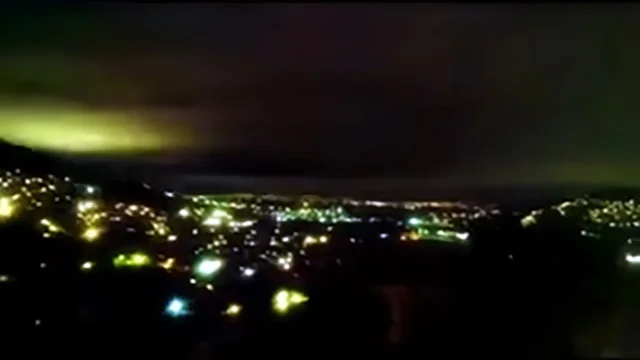
Light in the sky before devastating earthquakes, scientists give their explanation
"Earthquake lights", like those seen in videos captured at the moment the ground began to shake in Morocco, date back centuries to ancient Greece.
These multi-colored bursts of light, which were recently filmed after last Friday's magnitude 6.8 earthquake in Morocco, have long baffled scientists and there is still no consensus on what causes them.
"However, they remain definitely real," says John Derr, a retired geophysicist who worked at the US Geological Survey. He is the co-author of several scientific papers on earthquake lights, or EQL.
"Seeing EQL depends on darkness and other favorable factors," he explained.
He said the latest video from Morocco shared online resembled the earthquake lights caught on security cameras during a 2007 earthquake in Pisco, Peru.
Juan Antonio Lira Cacho, a professor of physics at the Universidad Nacional Mayor de San Marcos in Peru and the Pontifical Catholic University of Peru, who has studied the phenomenon, says the widespread use of security cameras has made it easier to study earthquake lights. .
"Forty years ago, it was impossible," he said. "If you saw them, no one would believe what you saw."
Earthquake Lights Take Different Forms
Earthquake lights can take several different forms. Sometimes they can look similar to ordinary lightning, or they can be like a bright band in the atmosphere similar to the aurora borealis.
Researchers have discovered that about 80% of such phenomena studied occurred in earthquakes with a magnitude greater than 5.0.
In most cases, the phenomenon was observed shortly before or during the seismic event and was visible up to 600 kilometers from the epicenter of the earthquake.
Possible causes of earthquake lights
Friedemann Freund, Derr's collaborator and assistant professor at the University of San Jose, has come up with a theory about the earthquake lights.
He explains that when certain defects or impurities in the crystals in rocks are put under mechanical stress, such as during tectonic stress build-up before or during a large earthquake, they immediately rupture and produce electricity.
The rock is a type of insulator that, when mechanically stressed, becomes a semiconductor, he said.


