Is this police force professional and capable of handling violen...
/ 2026-10-16 18:54:07Focus


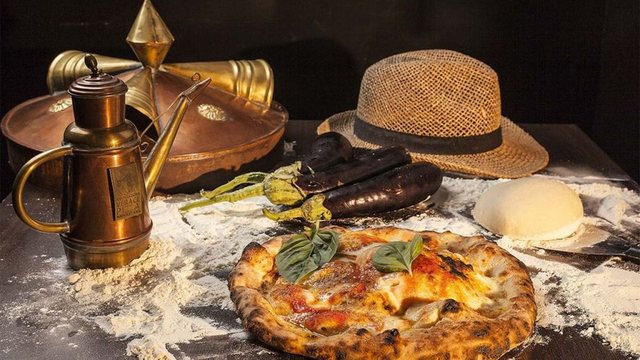
While pizza spreads around the world with new flavors and modern shapes, an organization in Naples fanatically protects its original version, with codified recipes, secret agents and a single idea: authenticity.
If there's one food that unites the world, it's pizza. But as versions of it flourish in every corner of the globe, from Korea to Canada, from Japan to Brazil, a group of dedicated Italians are secretly traveling to discover one truth: what exactly is a real pizza?
On a scorching day in the southern Italian sun, just outside the catacombs of San Gennaro in Naples, a group of international trainees have gathered for a sacred, but not religious, reason. From different parts of the world, they are aspiring pizzaioli (traditional Italian pizza bakers), preparing for the most important exam of their lives: the exam to earn the Neapolitan certificate of authenticity.
Beyond the ingredients: an idea, a mission, a certificate
The center of this mission is the Associazione Verace Pizza Napoletana (AVPN), founded in 1984 to "promote and protect" traditional Neapolitan pizza, so much so that, thanks to it, the "art of preparing Neapolitan pizza" was declared an intangible cultural heritage by UNESCO a few years ago.
Neapolitan pizza has only two well-known versions: Margherita (tomato, mozzarella and basil) and Marinara (tomato, garlic and oregano, no cheese). But the modern world has created endless variations that would shock a traditionalist: from pizza with blue cheese and honey to one with lemon zest from Vesuvio. However, just as there are rules for champagne and Parmigiano cheese, the AVPN has set standards for what can be called “real pizza.”
An academy, a statute, a… bronze statue
With its school, trade fairs, competitions and a bronze statue of a pizza outside its headquarters, AVPN has become an empire of authentication. The rules are clear: the pizza must be “round”, with a puffy crust (but no more than 1–2 cm high), without large bubbles or burnt spots. It must be soft, elastic and foldable. The use of foil or baking sheets is prohibited. And above all: the baking time must not exceed 90 seconds and it must be consumed within 10 minutes of leaving the oven.
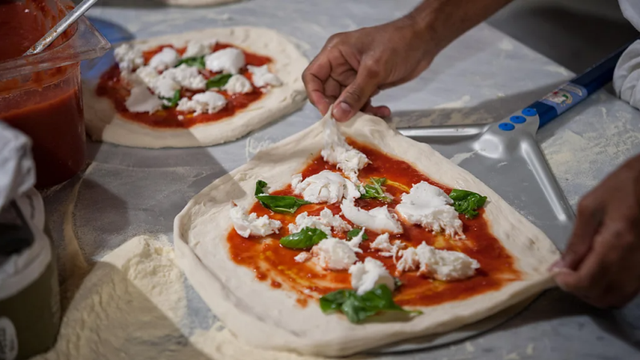
During the intensive course in Naples, candidates study everything from dough fermentation and moisture content, to selecting ingredients and putting the pizza in the oven, a technique more complicated than it might seem. On the last, hot and emotional day, the trainees prepare to present their version of the Margherita pizza in front of big names like Gino Sorbillo and Paolo Surace.
Pizza as a secret agent
But the story doesn't end with the diploma. AVPN is also a surveillance network, which occasionally sends out "undercover pizza agents" to check on restaurants claiming to serve Neapolitan pizza. In Japan, a restaurant in Osaka that held the certificate despite being expelled from the organization was "visited" by the AVPN team, accompanied by a lawyer, as vice president Massimo Di Porzio recalls with a laugh.
This struggle for authenticity also has a cultural and mythic function. Karima Moyer-Nocchi, a food historian at the University of Siena, explains that through this process, AVPN doesn’t just preserve a tradition, it produces it. “It creates an inner circle,” she says, “that elevates pizza to an almost transcendentalistic experience.”
From 17 families to the scientific pizza revolution
AVPN was born as a union of 17 Neapolitan pizza families who, tired of fast-food style pizza “clones”, came together to standardize the real recipe. In 1998, they joined forces with the Parthenope University of Naples to create a special observatory for the socio-economic and scientific study of pizza. Every year, the best bakers gather to debate changes that might be needed in the rules, for example in improving the flour or new baking technologies.
But, as Di Porzio admits, pizza is not a frozen monument. In 2013, the AVPN decided, after much debate, to allow the use of electric ovens, which angered many purists. And in 2024, Gino Sorbillo himself, one of the AVPN judges, presented a Neapolitan pizza with pineapple, Hawaiian style, to great acclaim. Some saw it as a provocation, others as a betrayal, but Sorbillo insists: “Pizza doesn’t stop. It evolves, it changes, it learns.”
Tradition in a sea of innovation
Italy has dozens of pizza styles beyond Neapolitan, from the deep-fried pizza fritta, to the crispy Roman pizza with thin crust, to the deep-fried pizzonta from Abruzzo, and variations of pan pizzas. But only Neapolitan pizza has a global organization that fanatically defends its recipe.
Yet even in an era where change is the norm, one thing remains sacred: pizza's connection to the culture of Naples. "Neapolitan pizza is not necessarily the best in the world," says Di Porzio. "But it is the one with the deepest cultural roots. It is a skill that must be learned and inherited."