Is this police force professional and capable of handling violen...
/ 2026-10-16 18:54:07Focus


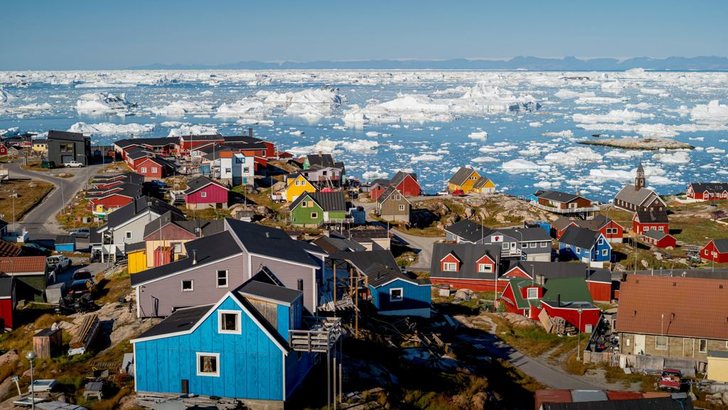
The purchase of Greenland by the United States would be, in essence, “a major real estate operation.” This idea has been repeated by Donald Trump several times since 2019, when he first publicly floated the idea of buying the large Arctic island from Denmark. Now that the US president seems more determined than ever to make an offer to the current owner, the question naturally arises: how much is Greenland worth?
One way to answer this question is to take a historical approach. The United States has tried to buy the island before.
After purchasing Alaska from Russia for $7.2 million in 1868, US Secretary of State William H. Seward considered the possibility of purchasing Greenland and Iceland for $5.5 million, but never presented a formal offer.
A formal proposal was made in 1946 by President Harry Truman, who offered Denmark $100 million in gold bullion to persuade it to sell the territory. The offer was rejected. According to estimates by the conservative think tank American Action Forum, this amount would be equivalent to about $1.6 billion today.
However, if the amount is calculated in relation to the US Gross Domestic Product in 1946 and that of 2025, it turns out that Trump would have to offer about $12.9 billion to match Truman's proposal.
Since 1946, however, the global economy has changed significantly. Therefore, a possible “price” for Greenland would have to take into account its value to the US and global economies. The island is estimated to contain mineral resources with a total value of about $4.4 trillion: approximately $1.7 trillion in oil and gas, the extraction of which is currently prohibited for environmental reasons, and $2.7 trillion in other minerals, including strategically important rare earths.
However, exploiting these reserves is extremely difficult due to the harsh climate, labor shortages, and inadequate infrastructure. Less than 2% of Greenland's territory is currently covered by mining exploration licenses.
For this reason, the American Action Forum estimates that the current value of the actually exploitable resources is about $186 billion. This figure, however, does not take into account the possibility that the United States, if it were to own them, would significantly increase mining and oil extraction activity, in the spirit of the slogan “Drill, baby, drill.”
Beyond its natural resources, Greenland is also important for geopolitical reasons. "We need it for our security," Trump said, referring to the island's strategic position in the Arctic. With melting glaciers and technological advancements, the region is increasingly becoming a zone of rivalry between the great powers: China, Russia and the United States.
But how can this non-economic, but strategic and military component be valued in monetary terms? If Greenland is treated as a "real estate asset," then, according to the think tank, it can be valued by the criteria of this market.
If the US were to buy all the existing buildings in Iceland, a country with a similar geostrategic position, it would have to pay about $131 billion, or $1.28 million per square kilometer. Applying this value to the entire territory of Greenland, the total price would come to $2,760 billion, about 9% of US GDP and 7% of US public debt.
The amount is very high, but not unprecedented if you look at historical cases. In 1803, for example, the US purchased Louisiana from France – a territory the size of one twentieth of Greenland – for $15 million, or about 3% of the GDP of the time, which today would translate to about $890 billion.
Even more favorable for the United States, especially in terms of long-term benefits, were the purchase of Florida from Spain in 1819 ($5 million, 0.68% of GDP), Alaska from Russia in 1867 ($7.2 million, 0.09% of GDP), and the U.S. Virgin Islands, which Denmark sold for $25 million in 1917 (0.04% of GDP).
However, most of these precedents date back to an era when territories were considered, in international law, as negotiable assets and objects of purchase and sale. The consolidation of nation-states, the principle of sovereignty and that of self-determination of peoples make today the idea of Trump buying Greenland seem out of date, or at least very difficult to materialize through a bilateral contract.
Not coincidentally, in a joint statement, Italy, France, Germany, the United Kingdom, Denmark and Spain stressed that "Greenland belongs to its people: only Denmark and Greenland have the right to decide on matters that affect them."