Berisha: Altin "Troplini" Dumani amnestied electoral crimes, SKA...
/ 2026-10-19 11:44:20Focus


Several experts from Kosovo and the United States discussed on Tuesday in Washington the changes in American foreign policy and the possible impact on Kosovo. As reported by colleague Artan Haraqija, the experts, among other things, said that Kosovo is vulnerable to the geopolitical changes that are taking place. They suggested that political parties, regardless of being in government or not, should reach an inter-party agreement, in order to establish a sustainable policy that would be able to cope with the complex challenges that the country is expected to face.
The United States’ relationship with Kosovo for over two decades has been special and unique, with Europe’s newest state often called one of the greatest success stories of American foreign policy, according to the former Director of Justice for Eurasia at Voice of America, a renowned observer of developments in the Balkans. However, like any bilateral relationship between a powerful state and a small country, the relationship has changed over the years.
"President Trump's second term has brought profound political changes. The softening of US-Russia relations, the diplomacy being implemented towards Ukraine to make concessions to Moscow, signal a departure from the previous plan to promote democracy, fight against Russian influence in the Balkans and oppose growing authoritarianism in the region. Kosovo remains vulnerable to changes in US policy and the new geopolitical landscape ," says Dr. Elez Biberaj.
The organizer of the discussion, Dr. Jeta Abazi Gashi, who is part of the 'Fulbright' program at 'George Washington' University, says that Americans themselves have a lot of uncertainty about how far the changes in American foreign policy will go. However, she adds that it is clear that Kosovo cannot expect the continuation of ties with America as it has been until now.
“This shift in public diplomacy suggests that the United States is no longer focused on shaping Kosovo’s international standing, as it is dealing with its internal affairs. Current American public diplomacy has changed; it is no longer about others, but about itself,” she says.
For Kosovo, the partnership with America is irreplaceable.
“In the goal and desire for Euro-Atlantic integration, NATO comes first and the European Union is second in importance. From this perspective, the United States is more important than Europe. I say this despite great respect for the European family that we aspire to join. However, in the most difficult crises and moments that we have faced, the EU has managed to act only after being encouraged by the United States ,” says Kosovo’s ambassador to Washington, Ilir Dugolli.
"In the most difficult crises and moments we have faced, the EU has only managed to act after being encouraged by the United States."
Ambassador Dugolli said that even during his first term, Kosovo has managed to find common ground with President Trump's administration, citing, among other things, Pristina's readiness to recognize Jerusalem as the capital of Israel, for which it was criticized by Brussels, as well as the declaration of the military and political wing of the Lebanese group Hezbollah as a terrorist organization. These, according to him, aligned Kosovo's foreign policy with that of Washington.
The Director of the Institute for Public Diplomacy at George Washington University, Dr. Babak Bahador, tells Voice of America that changes in the 80-year-old transatlantic alliance should encourage Kosovo to create new friendships.
"Kosovo should definitely keep the friends it has now, but in this very polar world, opportunities arise to create new connections, which perhaps did not exist before. Kosovo should expand the number of recognitions from more UN member states. To achieve this, it must improve connections with many countries in the world ," says Dr. Bahador.
Ambassador Dugolli, however, clarifies.
"When we think about the potential threat of a multi-polar world, what are the other forces or powers and what do they offer? In our region we have clearly seen what they offer. Therefore, there is no desire to look towards these other powers. In fact, when you look at Russia or China, they have been malevolent and that makes our relationship (with the United States) as a small country, truly irreplaceable," says the Kosovo ambassador.
Experts say the change in Kosovo-US relations began long ago, reaching the lowest level in the last four years after the West accused the Kosovo government of failing to fulfill its obligations from the dialogue with Serbia.
Dr. Elez Biberaj says Serbia feels emboldened by geopolitical changes. He recalled the aggressively-toned speech by Serbian President Aleksandar Vučić on February 15 when he claimed that the three-month-long protests by Serbian students against his government were instigated by foreigners because he would not allow capitulation on the Kosovo issue. Mr. Vučić accused, among other things, USAID, an agency whose work was recently suspended by President Trump for misusing funds abroad.
"Until 12 years ago, we apologized to the Albanians who are trying to divide a part of our territory, of our country...Serbia did not agree to the capitulation, Serbia experiences Kosovo as part of its territory, as part of Serbia, and it will be like this forever ," the Serbian President said, among other things, on February 15.
The Trump administration is currently dealing with major global issues such as the war in Ukraine and the Middle East and has not spoken about its approach to the Balkans.
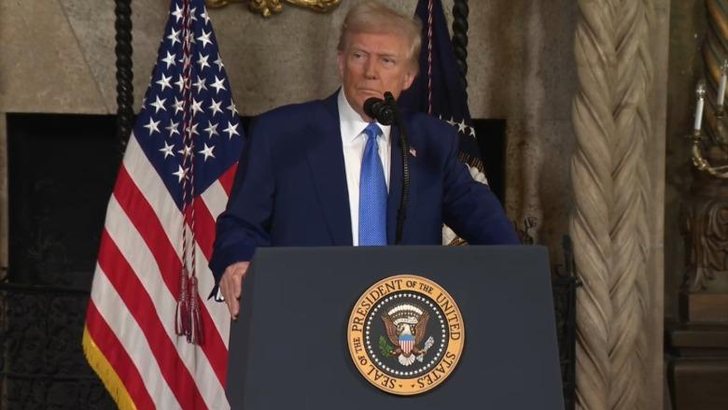
However, a window into this was President Donald Trump's congratulations sent to his Kosovo counterpart Vjosa Osmani on the anniversary of Kosovo's independence.
For Dr. Elez Biberaj, the content of the letter was good news.
"He expressed his full support for Kosovo and said that "the United States looks forward to building a more productive relationship with the government of Kosovo as the year progresses."
The letter, however, does not mention the dialogue with Serbia and the issue of strengthening the multi-ethnic state, which was the main reason for the divisions between the previous US administration and the government of Prime Minister Albin Kurti.
"In Kosovo, everyone is carefully watching what is happening now. It has gone so far that people are using artificial intelligence programs to ask how to interpret President Trump's letter on the anniversary of independence, whether it is positive or not for Kosovo. There are many analysts and experts who give different opinions and this shows that there is a fear of what will happen," says Dr. Abazi Gashi.
Experts say that beyond the uncertainties, there are opportunities for both countries to advance their bilateral relations. However, it is Pristina that needs Washington's help, especially in reaching an agreement with Serbia that does not undermine Kosovo's sovereignty.
"Regardless of who establishes the new government, Kosovo needs an inter-party agreement to develop a stable policy and engage pragmatic, influential senior officials with the necessary skills to deal with complex situations," says Dr. Elez Biberaj. /VOA