How Belinda Balluku is fabricating the rumor about Top Channel's...
/ 2026-10-19 16:19:00Focus


During a meeting in Toulon, French President Macron and German Chancellor Merz are expected to give a new impetus to the Eurofighter successor. Berlin accuses the French arms industry of blocking the project.
At at least 100 billion euros, this is the most expensive single weapons project in Europe: the "Future Combat Air System" (FCAS) will combine from 2040 a new European fighter jet with fleets of drones, piloted by a European defense cloud.
"It's more of a flying combat system," explains German security expert Christian Mölling in an interview with DW. The goal: greater independence from the United States and its stealth-equipped F-35 fighter jet.
But it is mainly the aircraft itself that is the subject of a dispute between the companies involved, Dassault in France and Airbus in Germany and Spain.
Pressure from French arms manufacturer Dassault
The escalation is now so severe that leaders must intervene: French President Emmanuel Macron and German Chancellor Friedrich Merz are unexpectedly attending a meeting of the Franco-German Security and Defense Council in Toulon, southern France. The body meets twice a year, usually without the knowledge of the general public.
But above all, it is the chairman of the board of French fighter jet manufacturer Dassault who has exerted strong pressure in recent months. The company builds critical components for France's nuclear deterrent, the basis of the country's military independence.
In July, Dassault CEO Éric Trappier played the national card before the French parliament's Defense Committee: he said that some claim that "a weakening of this independence", such as that caused by the FCAS project, "would not be so damaging", because it would be compensated by the interdependence of European partners. But Trappier believes that "once we have taken this step, we cannot go back".
Airbus Germany claims production parts
It is therefore necessary to carefully weigh "what we leave to our allies". This is a shock to advocates of a pan-European defense industry. Politics must decide with whom France will build the next-generation fighter jet.
European aerospace group Airbus, for its part, is demanding an equal say. Airbus builds the German Air Force's Eurofighter fighter jet in Germany and does not want to be excluded from this activity. "This is something that Germany does very well and wants to keep," explains arms expert Emil Archambault of the think tank DGAP (Deutsche Gesellschaft für Auswärtige Politik) in Berlin in an interview with DW.
Contract negotiations for the second phase of the project
The reason for the current escalation of the Franco-German conflict is that contracts are being negotiated in the background for the next phase of the project, the second: the construction of the first prototype of the aircraft that will be the heart of the new system. Dassault wants to have even more decision-making power there than it already has.
The exact distribution could be changed, according to DGAP researcher Archambault. "So that France builds a larger share of the aircraft" and, in turn, other areas in Germany and Spain are strengthened. "But this could also be very complicated. Because it's not just the main companies, but also the medium-sized subcontractors. It's a question of knowing who does what exactly and who coordinates it," explains Archambault. In an online promotional video, Airbus is at least trying to give the impression that it is at the forefront of technology.
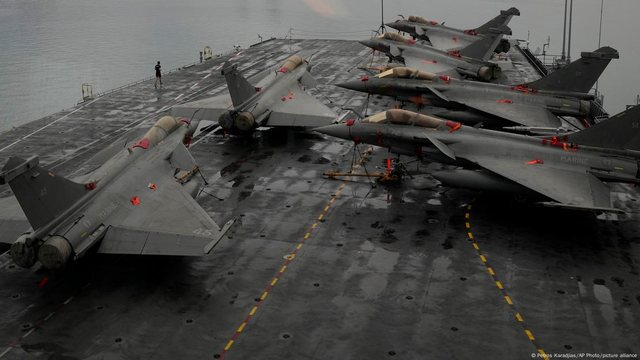
Political signal expected in Toulon
At the meeting between President Macron and Chancellor Merz in the south of France, Archambault expects little more than a "political signal" that France and Germany are moving forward with the project. There can be no discussions on the details of the contract until the third partner - Spain - sits at the table.
But time is running out: During his visit to Berlin in July, French President Macron agreed with Chancellor Merz that their defense ministers must present a final solution by the fall. Otherwise, starting the second phase of the project next year is unrealistic.
However, the German chancellor may have the best arguments for the moment: above all, more money. France is deeply in debt and the government risks finding itself with its shoulders against the wall if it fails to secure a majority for the budget.
"What is special is that Germany is in the unique situation where it does not have to prioritize between short-term and long-term armament projects, because we have the debt brake exemption for defense spending," explains security expert Christian Mölling in an interview with DW.
Is Germany's rapid rearmament more important than future projects like the FCAS? In the context of the Russian threat and Moscow's war of aggression in Ukraine, Germany has "a very short-term armaments agenda, which means we are buying more of what we already have and that works. And then there are future projects like the FCAS, which are not so important right now," Mölling said. He could imagine the FCAS project being scaled back or even disbanded over time.
It is also possible that a change of perspective could help resolve the ongoing conflict with French fighter jet manufacturer Dassault.
"Even if some people don't like to hear it," said Mölling, referring to France's pride in producing its own fighter jets: "The aircraft, that is, the airframe, is by no means the most important technology" for the FCAS. The drones, the so-called "carriers" and perhaps even more importantly, the "Combat Cloud," the software that connects all combat systems, are much more important.
More important than fighter jets: digital networking
This is exactly what we see in Ukraine's defense, where drones play a central role, according to Mölling. In fact, it is not the drones themselves that help Ukraine in its defensive war, but the networking of all the information: drone images, satellites, reconnaissance.
"This is ultimately the key that must be mastered, especially if we want to become independent from the Americans." And that's what all parties involved want.
That's why, according to Mölling, he believes that the FCAS will not disappear. The President and the Chancellor have made it clear: "This cannot die, so if they both come here, this will be first of all an increase in energy, a clear political signal" - for a future for the FCAS. One day./ DW