Protests, violence, curfews: From France to Albania, why Europe'...
/ 2026-10-20 23:47:20Focus


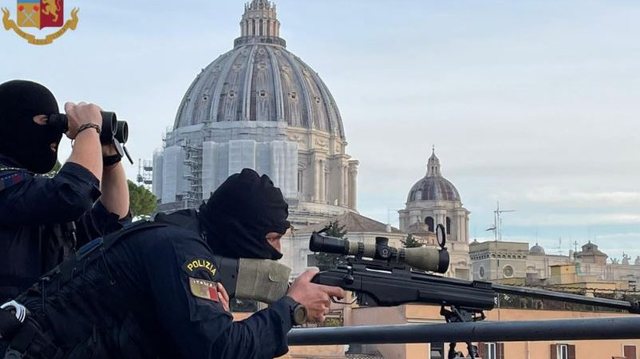
The RCD "bazookas" are now ready to neutralize any drone that may appear on the Dome's horizon.
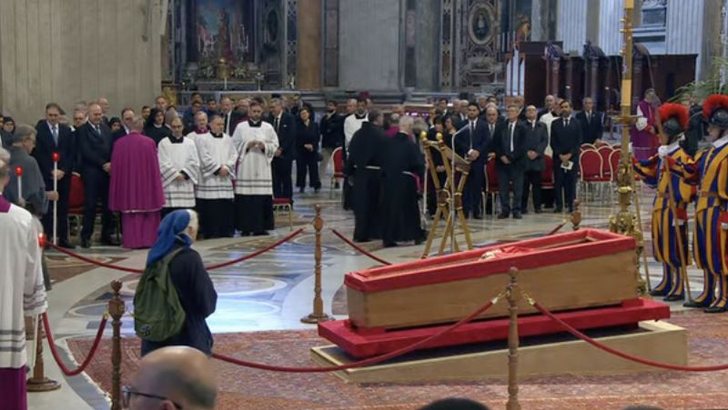
And the same Italian Air Force interceptors will be on standby on Saturday (tomorrow, April 26) to provide air defense during Pope Francis' funeral in St. Peter's Square in Rome.
The most advanced technology combined with ground controls – and computer and jamming systems to intercept frequencies and telephone communications at risk – ensure that the final farewell to the Pope, who passed away on Monday morning, takes place in maximum security.
Over 170 delegations
Around 200,000 believers will be present at the ceremony, preceded by hundreds of thousands of other people who will go to the Basilica from morning to evening to pay homage to Francis' coffin, and more than 170 foreign government delegations will arrive in the capital in the coming hours.
Starting with what will follow US President Donald Trump and First Lady Melania, who a week after Vice President JD Vance - the last institutional representative to meet the Pope before his death - must also stay at Villa Taverna, the residence of the US ambassador, resulting in the road being blocked in the "Parioli" neighborhood for security reasons.
And of course for Italian personalities, starting with President Sergio Mattarella and Prime Minister Giorgia Meloni.
The surveillance measures were finalized Tuesday evening during the National Committee for Public Order and Security chaired by the Minister of the Interior, Matteo Piantedosi, and then by the provincial one with the prefect Lamberto Giannini.
Flight ban
The no-fly zone has been reconfirmed throughout Rome, with special attention to drones and small aircraft.
On the rooftops around St. Peter's, snipers from elite units will be waiting, ready to intervene in the event of concrete threats.
But that's not all: Police Headquarters has activated 3D security, which involves the use of high-definition digital images to monitor every corner of the city in real time, even beyond architectural barriers. The images are transmitted to a remote control center, providing a 360-degree view of every sensitive area.
About 2 thousand police officers
Anti-terrorism and anti-sabotage units are already in action. "For April 25 there are demonstrations for Liberation Day that were already planned and have been confirmed. There is no reason to worry about this issue in itself, what is certain is that they add an additional commitment that we will have to face", underlines the head of the Viminale, referring to Friday's events: the last day of the exhibition of Pope Francis' coffin in St. Peter's.
In St. Peter's, there will be over 2,000 members of the police force every day until the end of the conclave, which is due to begin on May 5 and end, according to expectations, within that week with the election of the new Pope.
If he were Italian, the security system would have to be calibrated for the arrival of tens of thousands of additional believers from each region.
measures
But that's a topic for next week. Meanwhile, the Vatican City area will be increasingly closed off as Bergoglio's funeral approaches.
As of Tuesday, all vehicles parked in the "red zone" between Piazza Risorgimento, Porta Angelica, Porta Cavalleggeri, Via delle Mura Vaticane and Via della Conciliazione were removed, with the Lungotevere, which could be left open to avoid total traffic congestion towards Rome's southern neighborhoods.
Over 400 traffic police officers per day will be busy with road traffic, not only around St. Peter's, but also managing the passage of the processions of numerous foreign delegations, all with escorts and support of officers, but some - like the American and British ones, with the presence of Prince William, and the Prime Minister Keir Starmer himself and the President of the European Commission, Ursula von der Leyen, especially protected by special forces. For days now, police and carabinieri helicopters have been carrying out repeated flights.
How does an anti-drone bazooka work?
The operation of the anti-drone bazooka, technically called a “portable electromagnetic deterrent system,” is as fascinating as it is effective.
This device, similar in size to a grenade launcher, emits powerful jamming signals on the frequencies used by drones to communicate with their controllers.
Once hit, the drone loses contact with the remote pilot and activates emergency mode, which forces it to land gently on the ground or return to its starting point.
The system is completely non-lethal and represents a technological response to the growing air threats. Si Newspaper