Berisha: Altin "Troplini" Dumani amnestied electoral crimes, SKA...
/ 2026-10-19 11:44:20Focus


The Suez Crisis was the moment when Great Britain showed the world that it was no longer a superpower: the failure of the quick war it had planned with France to regain control of the Canal from Gamal Abdel Nasser's Egypt sealed the fall of the great European empires.
Then something else happened: the dollar finally surpassed the pound as the reserve currency for central banks around the world. Without the support of a healthy public budget, weakened by decades of trade deficits with the rest of the world, and now without overwhelming military power – and thus unable to control vital sea lanes – Great Britain saw its currency fall from 80% of global reserves in 1948 to less than 3% some thirty years later.
The Fall of Powers
The world had stopped paying (and being paid) for essential raw materials in a currency controlled by London. The United Kingdom could no longer enjoy arbitrarily low interest rates on its debt, and as a result had to curtail military spending and, with it, its projection of power (the chart below shows the dollar surpassing the pound).
Now, the United States under Donald Trump is not like Anthony Eden's Great Britain in 1956.
They enjoy a technological supremacy that London had lost for more than half a century; they control approximately 70% of international financial markets with their securities issued on their soil; and they continue to have the most powerful army in the world.
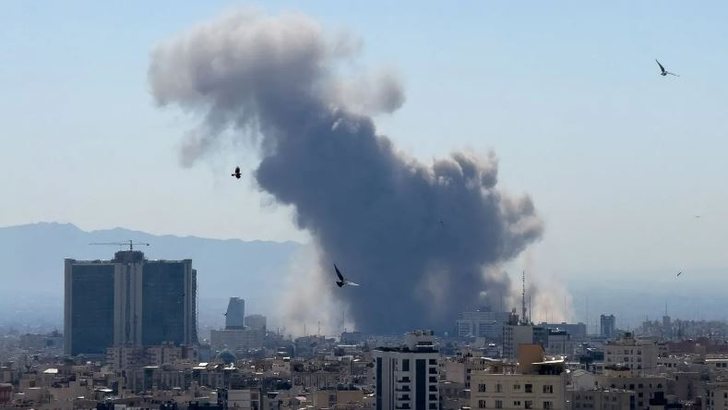
But are there any lessons for America in the Suez Crisis? Does the blockade of Hormuz accelerate China's rise as a geopolitical superpower? Could it undermine the dollar's overwhelming dominance as a currency of payment for goods? It is impossible to say before we know how the war will end.
But that is increasingly what is at stake. Because, as things stand, China is in a position to strengthen itself. For seven reasons.
The Lesson of Napoleon (or China?)
"An ancient Chinese proverb says: If your enemy is making a mistake, don't interrupt him."
This is how Beijing economist Keyu Jin, now at the Hong Kong University of Science and Technology, commented on Trump's war against Iran three days ago at the Teha Forum in Cernobbio.
Keyu Jin is almost certainly wrong, as the saying appears to have actually come from Napoleon.
But the meaning is clear, and Jin, the daughter of a high-ranking official of the People's Republic, is very aware of it.
In this crisis, China is keeping a low profile, or at least pretending to.
It is doing everything it can to show that it has no role and is not taking any action to profit from the war. It claims that it is only concerned with international stability and is trying to insulate itself from the effects of the Gulf shock.
In the meantime, however, it continues to buy oil from Iran and, above all, it is apparently helping Tehran wage war just as it is helping Russia against Ukraine.
Many converging reports explain that Beijing is making available its BeiDou3 satellite navigation system and other reconnaissance systems that allow the Revolutionary Guard to identify targets and strike with precision.
Furthermore, Beijing is reportedly selling Iran supersonic missiles essential to continuing its blockade of the Strait of Hormuz.
Xi Jinping sees this war as destabilizing China's export markets; however, he cannot help but recognize that this is a golden opportunity to strengthen his country's status.
Here are seven reasons.
Censorship and Batteries
1- Since the beginning of the conflict, China has tried to cultivate its international credibility as the only predictable superpower. Beijing condemns Iran's "violation of the principle of sovereignty" and the "hegemonic" behavior of the United States, calling for a ceasefire.
But a few days ago, the headline of an article in the South China Morning Post, one of the few articles analyzing the war, read “Chinese social media is flooded with criticism of the United States, but can it go too far?”
The article discusses the attacks on Trump that appear on Chinese platforms and when censorship steps in to delete them. The title itself was the message: the party does not lose its sense of proportion. It presents itself as a trustworthy entity – the only one with control of advanced technologies, industrial supremacy, nuclear weapons and a rational approach – with which any country can negotiate.
2- There is a commercial logic to all of this. With the blockade of Hormuz, China's renewable energy and electric vehicle industries hold out the promise of reduced dependence on oil and gas for billions of people.
In response to the war, countries like Pakistan, Thailand, Singapore, Indonesia, South Korea, and Vietnam are accelerating the spread of electric cars and industrial plants powered by photovoltaic panels.
Even before the conflict, solely for reasons of energy independence, Ethiopia banned the import of cars and commercial vehicles with internal combustion engines.
Following the lesson of Hormuz, these trends can only spread in response to the oil shock: just as after the Yom Kippur War in the 1970s, cars have become increasingly lighter and more fuel-efficient. And China, until now the world champion in renewable technologies and electric vehicles, will do business quickly. Since the start of the war with Iran, major Western carmakers, tied to traditional engines, have suffered sharp stock market declines: Stellantis fell 15.2%, Volkswagen fell 14.2% and the S&P 500 auto index in New York fell 10.3%. Meanwhile, shares of Chinese electric car giant BYD have risen 18%, and those of CATL, a world leader in storage batteries, have fallen almost 22%.
3 - Then there is a specific position of industrial dominance that gives Beijing even more power today. The People's Republic controls approximately 80% of the world's production and refining of tungsten, a metal that is made almost as hard as diamond and has a very high melting point in its derivative form as tungsten carbide WC, considered indispensable to the modern military industry.
All of the most advanced American and European missiles depend on tungsten, but since last year, China has imposed strict export restrictions. Right now, no one knows how depleted the American arsenals are after a month of fighting in the Persian Gulf, but according to the Wall Street Journal, the state of the reserves may be “worse than you think.” And access to new volumes of tungsten without relying on China takes years. Here too, Xi Jinping could have additional influence, having already demonstrated dishonesty in using it when he can.
4- Related to this is a more immediate strategic advantage for China: pressured by a relative shortage of military supplies, the Pentagon has been shifting military assets from the Far East to the Persian Gulf for weeks.
This applies to both naval forces and interceptor ships, from South Korea to the Taiwan Strait. The nervousness of America's allies in the region, primarily Seoul and Tokyo, is palpable.
China, on the other hand, feels increasingly liberated from the forces that contain its aggression on its eastern borders. “Any weakening of the US presence in the Asia-Pacific region will benefit someone. And we can only imagine who,” says Li Yihu, head of the Taiwan Research Institute at Peking University and a deputy to the People’s Congress.
5 - The People's Republic's ability to absorb oil and gas shocks longer than any other (non-producing) country in the world has already been written about. Its crude oil reserves remain secret, but Xi Jinping ordered them increased three years ago, and today they probably cover six months of consumption - more than the combined reserves of the 32 advanced democracies affiliated with the International Energy Agency.
Russia could cover some of the supplies blocked by the Gulf Arab states, and Iran has even increased exports to China.
Meanwhile, gas that no longer comes from Qatar now accounts for less than 9% of electricity production (in Italy, over 40%) and much less than the People's Republic's renewable energy sources.
Beijing is troubled by constant upheaval, but it can rely on extraordinary resilience.
The Guarantor of Hormuz and the Petro-Yuan
6- The combination of the above points – strategic autonomy, control of production bottlenecks, and a role as a vital ally and financier of Tehran – gives Xi Jinping a power that no other world leader has today: only China can force Iran to reach a solution that reopens Hormuz; only it can guarantee the credibility of a possible agreement with the regime of the Ayatollahs and the Revolutionary Guard.
Last year, the People's Republic was the largest buyer of crude oil from the Strait (almost 38% of the total), and it is natural that Saudi Arabia, the United Arab Emirates and Qatar – the three Sunni Gulf powers – suggest that they are turning directly to Beijing in search of solutions.
There is already a sign of this: when it seemed that negotiations between the United States and Iran could begin, the role of mediator fell to Pakistan, the Asian power to Beijing's west most integrated into China's sphere of influence.
Islamabad could not have accepted this assignment without first consulting Xi.
7- All this leads to what the Chinese are really interested in today: buying raw materials and other essential products around the world not in dollars, but in their own currency, the yuan renminbi.
Like America with the dollar, they want to be able to make purchases abroad in a currency they themselves have the power to create. Few countries are rushing to accommodate them, because the yuan is not fully convertible: once paid with it, it is not easy to convert it into dollars, euros, or gold; so it can be used almost exclusively to import Chinese products.
For this reason, Beijing settles international contracts in its own currency whenever it has the power to do so. It has done so with Russian oil since Moscow was placed under sanctions in 2022, it has done so with Brazil and Argentina for certain raw materials, it has done so with Pakistan and Laos. Since the sanctions against Russia in 2022, the yuan’s share of international transactions has more than quadrupled (to 8.3%).
Beijing is trying to erode the dollar's supremacy. It has already asked Saudi Arabia and the Emirates to accept yuan payments for crude oil. And now Xi Jinping will impose them, if he has the opportunity to play a role in a future solution to Hormuz without exposing himself too much.
In this case, the Third Gulf War – in homeopathic doses – would be to Trump's America what the Suez Crisis was to London.
Anthony's Ghost
It is uncertain whether this will end: it depends on the ability of the United States to forcefully reopen the Strait or bring about regime change, preventing Iran from responding to a ground invasion by destroying oil or civilian infrastructure in the rest of the Gulf.
The military operation may still succeed, albeit at a great human cost to the Americans themselves.
Trump has already made huge mistakes in launching and waging this war. If he repeats this in the days and weeks ahead, he could go down in history as the Anthony Eden of the United States: the leader who believed he was restoring his empire instead hastened the rise of the future./ Corriere della Sera