Protests, violence, curfews: From France to Albania, why Europe'...
/ 2026-10-20 23:47:20Focus


Democrats have warned that former President Donald Trump will destroy democratic institutions if he is re-elected to the top job in November. But former President Trump has said democracy will end if he is not re-elected this year. VOA correspondent Dora Mekouar examines whether a U.S. president really has the power to destroy democracy.
The Constitution is America's foundational document. It defines three branches of government: the executive, of which the presidency is a part; the Legislature, the House of Representatives and the Senate; as well as the judiciary, with the Supreme Court and other courts. Each of the branches is designed to balance the other two. The separation of powers is at the core of American democracy.
"We're kind of in uncharted territory because it's presumed that President Trump has the desire, if he's to be re-elected, to explore new frontiers, even where previous presidents haven't reached," said Professor Ronald Chen, a professor at Rutgers University.
"I only want to be a dictator for one day and I'll be a dictator for a day," Trump said.
He has said that if he is re-elected, he will not be dictator beyond the first day. What would happen if a president tried to override his powers in the future?
"If the alluding is that one branch is simply going to put aside the separation of powers, I honestly don't think it's been determined yet whether our system is strong enough to cope with that," Chen said.
"He has explicitly said he will be a dictator on day one," said Vice President Kamala Harris.
One of the main messages of potential Democratic candidate Kamala Harris is that former President Trump is a danger to democracy. Democrats point to his rejection of the 2020 election results, as well as the ensuing January 6, 2021, attack on the Capitol.
"Our fight is for freedom. "Across the country we see a frontal assault on hard-won freedoms and rights," Harris said.
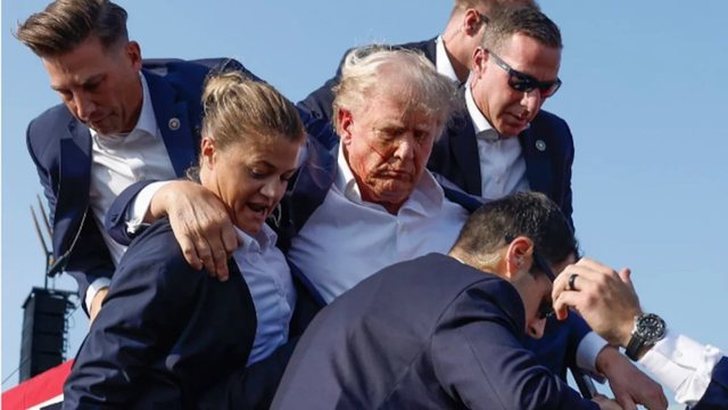
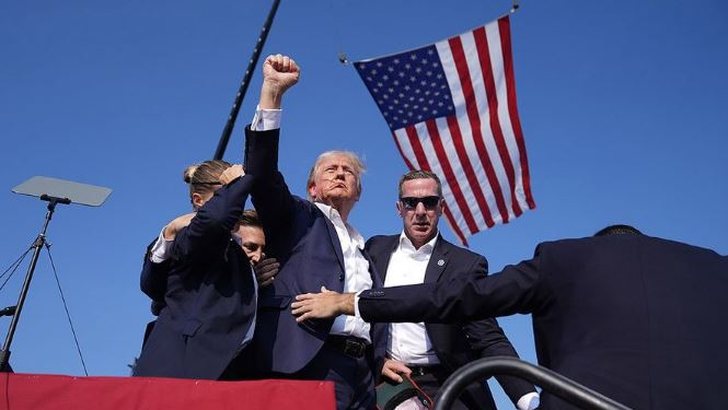
"They say I'm a danger to democracy. I wonder what I did to democracy? Last week I took the bullet for democracy," trump said.
Voters don't necessarily accept the argument that American democracy is at stake.
"I was talking to someone a few weeks ago who said, 'You hear all this stuff about Donald Trump trying to bring down democracy, but he didn't,'" said Chris Edelson, of the American Civil Society.
"There is still the feeling among some independent voters that the system worked. The transfer of power was made. So we're fine," said David Ramadan, of George Mason University.
It is not easy for a populist leader to destroy democracy, says Kurt Weyland, who studies democracy and authoritarian regimes.
"It only happens if there is a real institutional weakness and a very special opportunity because of the circumstances. So the argument is that in the case of the United States these kinds of circumstances are not valid," he says.
Weyland says there are a series of factors that limit the president from fully assescing power, such as the right people in public office. He cites the case of Secretary of State Brad Raffensperger, who refused to help overturn the outcome of the 2020 election, when former President Trump asked him to identify further votes in his favor.
"American democracy is strong and resilient. And the American people are committed to democracy, and American officials are fully committed to their institutional duties," Weyland said.
He adds that political leaders have a higher chance of destroying democracy if they have massive support from the people, with support levels above 70 percent. The highest level of support for former President Trump has been at 49 percent. Biden was at 57 percent. /VOA