Is this police force professional and capable of handling violen...
/ 2026-10-16 18:54:07Focus


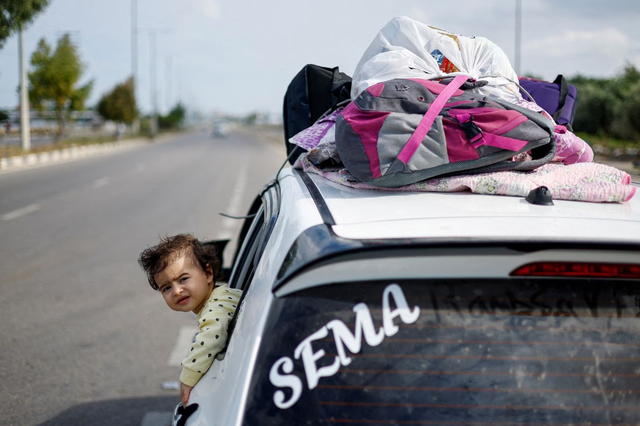
As desperate Palestinians fleeing the Gaza Strip struggle to find shelter, questions have been raised about why Egypt and neighboring Jordan are not taking them in.
Both countries, bordering Gaza and the occupied West Bank, have given a firm rejection response. Jordan has a large Palestinian population.
In his harshest comments yet, Egyptian President Abdel Fattah el-Sissi said the war Israel was currently waging was not only aimed at fighting Hamas, which rules the Gaza Strip, "but it was also an attempt to induce the civilian population to immigrate to Egypt". He warned that such a thing could disturb the peace in the region.
Jordan's King Abdullah II gave a similar message a day earlier, adding that no refugees would be allowed into Jordan and Egypt.
Their refusal is based on fears that Israel is instigating a permanent expulsion of Palestinians to their homelands and undoing Palestinian claims to statehood. Egyptian President El-Sissi also said a mass exodus would risk the militants establishing themselves in Egypt's Sinai Peninsula, from where they could launch attacks on Israel, jeopardizing the 40-year-old peace treaty between the two countries.
A story of displacement
Displacement has been a major theme of Palestinian history. In the 1948 war, when Israel was created, about 700,000 Palestinians were expelled, or fled, from the territory that is now known as the state of Israel. Palestinians refer to the event as the 'Nakba', which means "catastrophe" in Arabic.
In the 1967 Middle East war, when Israel occupied the West Bank and the Gaza Strip, another 300,000 Palestinians fled, mostly to Jordan.
The refugees and their descendants are estimated to number nearly 6 million, most living in camps and communities in the West Bank, Gaza, Lebanon, Syria and Jordan. The diaspora has spread even further and many refugees have built their lives in the Arab countries of the Gulf, or in the West.
After the 1948 war ended, Israel refused to allow the refugees to return to their homes. Since then, Israel has rejected Palestinian demands for the return of refugees as part of a peace deal, saying it would threaten the country's Jewish majority.
Egypt fears that history will repeat itself and a large population of Palestinian refugees from the Gaza Strip will end up staying permanently in the country.
No return guarantee
This is partly based on the lack of a clear scenario of how this war will end.
Israel says it aims to destroy Hamas, after the militant group's deadly attack on October 7 in the country's south. But Israel has given no indication of what might happen next and who will govern Gaza. This has raised concerns about a reoccupation of the territory for a period, fueling further conflict.
The Israeli military said Palestinians who obeyed the order to leave northern Gaza in the southern half of the strip will be allowed to return to their homes after the war ends.
Egypt continues to be concerned
Egyptian President El-Sissi said the fighting could last for years if Israel maintains that it has not hit the militants hard enough. He proposed that Israel shelter the Palestinians in its desert, the Negev, an area neighboring the Gaza Strip, until its military operations are over.
Egypt has urged Israel to allow humanitarian aid into Gaza, and Israeli authorities announced on Wednesday that they would do so, but did not say when. According to the United Nations, Egypt, which is facing an economic crisis, hosts about 9 million refugees and migrants, including about 300,000 Sudanese who arrived this year after fleeing the war in their country.
But Arab countries and many Palestinians also suspect that Israel could use this opportunity to make permanent demographic changes, with the aim of undermining Palestinian demands for a state in Gaza, the West Bank and east Jerusalem, which was also occupied by Israel in 1967.
Egyptian President El-Sissi on Wednesday repeated the warning that an exodus from the Gaza Strip was aimed at "eliminating the Palestinian cause, the most important cause of our region". He said that if a demilitarized Palestinian state had been established long ago through negotiations, there would be no war at present.
The fear of the Arab countries has only been fueled by the strengthening of the far-right parties that co-govern with Israeli Prime Minister Benjamin Netanyahu, parties that favor the removal of the Palestinians. Since the Hamas attack, their rhetoric has become less restrained, and some right-wing politicians and media commentators have called for the army to destroy Gaza and expel its residents. A lawmaker said Israel should carry out a "new Nakba" in Gaza.
Concerns about Hamas
At the same time, Egypt says a mass exodus from the Gaza Strip would bring Hamas, or other Palestinian militants, into its country's territory. Doing so would create instability in Sinai, where the Egyptian military has been fighting Islamist militants for years, also accusing Hamas of supporting them.
Egypt has supported Israel's blockade of Gaza since Hamas took control of the territory in 2007, tightening border controls. Likewise, Egypt also destroyed the network of cross-border tunnels that Hamas, or other Palestinians, had used to smuggle goods into Gaza.
Egyptian President El-Sissi warned of an even more destabilizing scenario: the destruction of Egypt and Israel's 1979 peace agreement. He said that with the presence of Palestinian militants, Sinai "would become a base for attacks on Israel. Israel would enjoyed his right to defend himself… and would strike Egyptian territory”.
"The peace that we have achieved would disappear from our hands", he said, adding that all this would be done "only for the sake of the idea of eliminating the Palestinian cause"./ Associated Press