How Belinda Balluku is fabricating the rumor about Top Channel's...
/ 2026-10-19 16:19:00Focus


This week, the Euro suffered another strong drop in the exchange rate with the Lek, dropping below the level of 116 Lek for the first time.
According to the official exchange rate of the Bank of Albania, the Euro was exchanged today at 115.84 ALL, down by 0.7 points since the beginning of the week and at the same time the lowest value ever recorded.
Market agents tell "Monitor" that there is a high supply of currency in the foreign exchange market. Not only the big players, such as commercial banks, but also the foreign exchange offices, are holding significant positions in the sale, which shows that they have abundant currency that they need to sell. Such a situation implies that the market has an abundance of currency and weak demand for it.
This trend is not new for the foreign exchange market, but during this year the devaluation of the Euro was partially restrained by the periodic purchases of the Albanian Electricity Corporation (KESH), for energy import needs. After the improvement of the water situation and river flows, in the second part of November, KESH reduced imports and even carried out exports. Agents believe that energy export revenues have created some foreign exchange reserves, which will reduce KESH's need to buy foreign currency, at least for the short term.
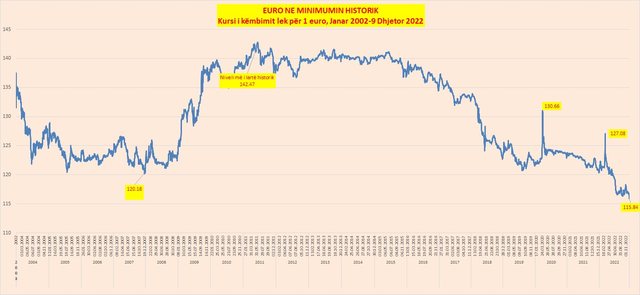
Also, seasonal factors are already in favor of Lek. Historically, the month of December, and especially its second part, is associated with an increase in the foreign exchange supply, as a result of inflows from year-end tourism and the return of emigrants. For this reason, it is likely that this month will continue to be characterized by low levels of the Euro-Lek exchange rate.
Based on the data of the Bank of Albania, for the 6th month of 2022 the current account deficit, representing the balance between the current inflows and outflows of currency in the economy, had the value of 469 million euros, down by 9.8% compared to the same period of last year.
Although this year the trade deficit in goods has continued to grow, by 12% more compared to the same period last year, the surplus in services expanded by 39% compared to the same period last year, making the main contribution in improving the current account balance. The increase in the surplus of the services account came mainly from the significant expansion of income from tourism and fashion.
For the first 6 months of the year, net income in the item of services for processing physical inputs owned by others (fasoneri) reached 340 million euros, 36% more compared to the same period last year and the value historical highest ever recorded. While the net income from tourism reached 338 million euros, an annual increase of 17%. Positive contribution to the reduction of the current account deficit was also given by the secondary income, which consists in the overwhelming part in the remittances of the emigrants.
Movements in the balance of payments are in theory the main factor that also affects the performance of the Lek exchange rate, especially against the Euro.
The euro is the dominant currency in the structure of Albanian imports, so its devaluation against the lek lowers the cost of imports and mitigates external inflationary pressures on the Albanian economy. The positive effect of the appreciation of the Lek against the Euro in the partial amortization of imported inflation has been often emphasized this year also by the Bank of Albania.
For this reason, the strengthening of the local currency in a strong inflationary period seems to benefit the Albanian economy. The strengthening of the Lek also helps borrowers in the European currency, with income in Lek, partially mitigate the negative effect of inflation and the increase of interest rates in their commercial or family budgets. This includes the Albanian government, which benefits from a lower cost of debt service in foreign currency.
On the other hand, the devaluation of the Euro has a negative effect on exporting businesses, which have income in Euro and expenses in Lek, especially related to labor costs. A typical case is the fashion sector. Individuals holding savings in the European currency also lose from the weakening of the Euro, although this is a relative consideration, as long as long-term assets (but often not only) in the Albanian economy are generally quoted in Euros. / Monitor