How Belinda Balluku is fabricating the rumor about Top Channel's...
/ 2026-10-19 16:19:00Focus


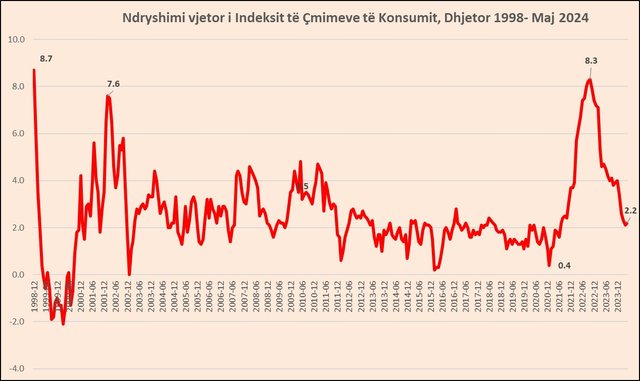
The Consumer Price Index, which measures the change in commodity prices for a certain basket of basic products, has returned to growth in May, marking an upward trend for the first time this year.
INSTAT announced that the annual change in the consumer price index in May 2024 is 2.2. In April, inflation was 2.1%, as it had been falling rapidly, compared to 4% that ended 2023.
Food and water, which for some cities has increased after the decision of the Energy Regulatory Body, have marked the biggest increase in May.
According to INSTAT, the annual increase in prices in May was mainly influenced by the group "Food and non-alcoholic beverages" with +0.69 percentage points, followed by the group "Rent, water, fuel and energy" with +0.42 percentage points. Also, the prices of the group "Furniture, home appliances and home maintenance" were affected by +0.28 percentage points, the prices of the group "Alcoholic beverages and tobacco" by +0.15 percentage points, the prices of the group "Various goods and services ” with +0.14 percentage points, the prices of the “Clothing and shoes” and “Hotels, cafes and restaurants” groups with +0.11 percentage points each, the prices of the “Entertainment and culture” group with +0.08 percentage points, the prices of the group "Health" by +0.07 percentage points, the prices of the groups "Transport" and "Educational service" by 0.06 percentage points each.
However, inflation remains below the targeted objective of the Bank of Albania of 3%.
At the last meeting, the Bank of Albania, whose main objective is to maintain price stability, kept the key rate unchanged at 3.25, the highest level since March 2022 when the bank tightened its monetary policy in response to rapid growth in prices. The Governor of the Bank of Albania, Gent Sejko, said that the rapid fall in inflation is coming from abroad and is transitory.
"On the other hand, internal inflationary pressures, although decreasing, remain relatively high. These pressures are fueled by solid demand for goods and services, demand which is reflected in the rapid growth of employment, wages and production costs of the private sector".
Meanwhile, a few days ago the European Central Bank decided to lower interest rates for the first time in almost five years. The bank took a U-turn on monetary policy, cutting the cost of borrowing, ahead of its US and UK peers. The move came as central banks raised interest rates over the past few years to stem the biggest inflation in a generation. The ECB cut its key deposit rate by a quarter of a percentage point to 3.75 percent. Eurozone inflation slowed from a peak above 10 percent in 2022 to close to its 2 percent target.
How much did the prices go up?
According to INSTAT, Compared to the month of May 2023, the biggest increase in prices is observed in the groups "Furniture, home appliances and home maintenance" and "Entertainment and culture" with 3.7% each, "Clothing and shoes" with 3.2 %, "Alcoholic beverages and tobacco" with 3.1%, "Miscellaneous goods and services" with 2.5%, "Hotels, cafes and restaurants" with 2.4%, "Rent, water, fuel and energy" and "Educational service" with 2.2% each, "Food and non-alcoholic beverages" with 1.9%, "Health" with 1.7%, "Transportation" with 1.1% and "Communication" with 0.1% .
Within the food group, the prices of the subgroup "vegetables including potatoes" increased by 4.6%, followed by the subgroups "fish" by 4.1%, "milk, cheese and eggs" increased by 3.6%, "sugar , jam, honey, chocolate and sweets" with 2.9%, "meat" with 2.3%, etc.