Protests, violence, curfews: From France to Albania, why Europe'...
/ 2026-10-20 23:47:20Focus


Ever since the invincible communist castle collapsed and disintegrated like a sand building, the dreams of Albanians to join the free world have taken hold. But since our imagination of the free world was shaped mainly by American-dubbed Italian films and the Sanremo festival, this could not help but affect the linguistic imagination of the geography of freedom.
Thus, in public places, in addition to the written form "Let's make Albania like all of Europe", the form "rebel" * "Europe" exploded: https://web.facebook.com/watch/?v=3660761297351868 . But it was not only the "chunaks" of the song who knew the name of the old continent through RAI, but also the politicians who came out of the student movement.
And although it would be expected, therefore, that the sign with two fingers raised up in a V-shape would have some effect on the preservation and preservation of the consonant V in the name "Europe", it was happening in some opposite cases. The name of the old continent appeared not with V but with U: «Europa»: http://ata.gov.al/2020/12/08/8-dhjetori-90-shehu-per-atsh-e-duam-shqiperine -as-all-current-europe-in-albania-should-be repeated /.
Thus, in addition to the usual concerns he was going through in the efforts to impose the linguistic norm on the Albanian Spelling, a new "concern" was added: the creation of a lexical dichotomy, which appeared as a war between the written form "Europe", decided by the Congress of Spelling and Unwritten Form * «Europe» articulated by the new protagonists of squares and pulpits. This new form appeared not only in the nominative case, but sometimes also took interesting forms in the oblique cases: * Europe, * Europs. But in the name of freedom everything was justified.
The new "stars" of politics and light music, even though they made language choices without knowing the concerns of language and spelling, suddenly became the inspirers of a new semiology.
It became fashionable to say * "Europe" in the way that the "great leader" speaks, as the "star" of the song sings. And "Spelling" was sad to see these. And with it, all those millions of users who trust a tried and tested spelling norm.
Schools, universities, hospitals and clinics were even set up with the "* Europe" / "* European" component. Money that "throws water up" can also change the spelling.
The rules of "Spelling" were taken care of only by ordinary users, those who are the bearers and custodians of the linguistic sense of Albanian. Those who trust a unified communication code.
But, as for the irony of fate, despite the normative sacrifice on the altar of Latin phonetics, that ardent desire to make Albania like the whole of Europe not only was not fulfilled, but is turning into an endless nightmare.
Prandaj ndonjëherë më zë veshi ca thashetheme se nuk është më faji i Shqipërisë dhe i shqiptarëve, por i Evropës, që ka hallet e veta dhe nuk ka nge të merret me zgjerimin, duke na akuzuar pa të drejtë.
Prit, them, me vete. Mos vallë paskan të drejtë?
Ky dyshim më vë më shumë në mendime. Hap visin internetik të Bashkimit Evropian dhe shoh trajtën «Evropë».
Hap visin internetik të Qeverisë Shqiptare dhe shoh trajtën «Europë»!
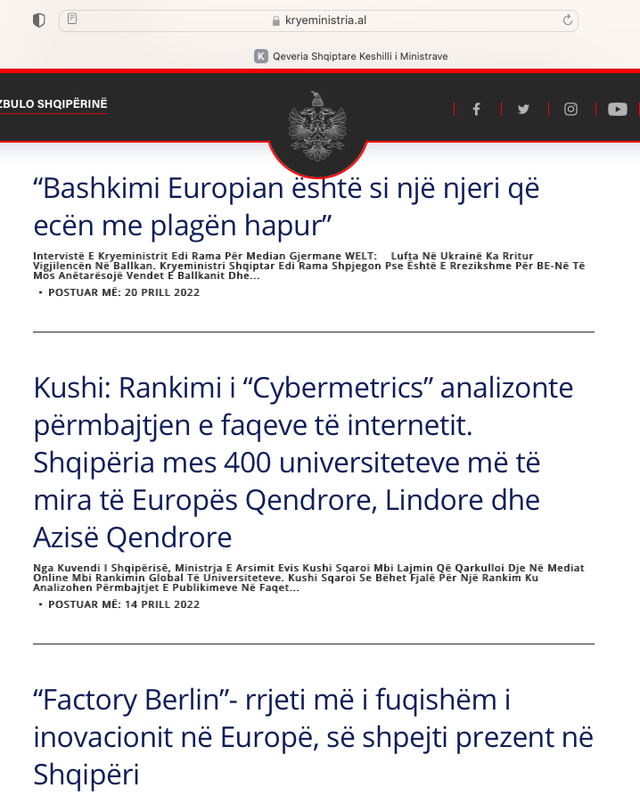
Nuk mund t’u besoj syve.
Atje në Bruksel paska një rregull për të zbatuar të gjitha rregullat. Dhe këtu hyn edhe «Drejtshkrimi i gjuhës shqipe», i cili përbën në të vërtetë ligj për shtetin shqiptar dhe për këdo që shkruan shqip, të paktën në formën zyrtare.
Mirëpo, nëpër shkresat e Qeverisë Shqiptare nuk zbatohet ligji drejtshkrimor i shtetit të vet! Unë nuk e di se cili këshilltar gjuhësor jep këshilla për të shkelur rregullat drejtshkrimore. Ndoshta dikush atje lart ka preferencat e veta ligjërimore dhe mund të vendosë në bazë të tyre. Vetëm se kjo duhet bërë me një ligj, i cili ende nuk ekziston. Për fat të mirë, emri i Ministrisë së Jashtme të Republikës së Shqipërisë është «Ministria për Evropën dhe Punët e Jashtme».
Ndoshta ka edhe gjuhëtarë – dhe pa dyshim që ka! – të cilët mendojnë se «*Europë»/«*europian» është më sistematike sesa «Evropë»/«evropian», pa e ditur se argumenti i sistematicitetit në pikëpamje gramatologjike nuk është i mjaftueshëm. Ose është po aq i mjaftueshëm sikur të thosha se [ev] është zhvillim i diftongut [eu], dhe shkrimi me [eu] përfaqëson një kthim prapa në kohë, pa le të tingëllojë ky argument si një ushtrim sofizmi.
Shteti është ai entitet konservues, që sidomos në çështje të ruajtjes së kodit gjuhësor nuk mund të tregohet inovativ. Sepse çdo prekje e këtij kodi ka menjëherë pasoja negative në ndërgjegjen gjuhësore të folësve dhe shkruesve të gjuhës.
Vlerat e vërteta që do të na çojnë drejt Evropës janë respektimi i ligjeve dhe puna për të krijuar dhe ruajtur vlerat ekonomike, kulturore, kombëtare, shoqërore. Dhe këtu bën pjesë edhe sjellja jonë gjuhësore.
«Europa» po i ndan shqiptarët!
Por ajo nuk është një ndarje që vjen nga Evropa, por nga vetë shqiptarët, më saktë nga një pjesë e tyre, që rendin drejt një ndryshimi formal sipërfaqësor, i cili gjithsesi nuk mund të mbulojë thelbin kompleks problematik që ka mbërthyer jetën publike shqiptare.
***
Professor Aristotle Spiro is one of the contributors to Vox News. The article is published with the permission of the author for Voxnews.al and Veritas et virtus