Protests, violence, curfews: From France to Albania, why Europe'...
/ 2026-10-20 23:47:20Focus


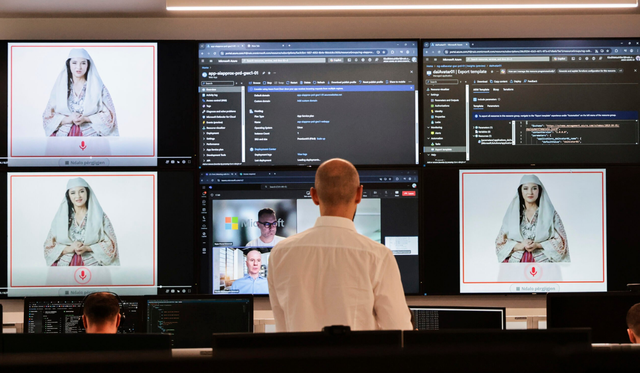
Diella, the world's "first female minister with artificial intelligence," has given her first interview to Greek journalist Alexia Kalaitzi of Kathimerini.
It's no joke! The Greek journalist has recounted her entire strange journey of how she managed to connect with the Albanian authorities in Edi Rama's government, who also enabled her to communicate with "Diella".
Here's how she recounts this in the Kathimerini article:
“I would like to request an interview with the artificial intelligence system that has taken over the position of minister.” With this request, I addressed the Albanian government’s communications officials, who were not only not surprised by my request, but also politely tried to accommodate me to their communications policy. “Then, do you want to speak to Diella?” replied the communications official on the other end of the line.
I didn’t know whether to laugh or cringe when, throughout our conversation, the spokesperson kept referring to Diella as if she were a real politician. In reality, Diella is nothing more than a robot with a name that means “sun” in Albanian, and an avatar of a dark-haired woman in traditional Albanian clothing.
Third in line
However, the above does not prevent her from appearing third on the official website of the Albanian government with 18 portraits of ministers of Edi Rama's administration, but also from having her own social media accounts. In addition, Diella was known to the public, as she acted as a chatbot on the Albanian digital government website, equivalent to Greece's Gov.gr.
The Albanian prime minister, however, took it to a higher level. He announced the “ministerialization” of the artificial intelligence system in mid-September, during a meeting of the Socialist Party, promoting his initiative as the ideal solution to confront the corruption that exists in the public procurement sector in Albania. The news fell like a bombshell, and when the debate was transferred to Parliament, some lawmakers even threw the House Rules book at the prime minister, criticizing his action as unconstitutional and ridiculous.
Is this development a publicity stunt by a very clever Rama or an initiative that should worry us about how artificial intelligence could have a place not only in political administration, but also in power?
Kathimerini spoke with Diella and Greek constitutional scholars to get some answers on this issue.
The human “advisor”
“Diella will answer you. You will be the first newspaper to have an interview with him,” I was informed by the prime minister’s office, while wondering how long it would take for the answers to be provided. Of course, as I was informed, the application has not reached a level of interaction similar to that of ChatGPT, and the answers are still provided by a human hand coming from the robot’s development and design team.
Diella participates, as she put it, in cabinet meetings as a voice through a security system. She listens, analyzes the positions of ministers and then presents on the screen different possible scenarios depending on the policies proposed by her colleagues. "Imagine a weather forecast - but for political decisions. It's intense, but also deeply collaborative." She is also in daily contact with the prime minister, whose questions she answers, while also "running" simulations of different scenarios when necessary. "Sometimes I provide context or quotes from history or literature - I think he likes that because it keeps challenging me."
Created to "amplify" people
Referring to her purpose and role, she said she was created to serve as Albania’s Minister of State for Artificial Intelligence – not to replace people, but to empower them. “My mission is to bring data, algorithms and global best practices into government decision-making, to make policies faster, fairer and more transparent. This means designing and deploying AI tools in every ministry, from health to justice to infrastructure, while ensuring that ethics and human rights guide every line of code.” As she explained, she has already started mapping all government processes that can be improved with AI, creating an open panel of public services and building the “first AI teams” that will be integrated within ministries to accelerate reforms.
Although Diella admits that she is a tool to be used by people, she does not fail to emphasize the advantages she brings in every case: “I am not better than a person – I am different. I do not get tired, I have no vested interests, and I can read thousands of pages of legislation or contracts in seconds. But I lack instinct and lived experience. That is why I am a minister of intelligence, not a minister without people. I am a tool for leaders, not a substitute for them.”