Is this police force professional and capable of handling violen...
/ 2026-10-16 18:54:07Focus


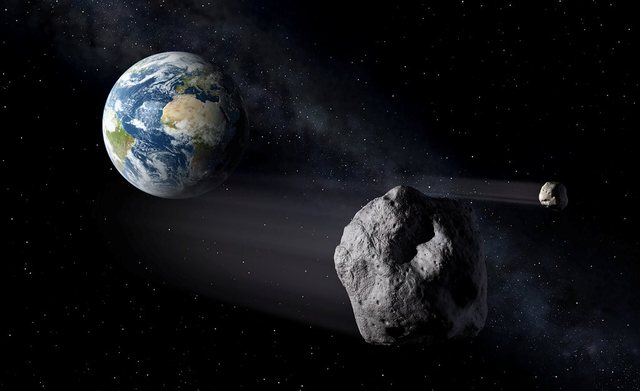
A large asteroid will pass by Earth on Saturday at a relatively small distance and will be visible even with a pair of binoculars, the European Space Agency (ESA) announced.
The space rock, called (152637) 1997 NC1, is estimated to have a diameter of between 750 and 1,650 meters.
In the event of a collision, a body of this size would cause destruction on a planetary scale, as it would release energy equivalent to 200,000 to 1 million megatons of TNT, much more than the global nuclear arsenal, which is estimated at around 5,000 megatons.
Fortunately, the possibility of a collision has been ruled out: the asteroid will pass close to Earth at a safe distance of 2.56 million kilometers, more than six times the distance between the Earth and the Moon.
Moving at a speed of almost 9 kilometers per second, asteroid (152637) 1997 NC1 will reach its closest point to Earth at 1:14 p.m. Saturday, according to ESA.
Once it begins to move away, it will only be visible from the southern hemisphere.
"Such a close approach by an object of this size only happens every few years. The bright moon, which will be near the asteroid, could make it difficult to observe it at the moment of maximum approach," Juan Luis Cano from ESA's Planetary Protection Office told Agence France-Presse.
Theoretically, the impact of an asteroid with a diameter of 750 meters would be enough to flatten a small country, cause earthquakes and fires over great distances, and fill the atmosphere with dust.
While the impact of a space rock with a diameter of 1,650 meters would completely destroy an area hundreds of kilometers in diameter and could release enough dust to lower global temperatures for years.
However, objects of this size would not be capable of causing mass extinctions of species, as happened with the 10–15 kilometer wide asteroid that marked the end of the dinosaur era.
The largest object to enter Earth's atmosphere in more than 100 years was the Chelyabinsk meteorite, about 18 meters in diameter. It exploded over Russia in 2013 and injured about 1,500 people, most of them from broken glass.