Is this police force professional and capable of handling violen...
/ 2026-10-16 18:54:07Focus


As dusk falls and the European Union offices begin to empty, dozens or hundreds of colorful garbage bags sprout up on the streets of Brussels. Some stand in geometrically ordered rows in front of houses, while others, half-open, spill food, diapers or cardboard waste.
In some neighborhoods, crows and rats arrive before the trucks that collect these bags on the streets of the Belgian capital, a city without traditional trash cans. The scene is unsettling for any newcomer.
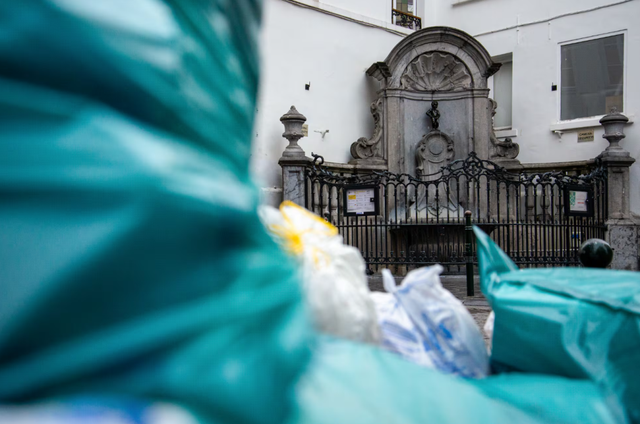
Piles of bags lie indiscriminately in front of the luxury Dior store on the wealthiest shopping street, as well as in front of typical Belgian houses in artistic neighborhoods.
To the untrained eye, this seems like a fundamental urban management problem for a city that generates about a kilogram of waste per person per day.
"When I arrived in the city, I thought there was some kind of strike. It was incomprehensible to me to see garbage bags on the streets," says Sofia Pagni , an Italian lawyer who has lived in Brussels for six years.
"Now I wonder if we are in a really dirty city or if here the waste is simply more visible, while in other places like Rome or Paris it is hidden and organized," she adds.
In fact, this landscape of plastic waste is not a sign of administrative collapse, but a rule of Brussels' waste management system.
Unlike other European cities, public or private containers are scarce here.
The system is based entirely on door-to-door collection of sorted waste in different colored bags. This is one of the first rules you need to learn, as the schedule varies by route.
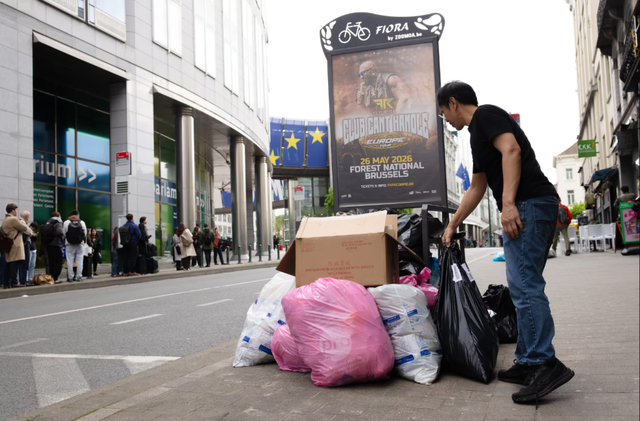
For example, on Wednesday afternoon, the yellow bag is taken out for paper and the white one for non-recyclable waste. On Thursday morning, the orange bag is taken out for organic waste; while on Sundays, the blue one is taken out for plastic packaging.
Adel Lassouli, spokesperson for the public agency "Bruxelles Propreté", explains that the system has historical and urbanistic reasons. It began when waste was not sorted and everything was left on the sidewalk.
"Brussels is a densely populated city of 1.2 million inhabitants and with a very old urban structure. In the case of public containers, you have to consider the space where to place them, so it was natural to choose door-to-door collection," he says.
The current system aims to promote recycling, currently accounting for 40 percent of the total and aiming to expand to 60 percent. According to the agency, the real problem lies with citizens who take out garbage bags outside of hours, do not close them properly, or abandon old furniture on the sidewalks.
However, to check 580,000 families and impose fines, only twenty inspectors circulate throughout the city.
This system is also a consequence of the fragmentation of the city into nineteen municipalities with separate competencies and large economic differences.
The government is considering deploying the containers with a budget of 12 million euros over the next three years. The challenge remains finding space. Above ground they take up parking spaces, while underground is clogged with gas and water pipes.
As the debate continues, critics point out that this model is severely damaging the image of the European capital, often making it resemble an open garbage dump.