How Belinda Balluku is fabricating the rumor about Top Channel's...
/ 2026-10-19 16:19:00Focus


The increase in extreme summer temperatures is becoming increasingly pronounced in Europe. According to data, the last summer was the hottest in Spain, a trend that is spreading across the continent and causing serious consequences for nature.
One of the hardest-hit countries is neighboring Greece, where in addition to the numerous fires that have devastated local ecosystems, the country is also facing a long and severe drought.
The consequences are dramatic in Lake Mornos, the main reservoir that supplies water to the Greek capital, Athens.
Konstantinos Lagouvardos, research director at the National Observatory of Athens and head of the Meteo unit, warned in “Kathimerini”: “The lake surface over the last three years has raised alarm bells.”
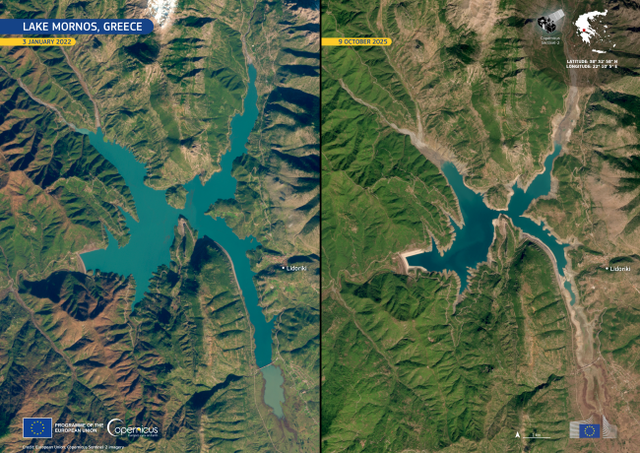
According to Greek authorities, in the last four years the lake has lost more than half of its water: from 19.1 square kilometers in 2022 it has decreased to only 8.7 square kilometers in September 2025. The main cause is the lack of rainfall and the prolonged heat that has affected the entire region.
Satellite images from the European Space Agency's Copernicus Sentinel-2 mission clearly show the change in water between January 2022 and October 2025, with exposed shores and a landscape that bears witness to the climate crisis that is worsening every year.

During a seminar on sustainable water management in Athens this week, EYDAP Executive Director Harry Sachinidis stressed the urgent need for alternative solutions, noting that if current trends continue, Greece will only have water for another 2.5 years.
“This year, we all prayed for rain and snow, but it didn’t happen, while we also experienced extremely high temperatures,” Sachinidis said. “As a result, we are facing a drought situation and if this continues at the same pace for two years, we will only have enough water for the next 2.5 years. Within two years, and maybe sooner, we need to find additional water sources.”