Details of the storm in the administration, here's who will resi...
/ 2026-10-22 22:25:00Focus


A good standard of living is essential in a society. A key role in achieving this is to ensure that statutory minimum wages are adequate. The proportion of workers earning only the minimum wage is higher than 10% in a number of countries across Europe. This year marks an important step towards improving working and living conditions in EU member states, because the new EU minimum wage directive must enter into law by November 15 of this year.
There is no minimum wage in 5 EU countries
Twenty-two of the 27 EU member states have a national minimum wage. Denmark, Italy, Austria, Finland and Sweden do not. Cyprus introduced one early last year. Among the 10 candidate and potential candidate countries, eight have a national minimum wage. Montenegro, Moldova, North Macedonia, Georgia, Albania, Serbia, Turkey and Ukraine all have one, while Bosnia and Herzegovina and Kosovo do not.
National minimum wage
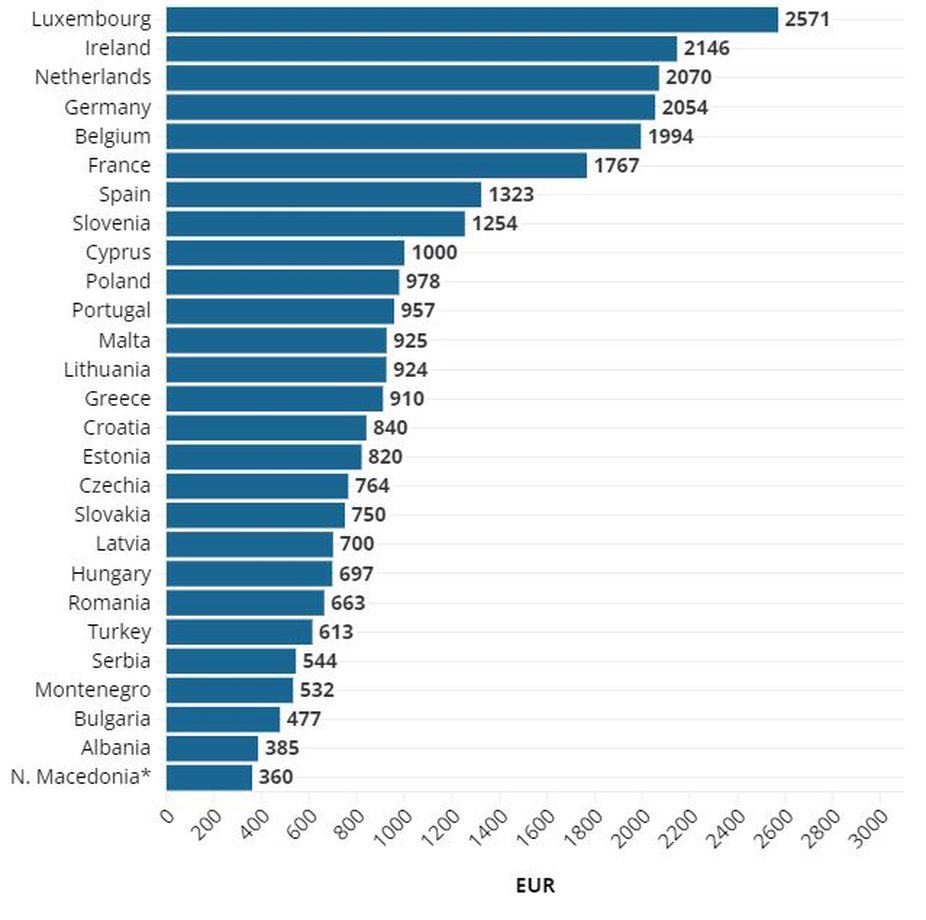
The European Free Trade Association (EFTA) countries of Norway, Switzerland and Iceland do not have a national minimum wage. The gross minimum wage is below €1,000 in almost two-thirds of the EU. Minimum wages for EU countries vary widely, with gross monthly minimum wages currently ranging from €477 in Bulgaria to €2,571 per month in Luxembourg. The minimum wage is more than 2,000 euros in Luxembourg, Ireland, the Netherlands and Germany, while the figure for France is 1,767 euros and 1,323 euros for Spain.
Minimum gross monthly salary (January 2024)
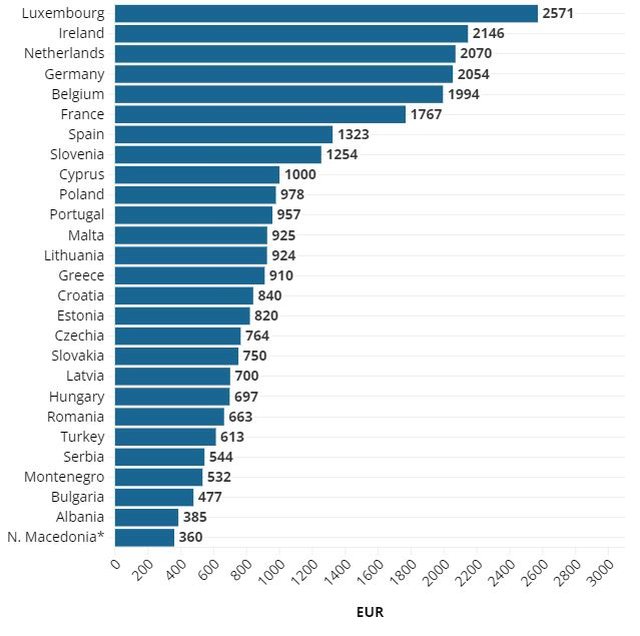
The minimum wage is below 1000 euros in 14 of the 22 member states where there is a national minimum wage. The figure varies from 360 euros in North Macedonia to 613 euros in Turkey among candidate and potential candidate countries. Bulgaria (€477) has a lower minimum wage than Turkey, Serbia and Montenegro, all of which are candidate countries.
Variations are smaller in PPS
Changes in minimum wages are significantly smaller in the purchasing power standard (PPS), which provides a fairer comparison. PPS is an "artificial currency unit" defined by Eurostat, based on price level differences between countries. A PPS unit can theoretically purchase the same amount of goods and services in each country.
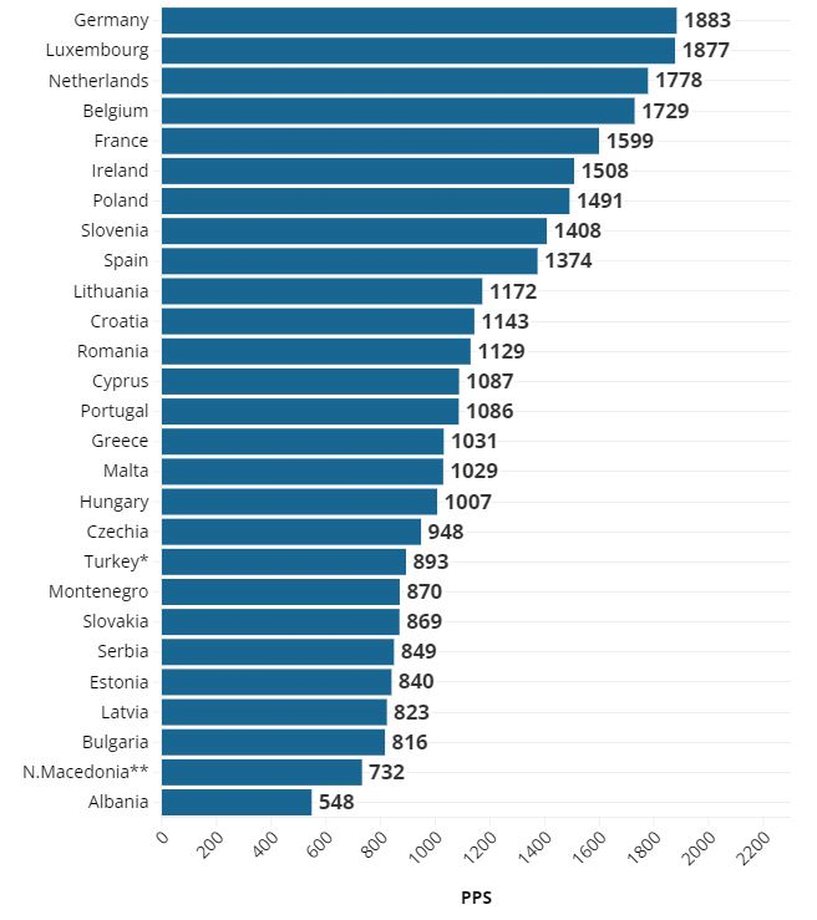
The minimum wage, adjusted for PPS, currently varies from 542 euros in Albania to 1,883 euros in Germany. In addition to Germany, this figure was over 1,250 euros in Luxembourg, the Netherlands, Belgium, France, Ireland, Poland, Slovenia and Spain.
Minimum monthly wages in purchasing power standards (January 2024)

The Czech Republic, Slovakia, Estonia, Latvia and Bulgaria recorded the lowest minimum wage in PSS among EU countries with a minimum wage in PPS below EUR 1,000. Some candidate countries such as Turkey, Serbia and Montenegro had higher wage levels than EU countries such as Estonia, Latvia and Bulgaria, but the figure was still below €1,000 for all candidate and potential candidate countries, for which there data available.
How to set an appropriate minimum wage?
It is not easy to determine an appropriate minimum wage. The EU Directive includes this statement: "For this purpose, Member States may use indicative reference values commonly used at international level such as 60% of the average gross salary and 50% of the average gross salary, and/or indicative reference values of used at the national level". Figures for 2022 show that many European countries had ratios lower than this level.
It is important to regulate minimum wages
Real minimum wages fell in most EU member states as inflation peaked in 2022. The OECD calls for regular reviews to protect the living standards of low-wage workers. "It is important that statutory minimum wages are adjusted regularly," says the OECD report "Minimum Wages in Times of Rising Inflation."
The EU Directive aims to establish a framework for:
· adequacy of statutory minimum wages
· promotion of collective negotiations for determining wages;
· increasing the effective access of workers to their rights for the protection of the minimum wage.