How Belinda Balluku is fabricating the rumor about Top Channel's...
/ 2026-10-19 16:19:00Focus


InsideStory has, for the first time, obtained material from the Çopjave crypto file that reveals new levels of Albanian gang navigation.
It all started after a tip from Spanish authorities. A handful of five-euro notes sparked an investigation that stretched across Europe to Albania, uncovering an entire laundering network.
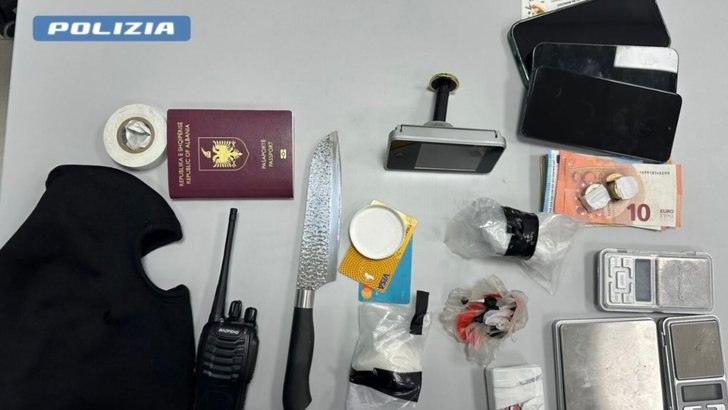
According to official Europol data, in 2021, during a search of a residence related to a cocaine trafficking investigation, cash and several handwritten 5-euro notes were seized. They provided information on the individuals coordinating and facilitating the financial aspect of the trafficking.
The Spanish Guardia Civil realized that what they had in their hands was a "handbill" of a global network that moved millions of euros from drug trafficking through a parallel financial system, invisible to banks, but readable to those who knew how to interpret the digital code of the criminal world.
"International cooperation and keeping digital money in the spotlight is a necessary step to prevent this sector from being covered by the veil of money laundering and a dark sector. Cryptocurrency is not necessarily a dark sector ," said Nadia Elbasani, a lecturer.
"SPAK has imposed a seizure on digital assets that were in bitcoin or other cryptocurrencies, thanks to cooperation with foreign law enforcement agencies. But always only at the moments when an exchange has been carried out. So we have that third party that is the exchange, which only in this case identifies the person sending and the person receiving," said lawyer Dritan Jahaj.
After seizing those banknotes, Spanish authorities notified Europol. What was then discovered was much larger: the network had branches in Dubai, the Netherlands, and Albania.
At this stage, SPAK comes into play. Cooperating with Europol, Albanian investigators began to track digital transactions that passed through encrypted “wallets”. Each virtual currency carried the story of a dark financial path. From cocaine trafficking to investments in villas and seemingly legitimate businesses in our country.
"In such a case, it should be necessary for the subject who has been seized and is being investigated by the prosecution for laundering the proceeds of a criminal offense to confirm that he is the user of that wallet, to provide his data, to show the transactions that he has actually carried out and has benefited from the income from this wallet that he manages, and the main thing is to identify the main source, that is, the initial moment that he invested in the purchase of these cryptocurrencies ," said lawyer Dritan Jahaj.
"So far there has been a very good result in tracking wallets that have made secret transactions, with the aim of hiding money or hiding their investments, which they have in cryptocurrencies. But, there is always a way that at some point in a moment the digital portfolio that is unidentified must be linked to the person. "said Dorian Kane, Crypto expert.

Thanks to this operation, a secret network was discovered, where every click on the blockchain served to launder the blood and money of crime. From Spain to Tirana, SPAK and Europol seized over 35 million euros. 25 in Spain and following it 10 million euros were seized by order of the Special Prosecutor's Office in Albania, hitting the core of the "underground banks" of organized crime.
For the first time, Albanian authorities were facing a new investigative reality, one where evidence was no longer a physical file or a bank account. It was a code on the blockchain, a chain of transactions that could only be traced by experts in cyber and criminal finance.
The perfect scheme, how currency exchange points were used to circulate tens of millions of euros of crime in cryptocurrency
The 'Bitcoin' file obtained by InsideStory states that the Çopja criminal organization used every possible means to strengthen its power and launder the proceeds of crime. One of the most important tools was the use of cryptocurrencies.
"We have seen that criminal groups have historically laundered money in other sectors, but the cryptocurrency sector has created a kind of veil that money can be laundered easily, but it is not that simple. To launder money through cryptocurrencies, of course, is not impossible, but platforms that are licensed, here we are talking about outside of Albania, laundering money through these platforms is somewhat difficult because, of course, they have the knowledge of the client," said Nadia Elbasani, a lecturer.
"International cooperation that concerns the main digital wallet exchanges and those that mainly circulate cryptocurrencies such as Binance or another company or exchange created in 2011 in the USA, named Cragen. These two are the main exchanges that Albanian law enforcement agencies have acted on in international cooperation," said former prosecutor Eugen Beci.
According to investigations, the accounts on the BINANCE platform, suspected of being controlled by citizens Kujtim Kala and Izeir Loloci, contained millions of dollars..... The persons in question are suspected of having collaborated with the group of strongmen, who are owners of exchanges in Tirana.
SPAK, with the help of blockchain experts, discovered that transactions were carried out through the TRON/TETHER network, with large values.
The file mentions 4 transactions worth 105 thousand, 237 thousand, 978 thousand and around 2 million dollars. These amounts are suspected to be money earned from drug trafficking.
"The moment a licensed platform knows the person who is making the transaction, the difficulty of laundering money on these platforms is undoubtedly increased. But, unfortunately, we have platforms that do not have customer identification. And these platforms have more potential for money laundering by criminal groups ," said Nadia Elbasani, lecturer.
"An IT expert can look directly at the blockchain, all the transactions where they are coming from, where they are going, which exchange these funds are, and then if these funds are moving from one exchange and going to another exchange. But this requires a lot of experience, requires a lot of expertise, as well as some software that is very advanced for tracking and tracing these exchanges," said Dorian Kane, a crypto expert.
Investigators initially focused on the gateway, the exchanges. These centralized platforms, where proceeds are converted into crypto with a click, are where dirty money takes on the guise of legitimacy......
In many cases around the world, and also in this case, operators use local exchange points to legalize flows. This is thought to be the reason for the involvement of two individuals operating in the foreign exchange business.
The investigation revealed a clear structure: safe money corresponding to drug sales was transferred to bank accounts in other countries, from there it was purchased in Tether, Ethereum, Bitcoin, and sent to digital wallets of a widespread network of users.....
Part of the network was clear: accounts on Binance, other accounts hosted on a platform that turned out to be “ALT 5 Sigma,” and between them wallets that held the large transactions.
"The prosecution body has every right to impose seizure if it suspects that this wall was used to launder the proceeds of a criminal offense, but it must investigate, collect evidence to proceed with the confiscation case. But there is also a very important issue here, which is the issue of the Key," said lawyer Dritan Jahaj.
As the investigation progressed, one clear element emerged: SOLUTION SRL, a company registered in the city of Milan, Italy. That company was nothing more than a cabinet that covered the flows.
From October 23, 2024 to July 9, 2025, transaction records showed purchases of about $40 million worth of cryptocurrency. That's far more than the $10 million previously reported. As the documents show, the money flowed from bank accounts in the United Kingdom and Spain into a jungle of digital transactions. It then passed through several wallets and eventually ended up at addresses that investigators linked to members of the organization in Elbasan.